
Mindmap
2. You have two types of vision
Inhalt der Mindmap
2. You have two types of vision
Central
- Central vision is what you use to look at things directly and to see details.
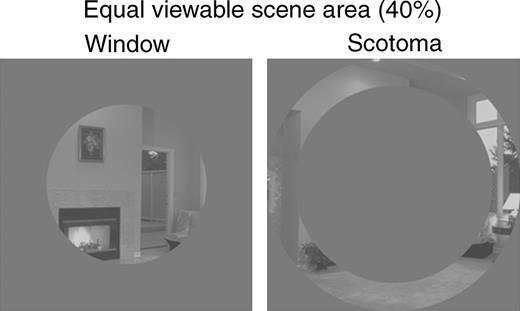
- Adam Larson and Lester Loschky (2009) showed people photographs of common scenes, such as a kitchen or a living room. In some of the photographs the outside of the image was obscured, and in others, the central part of the image was obscured. The images were shown for very short amounts of time and were purposely shown with a gray filter so they were somewhat hard to see. Then they asked the research participants to identify what they were looking at.
- Larson and Loschky found that if the central part of the photo was missing, people could still identify what they were looking at. But when the peripheral part of the image was missing, then they couldn’t say whether the scene was a living room or a kitchen. They tried obscuring different amounts of the photo. They concluded that central vision is the most critical for specific object recognition, but peripheral vision is used for getting the gist of a scene.
Peripheral
- Peripheral vision encompasses the rest of the visual field—areas that are visible, but that you’re not looking at directly. .
- Being able to see things out of the corner of your eye is certainly useful, but new research from Kansas State University shows that peripheral vision is more important in understanding the world around us than most people realize. It seems that we get information on what type of scene we’re looking at from our peripheral vision.
Bilder und Dateien der Mindmap
Informationen
- Beschreibung
- Der Nutzer hat seine Fachbereichs-Information gelöscht. Mindmap am 2. You have two types of vision, erstellt von Gelöschter Nutzer am 29/03/2018.
- Erstellt von
- Gelöschter Nutzer · Mär 2018
- Aktualisiert
- 29 Mär 2018
- Aufrufe
- 24
- Verlauf
-
- Erstellt von Alena Niadzelka · 27 Mär 2018
- Kopiert von Alena Niadzelka · 29 Mär 2018
- Bewertung