
The Respiratory System - Ventilation - effects of smoking and exercise.
Folien in diesem Satz (6)
-
- https://www.youtube.com/watch?v=hc1YtXc_84A (Einbetten)
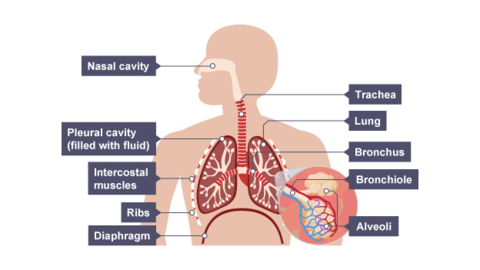
- The respiratory system consists of :
- trachea
- bronchi (left and right bronchus)
- alveoli
- ribs
- intercostal muscles
- pleural membranes
- diaphragm
- The trachea branches into two bronchi (one to each lung).Pleural membranes surround each lung. Cartilage rings in the walls of the trachea help to keep it open.The bronchi split into smaller and smaller tubes called bronchioles. These end in microscopic air sacs called alveoli. There is a musculardiaphragm below the lungs
-
- The ribs, intercostal muscles and diaphragm all play important roles inventilation (breathing).
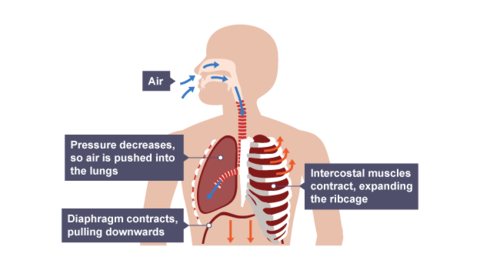
- Breathing in
- When you inhale:
- the internal intercostal muscles relax and the external intercostal muscles contract, pulling the ribcage upwards and outwards
- the diaphragm contracts, pulling downwards
- lung volume increases and the air pressure inside decreases
- air is pushed into the lungs
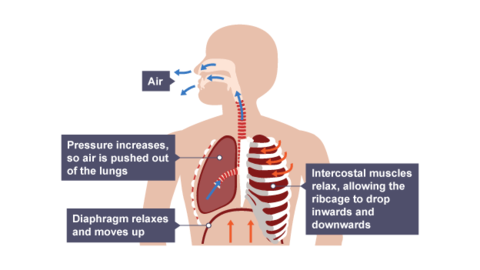
- Breathing out
- When you exhale:
- the external intercostal muscles relax and the internal intercostal muscles contract, pulling the ribcage downwards and inwards
- the diaphragm relaxes, moving back upwards
- lung volume decreases and the air pressure inside increases
- air is pushed out of the lungs
-
-
-
Effects of exercise on breathing
- During exercise there is an increase in physical activity and muscle cells respire more than they do when the body is at rest.Woman jogging along a tree-lined path in a park.Exercise increases the rate and depth of breathingThe heart rate increases during exercise. The rate and depth of breathing increases - this makes sure that more oxygen is absorbed into the blood, and more carbon dioxide is removed from it.The rate of breathing can be measured by counting the number of breaths in one minute. The depth of breathing can be measured using a spirometer (a device that measures the volume of air inhaled and exhaled).To investigate the effects of exercise on breathing, record the rate of breathing for a few minutes when the person is at rest. After they do some exercise, record their rate of breathing every minute until it returns to the normal resting value
-
- Smoking can cause lung disease, heart disease and certain cancers.Nicotine is the addictive substance in tobacco. It quickly reaches the brain and creates a dependency so that smokers become addicted.
- Effects on the air passages
- Sticky mucus in the lungs traps pathogens. The mucus is normally swept out of the lungs by the cilia on the epithelial cells lining the trachea, bronchi and bronchioles. However, cigarette smoke contains harmful chemicals that damage these cells, leading to a build-up of mucus and a smoker’s cough. Smoke irritates the bronchi, causing bronchitis.
- Effects on the alveoli
- Smoke damages the walls of the alveoli. The alveoli walls break down and join together, forming larger air spaces than normal. This reduces the efficiency of gas exchange, so people with the lung disease emphysema (a type of COPD or chronic obstructive pulmonary disease) carry less oxygen in their blood and find even mild exercise difficult.
- Carbon monoxide
- Carbon monoxide, CO, combines with the haemoglobin in red blood cells. This reduces the ability of the blood to carry oxygen, putting strain on the circulatory system and increasing the risk of coronary heart disease and strokes.
- Lung cancer
- Carcinogens are substances that cause cancer. Tobacco smoke contains many carcinogens, including tar. Smoking increases the risk of lung cancer, and cancer of the mouth, throat and oesophagus.
Informationen
- Beschreibung
- GCSE - science - biology
- Erstellt von
- Gelöschter Nutzer · Jan 2019
- Aktualisiert
- 16 Jan 2019
- Aufrufe
- 53
- Verlauf
-
- Erstellt von Eesha sunda · 15 Jul 2016
- Kopiert von bill fingleton · 14 Jan 2019
- Bewertung