
88. People make predictable types of errors
Folien in diesem Satz (4)
-
88. People make predictable types of errors
- Decide which possible errors you are most concerned about and which are important to fix first.
- Collect data on which category of errors people are making.
- This will help focus your redesign efforts after testing.
- Use systems like HFACS (slide 4) to analyze and prevent errors, especially if errors may result in injury or death.
- Giphy (video/mp4)
- Bildunterschrift: https://gph.is/2aEsxuw
-
- Performance Errors
- Mistakes you make while you’re going through the steps to complete a procedure.
- Commission, Omission, and Wrong-action.
- Motor-control Errors
- Errors you make while using the control of a device. For example, accidentally swiping when you mean to zoom.
- Use the flashcards to learn the definitions and get real-life examples.
- 88. Performance error definitions
- 88. Performance error examples
-
Swiss Cheese Model of Human Error
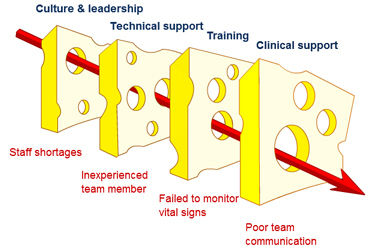
- Bildunterschrift: https://stratog.rcog.org.uk/human-factors/clinical-error/swiss-cheese-model
- Prof James Reason's Swiss Cheese Model (Einbetten)
- Bildunterschrift: In his book Human Error (1990) James Reason wrote that errors have a cumulative effect. Each error makes a hole in the system until the end when you have swiss cheese.
-
- In 2000 Scott Shappell and Douglas Wiegmann wrote a paper on The Human Factors Analysis and Classification System for the US office of Aviation Medicine. They worked from the Swiss Cheese Model and extended it to propose a system for analyzing and classifying human errors.
- See the video for an in-depth explanation.
- HFACS-D Research - User Level Survey (Einbetten)
Informationen
- Beschreibung
- Der Nutzer hat seine Fachbereichs-Information gelöscht. Folienset am 88. People make predictable types of errors, erstellt von Gelöschter Nutzer am 30/01/2019.
- Erstellt von
- Gelöschter Nutzer · Jan 2019
- Aktualisiert
- 30 Jan 2019
- Aufrufe
- 17
- Verlauf
-
- Erstellt von Elizabeth Poulin · 21 Jan 2019
- Kopiert von Elizabeth Poulin · 30 Jan 2019
- Bewertung