
Notizen
Biology - IGCSE : MRS GREN, Animal and Plant cell, Photosynthesis, Respiration, DNA, Variation, Graphs, The Five Kingdoms
Inhalt der Notizen (1)
Seite 1
MRS GREN (H)
Movement - the ability to change position
Respiration - releasing energy from glucose
Sensitivity - the ability to detect and respond to a stimula
Growth - the ability for cells to divide
Reproduction - the ability to create offspring
Excretion - getting rid of metabolic waste (eg. urea, CO2)
Nutrition - the need of metabolic substrates
Homeostatis / Control - controlling your internal environment (eg. keeping yourself at 37°C)
PLANT & ANIMAL CELLS

Cell wall - made of cellulose. Gives the cell its shape and support.
Cell membrane - controls what enters and leaves the cell. Like a sac, contains all the cells contents.
Chloroplasts - organelles that contain chlorophyll, which is needed for photosynthesis. Absorbs light and makes glucose. Gives green pigment.
Nucleus - controls the cell functions. Carries DNA of the cell.
Vacuole - sac that contains cell sap. 98% water. Store for waste, amino acids and sugars.
Cytoplasm - fluid that fills the cell, called protoplasm. 80% water and colourless.
PHOTOSYNTHESIS - How do plants live?
- The process of using light energy to make glucose sugar.
- Chloroplasts contain chlorophyll
- Chlorophyll's job is to absorb light energy
- Chloroplasts then store a lot of the produced glucose by turning it into starch.
Carbon Dioxide + Water -> Oxygen + Glucose
Plants need minerals to survive and grow. Poor plant growth is usually because there is a deficiency in one or more minerals.
Plants need nitrate to build proteins and help the growth. Leaves turn yellow when it lacks nitrate.
Plants need magnesium for photosynthesis. Leaves turn yellow. Chlorophyll molecules contain magnesium ions. Magnesium absorbs light.
Amino acids are building blocks for protein. Amino acids contain nitrate.
LEAF STRUCTURE
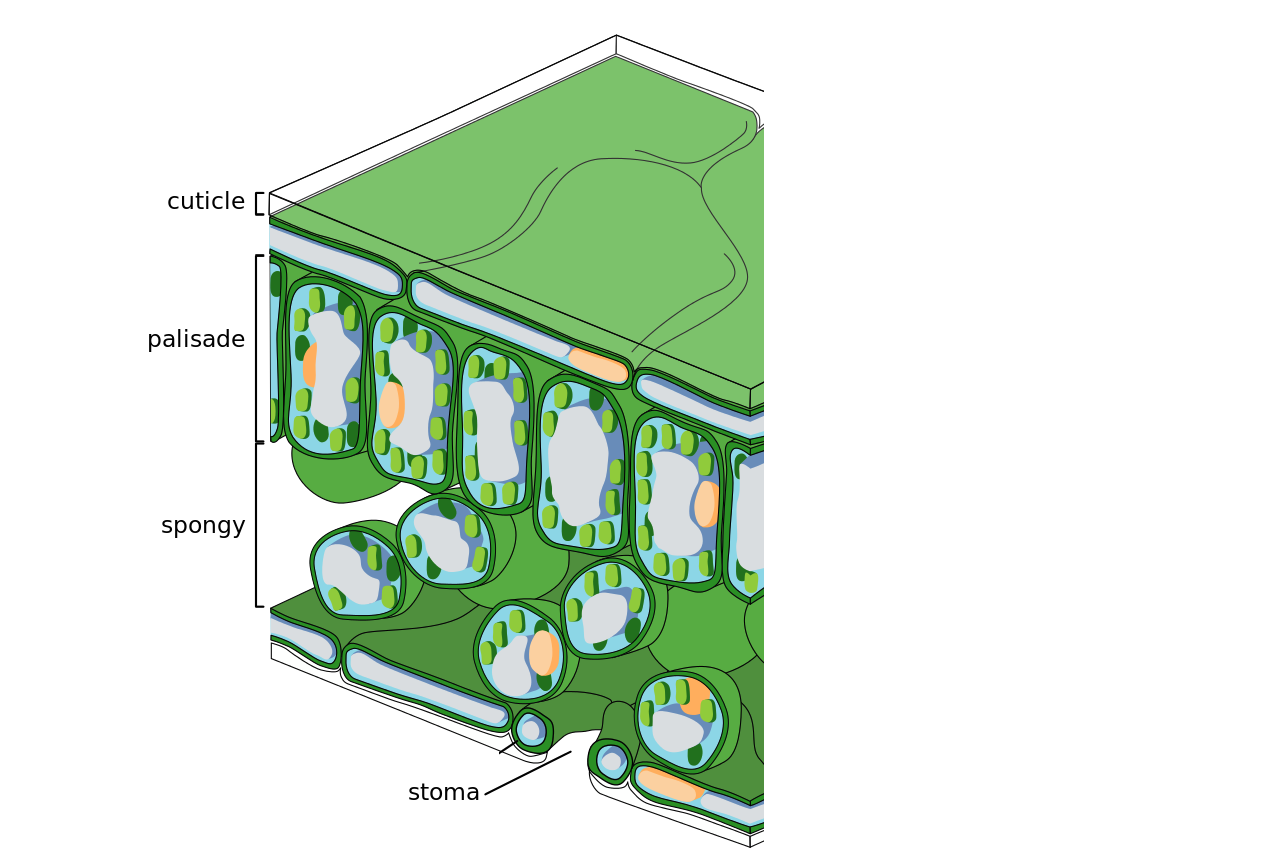
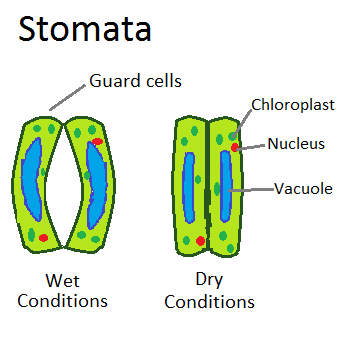
Stomata lets in CO2
Stomata lets out O2
Respiration
To breathe in....
- Diaphragm contracts and flattens
- Lungs are pulled downwards
- Volume of lungs increased
- The pressure of the air inside is lower than the external air pressure
- To balance the air pressure, air rushes in from the outside, and the lungs inflate.
NB. The opposite events occur when you breathe out.
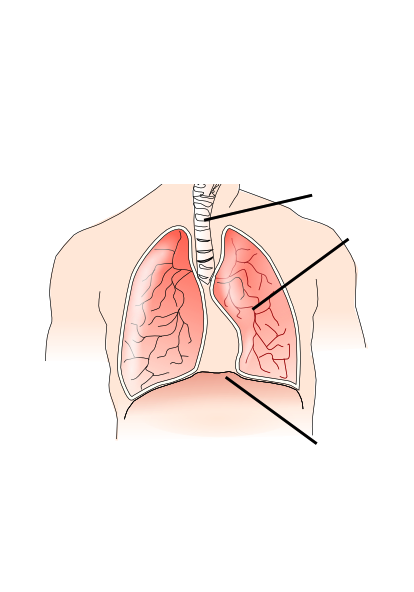
trachea
left lung
diaphragm
Inhaled
4/5 nitrogen
1/5 oxygen
trace of CO2
Exhaled
4/5 nitrogen
3/20 oxygen
1/25 CO2
DNA
Almost every cell of every organism can only survive if it aerobically respires ie. releasing energy from glucose. Aerobic respiration requires oxygen
Glucose + Oxygen -> Carbon Dioxide + Water
C6 H12 O6 + 6CO2 -> 6CO2 + 6H2O
Nuclei of most human cells contain 46 chromosomes.
Each chromosome is made of two very long chains of DNA wrapped together. So chromosomes contain DNA not the other way round. DNA stands for Deoxyribo Nucleic Acid.
A DNA strand consists of three components that repeat over and over again:
Sugar
Phosphate
Base
There are four different bases :
Guanine
Cytosine
Adenine
Thymine
G only bonds with C
A only bonds with T
A gene is a small stretch of DNA. All a gene does is code for a characteristic. The order of the bases in the gene is specific to what characteristic the gene codes for.
DNA is organisms can just randomly mutate. This mutated DNA will give the organism a new feature. The organism is now varied from the others of the same species. If this feature is beneficial it is called an adaption.
VARIATION
There are two causes of variation:
The environment
- language spoken
- hair length
- religion
2. Your DNA
- natural hair colour
- gender
- tongue rolling
Many characteristics can be affected by both :
- freckles
- weight
- skin colour
Variation can also be classified into two types:
Continuous
- the feature can take any value between the maximum an the minimum
- hair length
height
2. Discontinuous
- the feature can take one of a few set types
- eye colour
- gender
- blood type
Most of the time, if a variation is continuous, it's environmental.
Variation in humans:
- hair colour
- eye colour
- gender
- height
- weight
- tongue rolling
- freckles
- dimples
- skin colour
GRAPHS
Bar charts
- gaps needed
- discontinuous
Histograms
- touch
- continuous
- small number of categories
- 4 or 5 group ideal
Scatter Graphs
- two sets of continuous
- height and weight
- no line
Line graphs
- independent + dependent variable
- how it is affected by the first variable
- independent goes on the horizontal axis
- line joined point to point
THE SIX KINGDOMS
Kingdom KING
Phylum PLAYS
Class CHESS
Order ON
Family FRIDAYS
Genus (with) GREEN
Species PIECES
Animals
- multicellular
- cannot photosynthesise
- no cell walls
- can move from place to place
- store sugars as glycogen
human
chimpanzee
Plants
- multicellular
- can do photosynthesis because they contain chloroplasts
- have cell walls made of cellulose
- store sugars as starch
pine tree
rose
Fungi
- can be single celled (yeast) or multicellular (mucor mould)
- cannot photosynthesis
- body is made of threads called hyphae arranged into a mycelium
- have cell walls made of chitin
- feed by saprotrophism
- digest food outside their body then absorb it
- can store sugars as glycogen
Bacteria or monera
- single celled
- have cell wall but no nucleus
- some can photosynthesise
salmonella
pneumococcus (causes pneumonia)
lactobacillus
streptococcus
lact. & stre. are used to make yogurt
Protista or protoctista
- single celled
- some are animal like (amoeba)
- some are plant like (chlorella)
- some cause disease (plasmodium cause malaria)
Virus
- much smaller than bacteria
- can infect any other organism
- doesn't have a cellular structure
influenza
ebola
HIV (causes AID's)
TMV (Tobacco Mosaic Virus)
New Page
Informationen
- Beschreibung
- Notiz am Biology - IGCSE : MRS GREN, Animal and Plant cell, Photosynthesis, Respiration, DNA, Variation, Graphs, The Five Kingdoms, erstellt von ssallustio am 20/11/2014.
- Erstellt von
- ssallustio · Nov 2014
- Aktualisiert
- 19 Feb 2016
- Aufrufe
- 438
- Bewertung