
DNA and Protein Synthesis
Folien in diesem Satz (8)
-
- RNA stands for RIBONUCLEIC ACID.
- It's made up of Ribose, Phosphate group, organic bases.
- The 4 Organic Bases are: ADENINE, URACIL, CYTOSINE, GUANINE.
- The Pentose sugar is RIBOSE
- A monomer of this molecule is called a NUCLEOTIDE
- The bond that join these monomers together is a PHOSPHODIESTER BOND.
- The bond is a result of a CONDENSATION REACTION.
-
- -Both Single Stranded
- -Both Have Ribose Sugar
- -Both Have Same bases
-
Polypeptide Synthesis,DNA terms/concepts
- The Genetic Code is described as Universal, what does this mean?
- -Genetic Code= universal as it appears to be the SAME in all organisms.
- Why do we believe that the genetic code is a triplet code?
- A DNA TRIPLET CODE is the Smallest coding unit that can accommodate the 20 A.A that make up the variety of proteins.
- What are stop codons and how many are there? [Do not code for anything]
- 3 of the possible 3-letter codons fail to specify an A.A; such triplets are STOP CODONS and indicate the end of the genetic message in a gene. In MRNA: [UAA, UAG, UGA]
- What is the significance of the AUG CODON?
- The AUG codon is the START CODON and is found at the start of all the genes.
- Why is the genetic code described as non-overlapping.
- The GC is non-overlapping being read in groups of 3 bases with no overlap between the codons.
- Why is the genetic code described as degenerate?
- An amino acid may be coded for more than 1 triplet code. E.g. ATA|CGG both code for the same amino acid.
-
- MRNA:
- -Rna mols that Convey genetic info from DNA to Ribosome.
- TRNA:
- -Rna mols-help decode an mrna sequence into a protein.
- Rrna:
- -Rna component of the ribosome.
- Proteome: The full range of proteins a cell is able to produce
- Exon: Section of DNA that codes for amino acids.
- Introns: Section of DNA that does not code for amino acids.
-
Polypeptide Synthesis -Transcription
- The process of making pre-MRNA using part of the DNA as a template. UTRPRDIL
- 1.) Section of DNA unzips- H bonds being broken by the enzyme DNA HELICASE.
- 2.) One of the exposed strands of DNA becomes a template (template strand) and nucleotides of RNA present in the nucleus attach to complementary DNA nucleotides (T being replaced by U).
- 3.) Enzyme RNA POLYMERASE joins RNA nucleotides together to form a single strand of MRNA.
- 4.) As a strand of pre-MRNA is formed by RNA polymerase moving along the DNA, the DNA zips back up behind the enzyme.
- (only 12 DNA bases exposed at any one time.)
- 5.) When RNA POLYMERASE reaches a STOP CODON, it detaches from the DNA and the production of pre-MRNA is then complete.
- 6.) DNA is constructed from INTRONS (not code for amino acids) and EXONS (Code for amino acids) [Prokaryotes=not have Introns].
- Introns are unnecessary to the structure of the MRNA and would interfere with polypeptide formation, therefore are removed in SPLICING. (exons are joined together when introns are removed)
- 7.) The MRNA leaves the nucleus through a pore in the nuclear membrane (as MRNA mols are too large to diffuse out of the nucleus).
- Outside the nucleus, the MRNA is attracted to the ribosomes, to which it becomes attached, ready for translation.
-
- During Translation, the entire message in MRNA is read CODON-BY-CODON [non overlapping] until the polypeptide chain is completely assembled according to the instructions originally encoded in the DNA.
- The process of translation involves MRNA, Amino Acids, Ribosomes, A variety of enzymes, and chemical energy in the form of ATP.
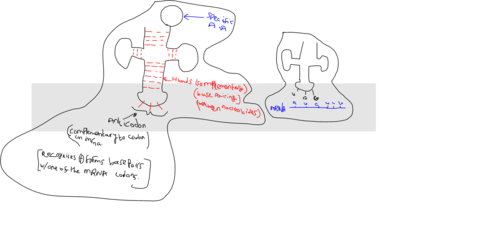
- Translation also requires TRNA that decodes MRNA's message and translates it into the language of proteins. TRNA is referred to as a Decoder Molecule.
- There are a variety of unique TRNA mols that differ from one another in the triplet of bases at one end of the mol called the anticodon.
-
- 1.) Ribosome attaches to start of MRNA mol.
- [3 bases on the MRNA mol form a codon and 2 codons fit into ribosome at once.]
- 2.) TRNA mol with complementary anticodons to the MRNA codons enter Ribosome. They bring their specific amino acids.
- 3.) The 2 A.A carried by the TRNA mols come very close to one another. They join to each other by a peptide bond- this requires energy in the form of ATP.
- 4.) The first TRNA is now released from the A.A. It leaves the Ribosome and can now bring another A.A of the same kind to the Ribosome.
- 5.) The Ribosome moves along the MRNA, and a new TRNA enters the ribosome, bringing its A.A.
- 6.) This process continues until the Ribosome reaches a STOP or non-sense codon which does not code for an amino acid.
Informationen
- Beschreibung
- Der Nutzer hat seine Fachbereichs-Information gelöscht. Folienset am DNA and Protein Synthesis, erstellt von Gelöschter Nutzer am 26/03/2019.
- Erstellt von
- Gelöschter Nutzer · Mär 2019
- Aktualisiert
- 26 Mär 2019
- Aufrufe
- 48
- Verlauf
-
- Erstellt von Abdul Raja · 2 Mär 2017
- Kopiert von bill fingleton · 26 Mär 2019
- Bewertung