
Notizen
Blood Transfusion
Inhalt der Notizen (1)
Seite 1
Blood Transfusion
Procuring blood & blood products
Donors must meet minimal requirements
Body weight at least 50 kg (110 pounds)
Age – no upper limit; if 17 or younger parental consent needed
Oral temperature less than 37.5◦C (99.6◦F)
Regular pulse rate between 50-100 bpm
SBP 80-180; DBP 50-100
Hemoglobin levels 12.5 g/dL
Types of Donations
Directed
Standard
Autologous
Intraoperative Blood Salvage
Hemodilution
Complications of Donation
Excessive bleeding from venipuncture site
Fainting
Emotional factors
Vasovagal response
Prolonged fasting
Rare (requires further medical evaluation)
Anginal pain
Seizures
Blood Processing
Testing
HIV
Hepatitis B, C
Human T-Cell lymphotropic virus
(anti-HTLV-I/II)
Syphilis
CMV
Typing
ABO and Rh systems
Type O in emergency no longer recommended
Pre-Transfusion
Assessment
Patient history
Previous transfusions/reactions
Females: number of pregnancies
Cardiac, pulmonary, and vascular disease
Physical assessment
Base-line VS
Cardiac and respiratory systems
Skin and sclera
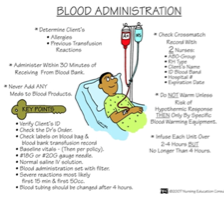
Once other nurse checks the blood and makes sure everything is right; do not rush and administer the blood. Take a minute and double check
First 15 min in PT room; severe reactions occur within the 15 min
Make sure blood is going into PT vein
Document during 15 min
VS taken every 15 minutes
Education
Risks and benefits and what to expect during/after transfusion
Signs/Symptoms of transfusion reaction
Fever
Chills
Respiratory distress
Low back pain
Nausea
Pain at IV site
Anything “unusual”
Reassure blood typing/testing
Types of Complications
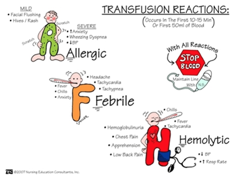
Febrile nonhemolytic reaction
Caused by antibodies to donor leukocytes
↑ in patients who have had previous transfusions
Exclude other causes
Chills, fever
Prevent: Use leukocyte reduction filter
Acute hemolytic reaction
Life-threatening
Donor blood incompatible with recipient (Type II hypersensitivity)
Errors in blood labeling/patient identification
Fever, chills, low back pain, nausea, chest tightness, dyspnea, anxiety, hemoglobinuria
May result in hypotension, bronchospasm, vascular collapse, ARF, DIC
Allergic reaction
Sensitivity to plasma
Urticaria
Generalized itching
Flushing
Responds to Diphenhydramine
Severe: epinephrine, corticosteroids, vasopressors
Prevent: Pre-medicating with diphenhydramine or corticosteroids. Wash blood components to remove plasma proteins
TransfusionAssociated Circulatory Overload (TACO)
Hypervolemia
Dyspnea, orthopnea, tachycardia, sudden anxiety, ↑BP
JVD, crackles, hypoxemia
Assess for risk
Prevent/treat
Diuretics
Slow rate of infusion
Oxygen/morphine
Bacterial Contamination
Risk is very low
Can occur at any point during procurement or processing, but often results from organisms of patient’s skin
Platelets at greatest risk of contamination because stored at room temperature; blood centers have developed rapid methods of culturing platelet unit
Prevention: meticulous procurement and processing. PRBCs or whole blood transfused within 4 hours
S/S: fever, chills, hypotension
Tx: fluids and broad-spectrum antibiotics
Transfusion-related acute lung injury (TRALI)
Potentially fatal
Development of TRALI occurring within 6 hours after a transfusion >>> vascular endothelium injury >> interstitial/interalveolar edema and sequestration of WBCs in pulmonary capillaries
Onset is abrupt (2 to 6 hours)
SOB, hypoxia, hypotension, fever, eventual pulmonary edema
Bilateral pulmonary infiltrates without evidence of cardiac failure
Aggressive supportive therapy that may prevent death: oxygen, intubation, fluid support
More likely to occur with plasma and platelets
Nurse Management with Transfusion Reactions
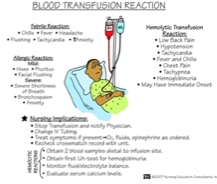
STOP TRANSFUSION IMMENDIATELY!!!
Maintain IV line with NS with new tubing at a slow rate
ASSESS PATIENT
Compare VS with baseline
Respiratory: oxygen saturation, lung sounds, AMS
Any chills, diaphoresis, JVD, back pain or urticaria
Continue to monitor VS, cardiac, respiratory, and renal status
NOTIFY HCP
Assessment findings
Prescribed treatments
NOTIFY BLOOD BANK
SEND BLOOD PRODUCT WITH TUBING BACK TO BLOOD BANK
IF NECESSARY, COLLECT AND SEND SERUM/URINE SPECIMENS
Pharmacologic Alternatives to Transfusion
Growth Factors
Erythropoietin
epoetin alfa (Epogen, Procrit)
Granulocyte Colony-Stimulating Factor (G-CSF)
filgrastim (Neupogen)
GranulocyteMacrophage Colony-Stimulating Factor (GM-CSF)
sargramostim (Leukine)
Thrombopoietin
Informationen
- Beschreibung
- Der Nutzer hat seine Fachbereichs-Information gelöscht. Notiz am Blood Transfusion , erstellt von Gelöschter Nutzer am 02/06/2019.
- Erstellt von
- Gelöschter Nutzer · Jun 2019
- Aktualisiert
- 2 Jun 2019
- Aufrufe
- 8
- Verlauf
-
- Erstellt von Brittnee Gonzalez · 2 Jun 2019
- Kopiert von Brittnee Gonzalez · 2 Jun 2019
- Bewertung