
Notizen
7.1 - DNA Structure & Replication
Inhalt der Notizen (3)
Seite 1
The role of nucleosomes in DNA packing
histones are used by the cell to package DNA into structures called nucleosomes
nucleosome: consists of a central core of eight histone proteins with DNA coiled around the proteins
the eight proteins (octamer) consist of 2 copies of 4 types of histones
H1, an additional histone protein molecule, serves to bind the DNA to the core particle
the association of histones with DNA = supercoiling
it allows a great length of DNA to be packed into a small space in the nucleus
the nucleosome is an adaptation that facilitates the packing of the large genomes that eukaryotes possess
the H1 histone binds to form a structure called the 30 nm fibre that facilitates further packing
The leading strand and the lagging strand
synthesis on the two strands occur differently
because the two strands are arranged in an anti-parallel way
on the leading strand:
the strand is made continuously following the fork as it opens
on the lagging strand:
the strand is made in fragments moving away from the fork
new fragments are created as the replication fork exposes more of the strand
they are called Okazaki fragments
The direction of replication
DNA replication begins at sites called origins of replication
the phosphate group of new DNA nucleotides is added to the 3' carbon of the deoxyribose of the nucleotide at the end of the chain
replication only occurs in the 5' to 3' direction
Non-coding regions of DNA have important functions
only some DNA sequences code for the production of polypeptides
these are called coding sequences
there are a number of non-coding sequences found in genomes,
some have functions (like the ones used to produce tRNA and rRNA)
some play a role in the regulation of gene expressions such as enhancers and silencers
most of the eukaryotic genome is non-coding
Seite 2
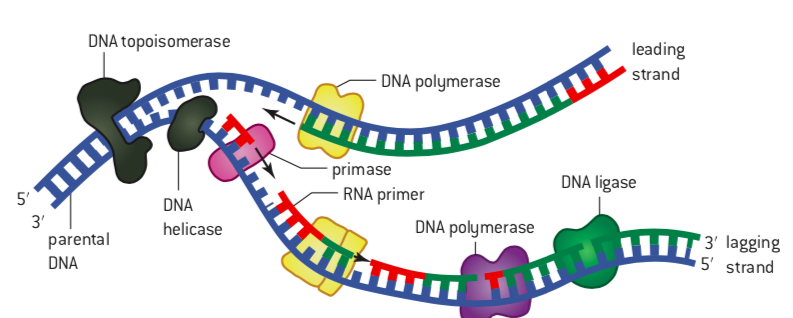
Proteins involved
Helicase:
unwinds the DNA at the replication fork
Topoisomerase:
releases the strain the develops ahead of the helicase
Single-stranded binding proteins:
keep the strands apart, keep them from reannealing long enough for copying fo the strand
DNA primase:
creates RNA primers on the strands; one on leading, many on lagging
DNA polymerase:
it covalently links the deoxyribonucleotide monophosphate to the 3' end of the growing strand
DNA ligase:
connects the gaps between fragments
Seite 3
How Replication Happens
Helicase
Helicase unwinds and separates the double-stranded DNA by breaking the hydrogen bonds between base pairs
This occurs at specific regions (origins of replication), creating a replication fork of two strands running in antiparallel directions
DNA Gyrase
DNA gyrase reduces the torsional strain created by the unwinding of DNA by helicase
It does this by relaxing positive supercoils (via negative supercoiling) that would otherwise form during the unwinding of DNA
Single-Stranded Binding (SSB) Proteins
SSB proteins bind to the DNA strands after they have been separated and prevent the strands from re-annealing
These proteins also help to prevent the single-stranded DNA from being digested by nucleases
SSB proteins will be dislodged from the strand when a new complementary strand is synthesized by DNA polymerase III
DNA Primase
DNA primase generates a short RNA primer (~10–15 nucleotides) on each of the template strands
The RNA primer provides an initiation point for DNA polymerase III, which can extend a nucleotide chain but not start one
DNA Polymerase III
Free nucleotides align opposite their complementary base partners (A = T ; G = C)
DNA pol III attaches to the 3’-end of the primer and covalently joins the free nucleotides together in a 5’ → 3’ direction
As DNA strands are antiparallel, DNA pol III moves in opposite directions on the two strands
On the leading strand, DNA pol III is moving towards the replication fork and can synthesize continuously
On the lagging strand, DNA pol III is moving away from the replication fork and synthesizes in pieces (Okazaki fragments)
DNA Polymerase I
As the lagging strand is synthesized in a series of short fragments, it has multiple RNA primers along its length
DNA polymerase I remove the RNA primers from the lagging strand and replaces them with DNA nucleotides
DNA Ligase
DNA ligase joins the Okazaki fragments together to form a continuous strand
It does this by covalently joining the sugar-phosphate backbones together with a phosphodiester bond
Informationen
- Beschreibung
- Der Nutzer hat seine Fachbereichs-Information gelöscht. Notiz am 7.1 - DNA Structure & Replication, erstellt von Gelöschter Nutzer am 20/02/2020.
- Erstellt von
- Gelöschter Nutzer · Feb 2020
- Aktualisiert
- 20 Feb 2020
- Aufrufe
- 10
- Verlauf
-
- Erstellt von Blen Abate · 16 Feb 2020
- Kopiert von Blen Abate · 20 Feb 2020
- Bewertung