
Notizen
8.1 - Metabolism
Inhalt der Notizen (5)
Seite 1
Metabolic pathways
a sequence of small steps that form chemical reactions
most metabolic pathways involve a chain of reactions
example: converting phenylalanine into fumarate and acetoacetate
some metabolic pathways form a cycle rather than a chain
the end product of one reaction is the reactant that starts the pathway
example: Calvin cycle and Krebs cycle
Seite 2
Enzymes and activation energy
substrates pass through a transition to be converted into products
energy is required to reach the transition stage
this is called the activation energy
the activation energy is used to break or weaken bonds in the substrates
when an enzyme catalyzes a reaction, the substrate binds to the active site and is altered to reach the transition state, it is then converted to products, which separate from the active site
this binding lowers the overall energy level of the transition state
the activation energy is lowered
the net amount of energy released by the reaction is unchanged
but the rate of reaction increases, typically by a factor of a million or more
Seite 3
Types of enzyme inhibitors
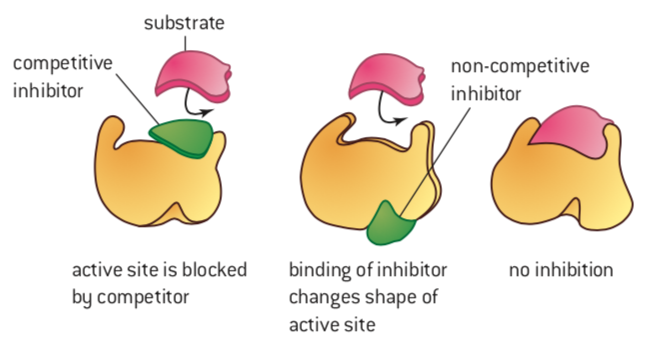
chemical substances bind to enzymes and reduce their activity
they are known as inhibitors
the two main types:
competitive inhibitors
interfere with the active site
the substrate cannot bind
non-competitive inhibitors
bind at another location
change the shape of the enzyme
Seite 4
Effects of enzyme inhibitors
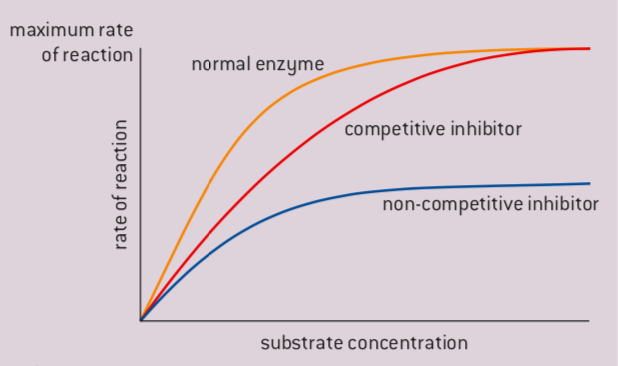
competitive inhibitor
the concentration of substrate begins to exceed the amount of inhibitor, the maximum rate of the uninhibited enzyme can be achieved but it takes a much higher concentration of substrate to achieve this maximum rate
non-competitive inhibitor
the enzyme doesn't reach the same maximum rate because the binding of the inhibitor prevents some of the enzymes from being able to react regardless of substrate concentration
same pattern as the normal enzyme
it takes approximately the same concentration of enzyme to reach the maximum rate, but the maximum rate is lower than the uninhibited enzyme
Seite 5
End-product inhibition
allosteric interactions: when enzymes are regulated by chemical substances that bind to special sites on the enzymes away from the active site
allosteric site: where these interactions take place
in many cases, the enzyme that is regulated catalyzes one of the first reactions in a metabolic pathway and the substance that binds to the allosteric site is the end product of the pathway
the end product acts as an inhibitor
the pathway works rapidly in cells with a shortage of end product but can be switched off completely in cells where there is an excess
reactions don't often go to completion, an equilibrium position is reached with a characteristic ratio of substrates and products
so if the concentration of products increases, a reaction will eventually slow down and stop, this effect reverberates back through a metabolic pathway when the end product accumulates
end-product inhibition prevents this build-up of intermediate products
example: through a series of five reactions, threonine is converted into isoleucine; as the concentration of isoleucine builds up, it binds to the allosteric site of the first enzyme in the chain, threonine deaminase, acting as a non-competitive inhibitor.
Informationen
- Beschreibung
- Der Nutzer hat seine Fachbereichs-Information gelöscht. Notiz am 8.1 - Metabolism, erstellt von Gelöschter Nutzer am 20/02/2020.
- Erstellt von
- Gelöschter Nutzer · Feb 2020
- Aktualisiert
- 20 Feb 2020
- Aufrufe
- 5
- Verlauf
-
- Erstellt von Blen Abate · 16 Feb 2020
- Kopiert von Blen Abate · 20 Feb 2020
- Bewertung