
Mindmap
"Planetarium" by Adrienne Rich
Inhalt der Mindmap
"Planetarium" by Adrienne Rich
Author Background
- Adrienne Rich, b. 1929 in Baltimore, MD, d. 2012.
- Began in the 1950s – her work became increasingly radical throughout the '60s and '70s.
- This is when she became exposed to free-verse poetry and feminist philosophy.
- Her later poetry was integral to the development of 2nd wave feminism.
- She was the recipient of many awards over the course of her career.
- She refused the National Medal of Arts in 1997 from President Clinton for political reasons.
- Rich was very outspoken about the political power of poetry.
- She refused the National Medal of Arts in 1997 from President Clinton for political reasons.
- This is when she became exposed to free-verse poetry and feminist philosophy.
- Began in the 1950s – her work became increasingly radical throughout the '60s and '70s.
- Adrienne Rich, b. 1929 in Baltimore, MD, d. 2012.
Poem Background
- Published in 1968, which was a central point in the Civil Rights Movement and an early period of 2nd wave feminism.
- Less than a year earlier, 23-year-old Jocelyn Bell was excluded from a Nobel Prize for her role in the discovery of the pulsar (integral to our current understanding of the universe). Rich refers to pulsars in the last stanza of this poem.
- Features an epigraph to Caroline Herschel (1750 - 1848), who was the first professional woman astronomer.
- She was the first woman to be admitted into the Royal Astronomical Society and the first woman to receive a salary as a scientist.
- In this poem, Rich captures many of Herschel’s accomplishments. Her older brother, William Herschel, was also an astronomer, but was more famous for his discovery of the planet Uranus.
- Rich identified with the challenges Herschel faced in a male-dominated world and field.
- In a 1971 essay, Rich said that this was the first time she identified with a persona in one of her poems.
- In an article from an issue of Lady Science, Leila A. McNeill shares her view that Rich focuses on the idea of mythmaking. Women face abuse in many of the myths written into the stars, but Rich recognizes that she has the ability to rewrite or reinterpret those stories written by men.
- Rich didn’t like how centuries of male writers have depicted women.
- Rich identified with the challenges Herschel faced in a male-dominated world and field.
- Features an epigraph to Caroline Herschel (1750 - 1848), who was the first professional woman astronomer.
- Less than a year earlier, 23-year-old Jocelyn Bell was excluded from a Nobel Prize for her role in the discovery of the pulsar (integral to our current understanding of the universe). Rich refers to pulsars in the last stanza of this poem.
- Published in 1968, which was a central point in the Civil Rights Movement and an early period of 2nd wave feminism.
Poem Breakdown
Poem Analysis
- Structure
- Extremely irregular structure.
- Breaks down the idea of what a poem should look like; this is reflective of the women mentioned in the poem, who break social conventions.
- Extremely irregular structure.
- Perspective
- This poem was written using multiple perspectives.
- The beginning offers Herschel’s story in 3rd person. Tycho’s story is also in 3rd person.
- Abruptly, Rich writes in 1st person (a collective ‘we’) pointing to her identification with Herschel. Herschel and Rich both are able to observe their world (and change their perception by their own will).
- Rich closes the poem with 1st person (‘I’).
- Perhaps this is Rich’s way of showing hope that she, too, can be more and can question the way women’s stories have been written.
- Rich closes the poem with 1st person (‘I’).
- Abruptly, Rich writes in 1st person (a collective ‘we’) pointing to her identification with Herschel. Herschel and Rich both are able to observe their world (and change their perception by their own will).
- The beginning offers Herschel’s story in 3rd person. Tycho’s story is also in 3rd person.
- This poem was written using multiple perspectives.
- Poetic Devices
- Allusion
- Tycho Brahe: famous Danish astronomer
- NOVA: astronomical event that causes sudden appearance of a bright star that appears new, but eventually fades
- Uranus: planet famously discovered by Caroline Herschel’s brother, William
- Taurus: A constellation; the Seven Sisters are a group of stars in this formation that supposedly are chased by the hunter Orion every night.
- Uranus: planet famously discovered by Caroline Herschel’s brother, William
- NOVA: astronomical event that causes sudden appearance of a bright star that appears new, but eventually fades
- Tycho Brahe: famous Danish astronomer
- Extra Spaces
- The poem is broken up in a way to convey intense emotions.
- Extra spaces create moments to pause between sections.
- The poem is broken up in a way to convey intense emotions.
- Enjambment
- Most of the poem has thoughts continue from one line to another without punctuation.
- This puts emphasis on the chaotic, unconventional structure and subject of the poem.
- Most of the poem has thoughts continue from one line to another without punctuation.
- Imagery
- Rich’s imagery in this poem focuses around astronomical phenomena.
- It calls to mind the stars and constellations.
- Rich’s imagery in this poem focuses around astronomical phenomena.
- Metaphor
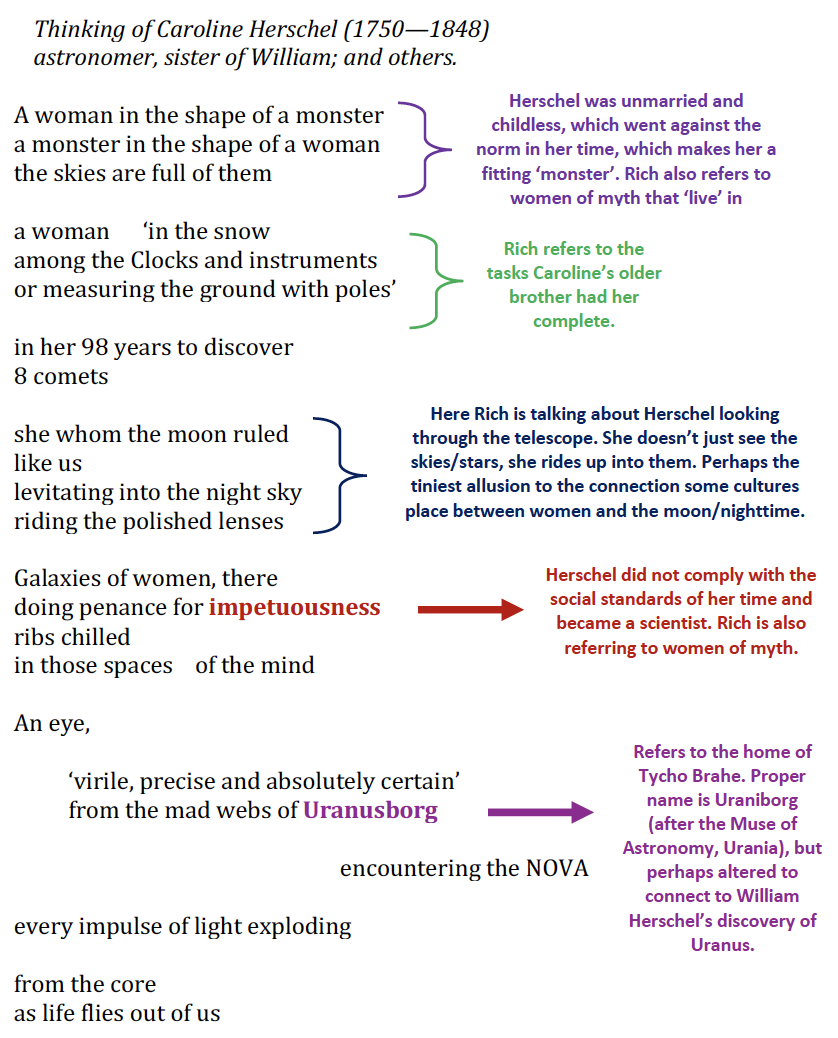
- The poem opens with metaphor, where a woman is monster-shaped, but the monster is also woman-shaped. Rich makes a connection between this metaphor and the next stanza – Caroline Herschel, too, is a monster-shaped woman or a woman-shaped monster.
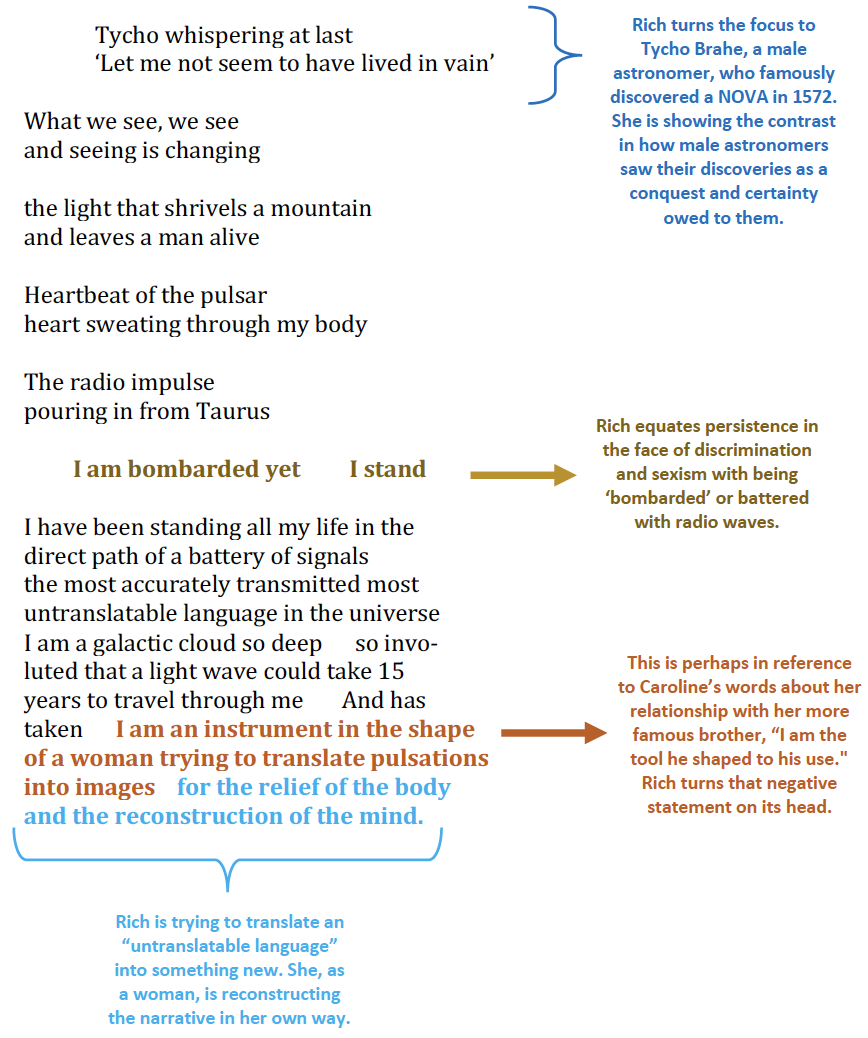
- “I have been standing all my life in the direct path of a battery of signals the most accurately transmitted most untranslatable language in the universe”
- Possibly meant half literally/half figuratively. But again, talking about the universe and how women fit into it.
- “I am a galactic cloud so deep” – Women have depth and substance (I know! Shocking...)
- Rich writes this poem in the 1960s, amidst her transformation into a poet of feminist politics.
- “I am a galactic cloud so deep” – Women have depth and substance (I know! Shocking...)
- Possibly meant half literally/half figuratively. But again, talking about the universe and how women fit into it.
- “I have been standing all my life in the direct path of a battery of signals the most accurately transmitted most untranslatable language in the universe”
- The poem opens with metaphor, where a woman is monster-shaped, but the monster is also woman-shaped. Rich makes a connection between this metaphor and the next stanza – Caroline Herschel, too, is a monster-shaped woman or a woman-shaped monster.
- Personification
- “She whom the moon ruled”
- The moon has a power over Herschel (and to all women in the context of Rich’s poem).
- Interesting to note that the skies are personified in connection with female astronomers, but not male astronomers.
- The moon has a power over Herschel (and to all women in the context of Rich’s poem).
- “She whom the moon ruled”
- Allusion
- Structure
Poem Themes
- Internalized Sexism
- Parts of this poem can be read as a reaction against internalized sexism among great thinkers who are women.
- Caroline Herschel wrote “I am nothing” when asked about her life’s work alongside her older brother. She had a poor image of her incredible contributions to astronomy.
- Rich ends the poem with an acknowledgement that she is actively trying to correct her way of thinking and observing the world. – ‘for the relief of the body and the reconstruction of the mind’
- Also, the idea of “galaxies of women” needing to pay for what men have written down as their bad behavior.
- All types of constellations depicting women suffering/being punished: Cassiopeia chained to her thrown, Andromeda chained to a rock as a sacrifice, and more.
- Also, the idea of “galaxies of women” needing to pay for what men have written down as their bad behavior.
- Rich ends the poem with an acknowledgement that she is actively trying to correct her way of thinking and observing the world. – ‘for the relief of the body and the reconstruction of the mind’
- Caroline Herschel wrote “I am nothing” when asked about her life’s work alongside her older brother. She had a poor image of her incredible contributions to astronomy.
- Parts of this poem can be read as a reaction against internalized sexism among great thinkers who are women.
- Persistance
- “I am bombarded yet I stand”
- Literally, the woman in this poem has to work against radio signals.
- Figuratively, the woman in this poem is pushing back against society.
- “What we see, we see / And seeing is changing”
- Figuratively, the woman in this poem is pushing back against society.
- Literally, the woman in this poem has to work against radio signals.
- “I am bombarded yet I stand”
- Importance of Women's Contributions (to Science & Art)
- Rich focuses this poem on the life of Caroline Herschel (and others).
- Caroline Herschel was an astronomer in her own right, beyond helping her brother with his work.
- Rich points out that she in her 98 years she discovered 8 comets.
- Caroline Herschel was an astronomer in her own right, beyond helping her brother with his work.
- Rich focuses this poem on the life of Caroline Herschel (and others).
- Internalized Sexism
Bilder und Dateien der Mindmap


Informationen
- Beschreibung
- Der Nutzer hat seine Fachbereichs-Information gelöscht. Mindmap am "Planetarium" by Adrienne Rich, erstellt von Gelöschter Nutzer am 06/02/2021.
- Erstellt von
- Gelöschter Nutzer · Feb 2021
- Aktualisiert
- 6 Feb 2021
- Aufrufe
- 31
- Verlauf
-
- Erstellt von Joseph Gianotti · 25 Jan 2021
- Kopiert von Joseph Gianotti · 6 Feb 2021
- Bewertung