
Tema 1 Anatomía
Folien in diesem Satz (7)
-
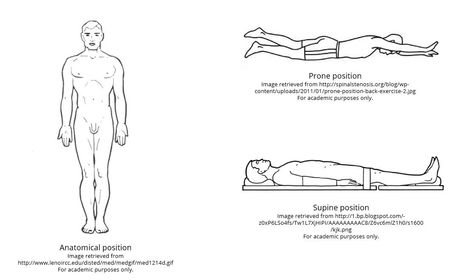
- Prone position
- Anatomical Position
- Supine position
-
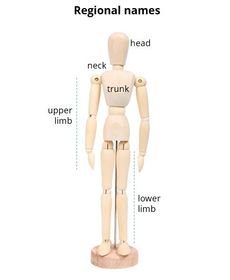
- The human body can be divided into several major regions that can be identified externally, and they include the head, neck, trunk, upper limbs and lower limbs.
-
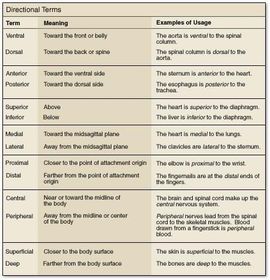
- Directional terms are words that describe the position of one body part relative to another, and they are used to locate various body structures.
-
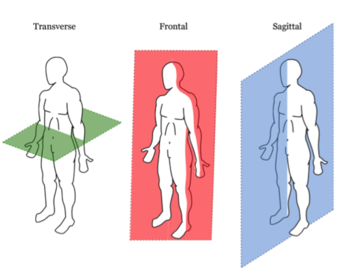
- Body planes are imaginary flat surfaces that are used to divide the body or organs to visualize interior structures.
-
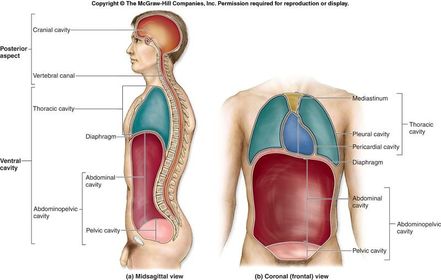
- Body cavities are spaces in the body that help protect, separate and support internal organs.
-
- Mucous membranes line the tubes of the digestive, respiratory, urinary, and reproductive systems. The epithelium contains goblet cells that secrete mucus that protects the body from invasion by bacteria and viruses. More mucus is secreted when a person has a cold and has to blow their nose.
- The meninges are membranes within the dorsal cavity that are composed of only connective tissue and serve as a protective covering for the brain and spinal cord.
- Synovial membranes line freely movable joint cavities and are composed only of loose connective tissue. They secrete synovial fluids that lubricates the cartilage at the ends of the bones so that they can move smoothly in the joint cavity.
- Serous membranes, which line the thoracic and abdominal cavities and cover the organs they contain, are also composed of epithelium and loose fibrous connective tissue. This helps hinder the spread of any infection.
-
- Homeostasis is a condition of equilibrium in the body’s internal environment produced by the interplay of all the body’s regulatory processes.
- For example, body temperature fluctuates slightly though out the day. Also, the body’s ability to maintain a normal internal temperature is somewhat dependent on the external temperature, if the external temperature becomes too hot or cold, we will die.
- A disorder is any abnormality of structure or function, whereas a disease is a more specific term for an illness characterized by a recognizable set of signs and symptoms. Diseases alter body structures and functions in characteristic ways.
- Someone with a disease may experience symptoms, which are subjective changes in body functions that are not apparent to the observer, such as a headache, nausea, and anxiety.
Informationen
- Beschreibung
- Folienset am Tema 1 Anatomía, erstellt von Diego Puente am 09/09/2015.
- Erstellt von
- Diego Puente · Sep 2015
- Aktualisiert
- 20 Nov 2016
- Aufrufe
- 449
- Tags
- Bewertung