
Karteikarten
Reproduction flashcards
Karten in diesem Stapel (44)
- 1ReproductionThe process by which living organisms produce new living organisms.
Some living organisms can reproduce either sexually or asexually depending on the environmental conditions. - 2Methods of reproductionAsexual
Sexual - 3AsexualThe process through which one organism creates new living organisms without the participation of another organism. The offspring are identical copies of the parent organism.
- 4SexualProcess in which two compatible organisms of the same species cooperate to create new living organisms.
Mix of the characteristics of the two parents - 5ClonesOrganisms that are identical copies of another organisms, and which contains the same genetic material
- 6Environmental conditionsThe parents does not need to find a compatible organism to reproduce asexually
It is suitably adapted to the environmental condition, its offspring will also be.
On the contrary sexual reproduction has the possibility to adapt to new conditions. - 7Organisms that reproduce asexuallyProkaryotic organisms: ex. bacterias
Single-celled eukarotic: ex. protozoa, single-celled algae and yeast
Fungi and multicellular algae. - 8Parts of asexual reproductionBipartition
Budding
Fragmentation
Spore formation - 9Bipartitionit divides into two identical individual
- 10BuddingGenerates a bud or outgrowth which ends up separating
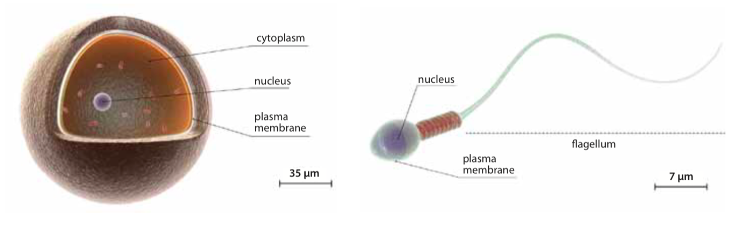
- 11FragmentationOrganisms capable of fully regenerating their bodies after being fragmented accidentally
- 12Spore formationThey generate special cells which are capable of spreading and becoming new individuals.
- 13COmbining traitsIn sexual reproduction the organisms are not identical to each other.
The offspring's traits are a combination of the parents' traits - 14Organisms that reproduce sexuallyAll living organisms formed by eukaryotic cells reproduce sexually
- 15Sex cells or gametesSpecialized cells that take part in sexual reproduction.
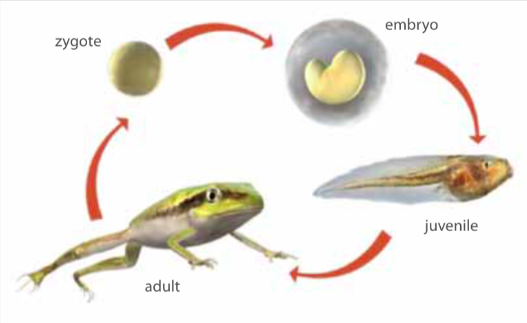
- 16ZygoteFirst cell of the new organism resulting from the fusion of the gametes.
Its formation is only the first stage in the sexual reproduction of a multicellular organisms. - 17Female sex cellsLarge cells
Spherical
Cytoplasm stores reserve substances to be used as a source of energy and matter - 18Male sex cellsSmall cells
Nucleus occupies the majority of space
Specialized in traveling to the female gamete - 19Parts of male and female sex cells
- 20FertilizationFusion of male sex cell (sperm) and female sex cell (egg) results in a zygote
- 21embryonic developmentIs the process by which the zygote transforms into a multicellular organism. Two important processes
Cell division
Cell differentation - 22Cell divisionThe zygote genetic material duplicate, its cell membrane divide the cell into two halves producing two cells with a copy of the genetic material.
This process is called MITOSIS - 23Cell differentiationAccording to the position of each cell in the embryo, each one develops in a certain way with different forms and functions
- 24EmbryoWe refer to a living organism inside the womb of the mammals or the eggs.
Made up of thousand of cells. - 25Biological cycle
- 26GonadsOrgans that carry out sexual reproduction
- 27Types of gonadsTesticles: produces male sex cells-spermatozoa
Ovaries: produces female sex cells-ova - 28Unisexual speciesYou either can have female gonads or mal gonads.
Sexual dimorphism: physical differences between females and males - 29Hermaphroditic speciesBoth types of gonads simultaneosly or at different time
Self-fertilization - 30Internal fertilizationOccurs inside the female's body. It requieres the male gametes to be inserted with the male reproductive organ.
Common among land animals - 31External fertilizationThey both release their gametes into the open and fertilization occurs.
Common between aquatic and semiaquatic animals. - 32Types of reproductionOviparous
Viviparous
Ovoviparous - 33OviparousThe embryo develops inside an egg.
- 34ViviparousEmbryo develops in the mother's womb, in a specialized structure called the PLACENTA
- 35OvoviviparousEmbryo develops within an egg that remains within the maternal body until it is ready to hatch.
- 36Postembryonic developmentstage of an animal's life cycle that begins with birth and includes growth and reaching sexual maturity.
- 37Two types of embryonic developmentont. DirectYoung animals look similar to adults.
It includes viviparous and oviparous - 38Two types of embryonic development. IndirectNewborn organisms, called LARVAE. Look different to adults.
Series of changes = metamorphosis
Period of inactivity = pupation - 39Asexual reproduction in plantsplants structures with the ability to sprout and develop into plants genetically identical to the parent
It is called vegetative reproduction - 40Vegetative reproductionTubers. Such as potatoes
Bulbs: such as garlic cloves
Rhizomes: such as ginger plants
Stolons: such as strawberry - 41Sexual reproduction in plantsit takes place in the flowers where the seed develop
Plants can be hermaphoditic or dioecious. - 42The parts of the flower
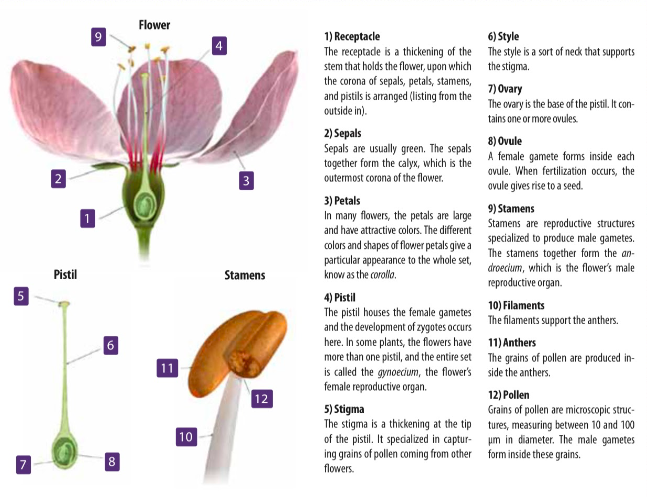
- 43PollinationThe male gametes are contained in the pollen grains.
To fertilize a female gamete the pollen grain must travel from the anther where was formed to the stigma of another flower of the same species - 44Means of pollinationBy wind: it can travel long distances.
By animals: theses animals are called pollinators, they are flying animals such as bees, hummingbirds.
Informationen
- Beschreibung
- Der Nutzer hat seine Fachbereichs-Information gelöscht. Karteikarten am Reproduction flashcards, erstellt von Gelöschter Nutzer am 27/02/2022.
- Erstellt von
- Gelöschter Nutzer · Feb 2022
- Aktualisiert
- 27 Feb 2022
- Aufrufe
- 17
- Verlauf
-
- Erstellt von Luciana Rosell · 15 Feb 2022
- Kopiert von Luciana Rosell · 27 Feb 2022
- Bewertung