
Notizen
Static Electricity: Electric Charge
Inhalt der Notizen (1)
Seite 1
Electric Charge
Q = total charge on a body
q = charge on an individual particle
Indicates if a body has an excess or a deficiency of electrons
Scalar quantity
Unit: Coulomb (C)
1 Coulomb is the amount of charge that passes any point in a circuit when a current of 1 ampere flows for 1 second
Like charges repel each other; unlike charges attract each other
Methods of Charging
Charging by contact
Charging by induction
Charging by contact
Involves the contact of a charged object to a neutral object
The substance with a weaker attraction will lose some of its electrons to the other substance
Rubbing polythene or Perspex rods with a cotton cloth causes the polythene rod to gain electrons from the cloth, whereas the Perspex loses electrons to it
The polythene rod becomes negatively charged
The Perspex rod becomes positively charged
Charging by induction
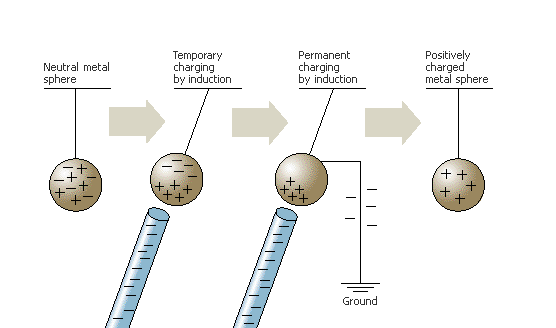
If you bring a charged insulator (a negatively charged polythene rod) close to a conductor (a metal sphere on an insulated handle), the charge on the rod will cause the opposite charge to be attracted to it, and the similar charge to be repelled
If you then earth the sphere (by touching it), the negative charges will flow to the ground
Then, you remove the earth and subsequently the charged rod
The positive charges spread out and you are left with a positively charged metal sphere
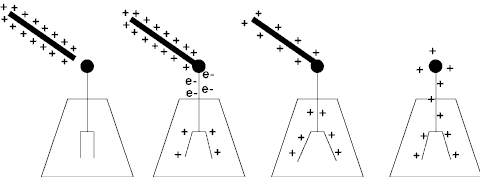
In this diagram, a positively charged rod is touched against a neutral gold leaf electroscope
The positive charges on the rod attract the negative charges and repel the positive charges on the electroscope
The negative charges are cancelled out by the positive charges on the rod, leaving everything positively charged
The rod is then taken away, leaving a positively charged electroscope
Conductor = any substance through which electric charge can flow
Insulator = any substance through which electric charge cannot flow
New Page
Informationen
- Beschreibung
- This note provides an introduction to electric charge, and also covers charging an object by contact and induction. It can be used in conjunction with the mind map on static electricity or as a stand-alone resource.
- Erstellt von
- tatemae.honne · Jan 2014
- Aktualisiert
- 19 Feb 2016
- Aufrufe
- 109
- Tags
- Verlauf
-
- Erstellt von alex.examtime9373 · 21 Jan 2014
- Kopiert von tatemae.honne · 21 Jan 2014
- Bewertung