
Mindmap
Th1L07 Enzymes
Inhalt der Mindmap
Th1L07 Enzymes
Main properties
- biological catalysts
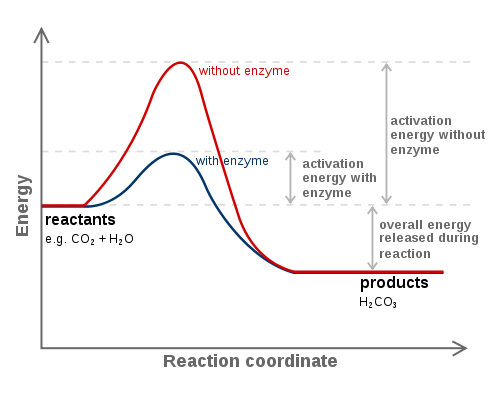
- speed up the rate of the reaction
- reduces necessary free energy (delta G) need to overcome the activation energy
- do NOT alter final equilibrium b/w reactants and products
- proteins
- Dependent on many weak bonds e.g. hydrogen bonds, electrostatic salt links and hydrophobic interactions
- Makes enzymes sensitive to changes in their environment
- Inactive enzyme
- Denatured enzyme state
- e.g. by eating the protein, giving rise to a disorganised or tangled structure in which the enzyme no longer has any catalytic activity
- temperature
- Between 20C, 30C and 40C for enzymes found in the body, you will usually speed up the reaction
- Up to 50C and beyond, denaturing of the protein will occur, similarly going to far below 20C will also reduce reaction velocity
- Inactive enzyme
- Makes enzymes sensitive to changes in their environment
- Dependent on many weak bonds e.g. hydrogen bonds, electrostatic salt links and hydrophobic interactions
Enzyme catalysis
- Enzymes contain an active site
- substrate binds to the enzyme at the active site producing an enzyme-substrate complex
- enzyme is then disregarded at the final product is revealed
- Stickase metaphor
- illustrates that enzymes should be complementary to the substrates transition phase rather than the substrate itself to bring about the activation of the reaction > product
Substrate specificity
- catalyse only one type of reaction and will act only on a few related molecules ('Group...')
- few are so specific that they will act only on a certain enzyme even to the point will it will only act on one stereoisomer
- presence of a groove or cleft of defined shape called the active site into which only the substrate of the correct shape and charge can fit
- Relevance?
- multiple enzymes within the same cellular compartment can co-exist without interfering with e/o
- allows for multiple metabolic pathways w/i cells
- multiple enzymes within the same cellular compartment can co-exist without interfering with e/o
- Systematic classification scheme of 6 main classes
- Six classes are divided into subgroups according to their substrate or source i.e. the type of reaction they catalyse
- Each enzyme IDed by individual 4 digit number I.U.B. Commission on Enzymes - established the systematic classification on enzymes Catalase 4 digit classification code - E.C. 1.11.1.6.
- mnemonic: TO HILL
- transferase
- oxoreductase
- hydrolyase
- isomerase
- ligase
- lyases
- catalyse only one type of reaction and will act only on a few related molecules ('Group...')
Bilder und Dateien der Mindmap
Informationen
- Beschreibung
- Der Nutzer hat seine Fachbereichs-Information gelöscht. Mindmap am Th1L07 Enzymes, erstellt von Gelöschter Nutzer am 26/08/2016.
- Erstellt von
- Gelöschter Nutzer · Aug 2016
- Aktualisiert
- 27 Aug 2016
- Aufrufe
- 34
- Verlauf
-
- Erstellt von Emma Allde · 17 Aug 2016
- Kopiert von Emma Allde · 26 Aug 2016
- Bewertung