
Karteikarten
GCSE AQA Chemistry - Unit 3
Karten in diesem Stapel (65)
- 1Who tried to arrange a periodic table in 1864, when only 63 elements were known?John Newlands
- 2Who realised that some elements had yet to be discovered in 1869, and left gaps to allow for their discovery?Dimitri Mendeleev
- 3What are the six elements in group 1 known as?The alkali metals
- 4What are the properties of the elements in group 1?- They have low melting and boiling points.
- Have a low density.
- Become more reactive as you go down the group. - 5Why are alkali metals more reactive as you go down the group?Because the outer energy level gets further away from the influence of the nucleus, and so an electron is lost more easily.
- 6What do alkali metals react with non-metals to form?Ionic Compounds
- 7What are the five elements in group 7 known as?Halogens
- 8What is produced when halogens react with metals?Ionic salts
- 9Fill in the missing words: Compared to group 1 elements, transition metals have _____________ melting points, are stronger and are _____________ reactive.Higher
Less - 10A more reactive halogen can ____________ a less reactive halogen from an aqueous solution of its salt.Displace
- 11How is water that is good quality and safe to drink produced?1. The water is passed through a filter bed to remove any solid particles.
2. Chlorine gas is then added to kill any harmful microorganisms.
3. Fluorine is added to drinking water to reduce tooth decay. - 12What does the amount of compounds present in tap water determine?Whether it is described as hard or soft water.
- 13Which contains more compounds?Hard water
- 14What type of ion does temporary hard water contain?Hydrogencarbonate ions (HCO3-)
- 15What does soft water readily form with soap?Lather
- 16What does hard water react with soap to form?Scum
- 17What two compounds does most hard water contain?Calcium or Magnesium
- 18What is the difference between permanent and temporary hard water?Permanent hard water remains hard upon heating, whereas temporary decomposes to produce carbonate ions.
- 19What is the advantage of hard water?The dissolved compounds in water are good for your health.
- 20What are the two disadvantages of hard water?- More soap is needed to form a lather, which increases costs.
- Using hard water often leads to deposits. - 21What are the two different ways to remove the dissolved calcium and magnesium ions from hard water to form soft water?1. Add sodium carbonate solution to it. The carbonates react with the calcium and magnesium ions to form calcium carbonate and magnesium carbonate respectively, which precipitate out of solution.
2. Pass the hard water through an ion-exchange column, which contains a resin that supplies hydrogen ions or sodium ions, As the water passes through the resin, the calcium and magnesium ions contained in it are replaced by hydrogen or sodium ions from the resin. - 22What is the unit of measurement for energy?The Joule (J)
- 23How can you measure the temperature change that takes place when a fuel burns?1. Place 100g of water in a calorimeter (a container made of glass or metal) and measure the temperature of the water.
2. Find the mass (in grams) of the fuel to be burned.
3. Burn the fuel under the water in the calorimeter for a few minutes.
4. Record the new temperature and calculate the temperature change of the water.
5. Weigh the fuel and calculate how much fuel had been used.
6. The energy released (Q) can be calculated using the following formula:
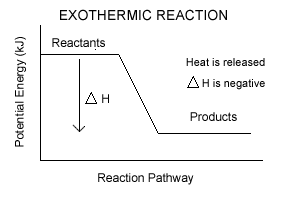
Q=mc∆T - 24Fill in the missing words: Breaking a chemical bond requires a lot of energy , this is an ____thermic process. When a new chemical bond is formed, energy is given out, this is an ____thermic process.Endothermic
Exothermic - 25What would you see in an energy level diagram for an exothermic reaction?
- 26What would you see in an energy level diagram for an endothermic reaction?
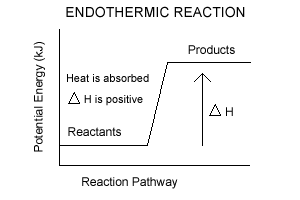
- 27What is the activation energy?The energy needed to start a reaction
- 28What do catalysts do?Reduce the activation energy needed for a reaction.
- 29What can hydrogen be used for?- As a fuel in combustion engines.
- In fuel cells, which produce electricity that can be used to power vehicles. - 30Flame tests can be used to identify metal...ions.
- 31How do you carry out the flame test?- Dip an inoculating loop in Hydrochloric acid.
- Dip in compound.
- Place loop in flame. - 32What colours would be observed in a flame test in the presence of: - Barium - Calcium - Lithium - Potassium - SodiumBarium - Green
Calcium - Brick red
Lithium - Crimson red
Potassium - Lilac
Sodium - Yellow - 33What do carbonates react with dilute acids to form?Carbon dioxide (and a salt and water)
- 34Name a base which can be used to form precipitates from metal ions...Sodium hydroxide
- 35What are the colour of these precipitates that are formed when the metal ions are mixed with PREVIOUS ANSWER: - Aluminium - Calcium - Magnesium - Copper (II) - Iron (II) - Iron (III)Aluminium Hydroxide - White
Calcium Hydroxide - White
Magnesium Hydroxide - White
Copper (II) Hydroxide - Blue
Iron (II) Hydroxide - Green
Iron (III) Hydroxide - Brown - 36Which metal precipitate out of these, dissolves when excess sodium hydroxide is added?Aluminium Hydroxide
- 37What is formed if dilute hydrochloric acid and barium chloride solution are added to a solution containing sulfate ions?A white precipitate of barium sulfate is produced.
- 38What kind of precipitate do iodide ions form with silver nitrate solution in the presence of nitric acid?Yellow
- 39What kind of precipitate do chlorine ions form with silver nitrate solution in the presence of nitric acid?White
- 40What kind of precipitate do bromide ions form with silver nitrate solution in the presence of nitric acid?Cream
- 41What is titration?An accurate technique that you can use to find out how much of an acid is needed to neutralise an alkali.
- 42Titration method...1. Wash and rise a pipette with the alkali that you will use.
2. Use the pipette to measure out a known and accurate volume of the alkali.
3. Place the alkali in a clean dry conical flask. Add a suitable indicator, e.g. phenolphthalein.
4. Place the acid in a burette that has been carefully washed and rinsed with the acid. take a reading of the volume of the acid in the burette (initial reading).
5. carefully add the acid to the alkali until the indicator changes colour to show neutrality. This is called the end point. Take a reading of the volume of acid in the burette (final reading).
6. Calculate the volume of acid added. - 43What is the Haber process used to manufacture?Ammonia
- 44What are the raw materials for the Haber process?- Nitrogen - from the fraction distillation of liquid air.
- Hydrogen - From natural gas and steam. - 45Fill in the gaps: The purified raw materials are passed over an ____ catalyst at a: ____ temperature (about ___°C) ____ pressure (about ___ atmospheres)Iron
High, 450°C
High, 200 - 46What happens in a closed system?No reactants are added and no products are removed.
- 47When is an equilibrium achieved?When the reactions occur at exactly the same rate in each direction.
- 48In an exothermic reaction, if the temperature is raised, the yield __creases, and vice versa. In an endothermic reaction, if the temperature is raised, the yield __creases, and vice versa.De(creases)
In(creases) - 49In gaseous reactions, an increase in pressure favours the reaction that produces the _____ number of molecules.Least
- 50Fill in the gaps: Alcohols are ______-based molecules that contain the functional group ___.Carbon
-OH - 51How can you turn ethanol into ethanoic acid.Oxidation
By either chemical oxidising agents or by microbial action. - 52Carboxylic acids are carbon-based molecules that contain the functional group...-COOH.
- 53TRUE OF FALSE: Carboxylic acids ionise fully in water, so they are called strong acids.FALSE
Carboxylic acids don;'t ionise fully in water, so they are called weak acids. - 54Alcohols and Carboxylic acids react together to form...esters.
- 55Esters contain the functional group...-COO
- 56What type of compounds are Esters?Volatile
(meaning they have a low boiling point). - 57Carbon Naming System: If there is one carbon atom in a chain, then the molecule's name starts with...Meth-
- 58Carbon Naming System: If there are two carbon atoms in a chain, then the molecule's name starts with...Eth-
- 59Carbon Naming System: If there are three carbon atoms in a chain, then the molecule's name starts with...Prop-
- 60Carbon Naming System: If there are four carbon atoms in a chain, then the molecule's name starts with...But-
- 61What do alcohols do when they get in water?Dissolve to form neutral solutions.
- 62Alcohols react with sodium to form...hydrogen.
- 63What do Carboxylic acids do when they get in water?Dissolve to form acidic solutions.
- 64Carboxylic acids react with carbonates to produce...carbon dioxide.
- 65How can you test for sulfate ions?Add dilute hydrochloric acid and barium chloride to the solution (which you think contains sulfate ions), and if you are right, a white precipitate of barium sulfate is produced.
Informationen
- Beschreibung
- The fun reaches its climax in the final installment of the GCSE AQA Chemistry series.
- Erstellt von
- Gelöschter Nutzer · Sep 2016
- Aktualisiert
- 8 Jan 2017
- Aufrufe
- 31
- Tags
- Verlauf
-
- Erstellt von James Jolliffe · 14 Mär 2015
- Kopiert von isobel thomas · 27 Sep 2016
- Bewertung