
Notizen
Classification of Law -English Legal System
Inhalt der Notizen (1)
Seite 1
Legal System - Classification of Law
Law can be classified into: 1. Subject matter of the dispute e.g. criminal, C&A, contract, tort. 2. Criminal/Civil Civil law solves disputes and provides remedies, it is not used for punishment. Action bought by C against D. claim claim > £50,000 = High Court Claimant proves case based on balance of probabilities. In civil cases, you are only LIABLE not GUILTY
Criminal law aims to keep the peace in society. Trials decide whether the accused (D) is GUILTY. Action is brought by the CPS (the state). Depending on the severity of the case it's either heard in the County Court or Magistrates Court.
Burden of proof is on the prosecution to prove the case beyond reasonable doubt (harder than civil) Courts have the powers to sentence imprisonment/community service/fine/probation/discharge.
3. Sources of law:
Common Law (judge made law) creates precedent
Equity - injunctions, specific performance orders, rescission(setting contract aside). Equity is not valid if the case is brought about too late. Delay defeats equity [Allcard v Skinner] 1887
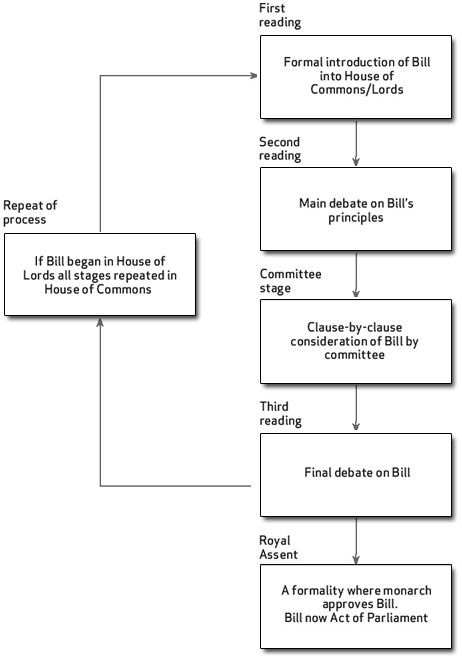
Legislation - law made by Parliament that has gone through the Parliamentary law making process. An Act of Parliament is the highest most superior form of UK Law. Statutes are often used to consolidate and codify existing law/create new law/ improve current law.The principle of Parliamentary Sovereignty is the practised idea that Parliament can make any laws but one Parliament cannot bind their successor. Most Bills are government Bills, but some are Private Members' Bills e.g. Abortion Act 1967.
See opposite process a Bill goes through to become an Act. HOWEVER sometimes if HCMs wants to bypass HLDs they can use the Parliament Act (1911/1949). E.g. HLDs never agreed to the hunting Bill so HCMs bypassed them and created the Hunting Act 2004.
HRA 1998 incorporates rights given by European Convention of Human Rights into UK law. All courts must take into account HRA when exercising powers.
If they do not, the ECJ can overrule decisions of the UK - ECJ ruled against UK in August 2014 because the UK denied the vote to prisoners.
Delegated Legislation - Parliament delegates authority to make law on its behalf. This law does not go through the above mentioned legislative process.
The main types of DL are:
Orders in council, times of emergency made my Privy Council when Parliament is not sitting usually about war/terrorism/flooding
Regulations to implement EU Law
Ministerial Regulations - where ministers of a particular area make law about that area
Local Authority by-laws
Delegated legislation is controlled through:
Consultations with local MP
HLDs scrutiny committee
Affirmative & Negative resolution procedure
Judicial Review in High Court (QBD)
3. Sources of Law cont...........
European Law:
28 Member States in the EU (UK joined in 1973). Now, all UK law is now subject to and applied in accordance with EU law. This was originally just for trade matters but has since been stretched to primarily include agriculture/employment/environment/consumer protection. BUT some law such as criminal is dealt with entirely by the UK.
Types of EU Law:
Treaties - Primary legislation - set up the EU originally, directly applicable (automatically becomes part of UK law) and have direct effect, citizens can enforce this law in domestic courts.
Regulations/Directives/Decisions -
Regulations bind all MS, directly applicable and have direct effect
Directives can be for particular MS not directly applicable but do have direct effect
Decisions are case law of the ECJ
Early treaties established 4 main agents that make up the EU:
Council of Ministers - based in Brussels, made up of heads of Governments/relevant ministers depending on subject matter.
European Commission - based in Brussels, formulate and administer EU policies, ensuring Treaty obligations are observed, drafting legislation and preparing the EU budget. Commissioners are appointed by each MS for 5 years.
European Parliament - sits in Strasbourg or Brussels, approves/amends EU budget put forward by European Commission. Approves new appointments to the Commission. Members of EU Parliament elected by MS for 5 years.
European Court of Justice - in Luxembourg, made up of judges from MS, gives rulings on EU law & hear cases. If a regulation is passed and the MS does not know how to administer it, they refer to the ECJ for advice and guidance.
Effects of EU law on the UK
Parliament is no longer the supreme law maker - puts Parliamentary Sovereignty into question.
When UK and EU law conflicts, EU law is followed
ECJ decisions bind all UK courts. [R v Secretary of State for Transport (Factortame)] 1991
BUT Parliament could repeal European Communities Act and take the UK out of the EU
The UK does contribute to what EU law is passed
After receiving interpretation of EU law from ECJ it is up to UK court to apply it to the case in front of them.
New Page
Informationen
- Beschreibung
- Der Nutzer hat seine Fachbereichs-Information gelöscht. Notiz am Classification of Law -English Legal System, erstellt von Gelöschter Nutzer am 10/10/2016.
- Erstellt von
- Gelöschter Nutzer · Okt 2016
- Aktualisiert
- 11 Okt 2016
- Aufrufe
- 25
- Verlauf
-
- Erstellt von oliviaheathcote · 7 Okt 2014
- Kopiert von Emma Read · 10 Okt 2016
- Bewertung