
Parts of the X-ray Machine
Folien in diesem Satz (10)
-
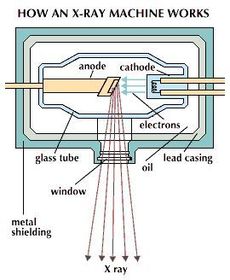
- Where photons are generated.
- Contains two electrodes; a negatively charged cathode and positively charged anode.
- Cathode; coiled wire filament (Tungsten); when an electrical current passes through it becomes hot and releases a cloud of electrons.
- Process known as thermionic emission.
-
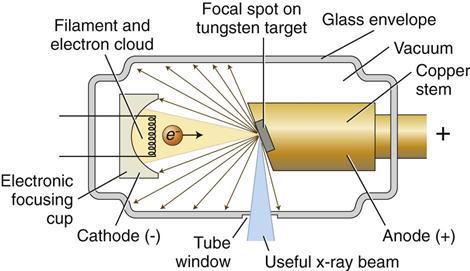
- The filament sits in a focusing cup made of nickel or molybdenum, which is also a negative potential so repels electrons and creates a narrower beam of electrons.
-
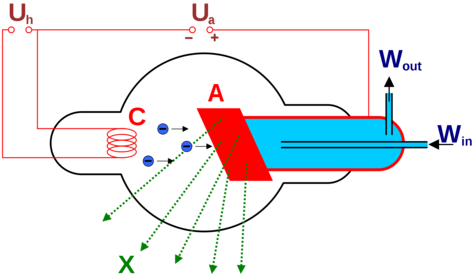
- A filament transformer decreases the mains supply as the electric current required to create electrons only needs to be small.
- The generated electrons then need to travel across the target.
- This is achieved by creating an electrical potential difference,
- The target becomes positive (so attracts the electrons) and the filament becomes negative (repelling the electrons).
- Filament = Cathode
- Target = Anode
- The weak electric beam that constitutes the electron beam is measured in milliamperes or milliamps (mA).
-
- The anode (target) and cathode (filament) are both made of Tungsten.
- This is because;
- it has a high melting point which is useful because it can withstand the high heat produced.
- it has properties where fine coils can be made.
-
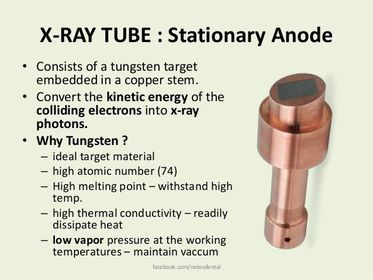
- On the fixed anode x-ray tube the tungsten target is about 3mm thick and is set in a copper block which makes up the stem.
- Copper is a good conductor of heat.
- Once heat is generated on the target by the collision of the electrons it is conducted along to the cooling fins then radiated into the surrounding oil bath which absorbs the heat.
- These are found in smaller, portable x-ray machines.
- X-ray output is limited by the amount of heat generated at the target.
- If overheating were to occur this would damage the machine, however in modern machine an automatic overload device is used to prevent this.
-
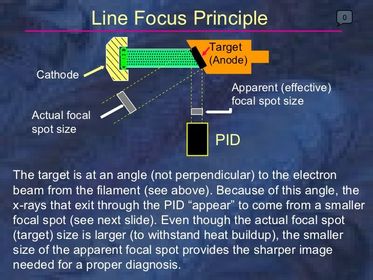
- The target is set at an angle of about 20 degrees.
- This increases the area that the electrons collide and so increase the area over which heat is produced = Actual Focal Spot
- The angle allows the actual focal spot to be as large as possible but the effective focal spot (the x-ray beam appears to originate from) to be small allowing sharp images to be produced.
-
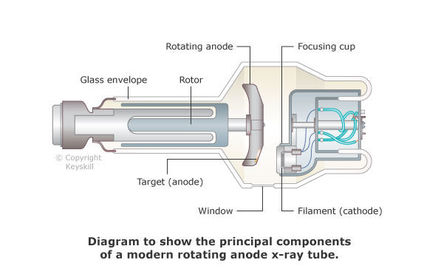
- Smaller fixed anode machines have limited use so larger machine are require, particularly when thick areas require radiography such as the chest and abdomen.
- Larger machines have a rotating anode to dissipate heat.
- The tungsten target area is the bevelled rim of a 10cm diameter disc which is set to a 20 degree angle.
- During the exposure the disc rotates rapidly so the electrons are hitting different areas.
-
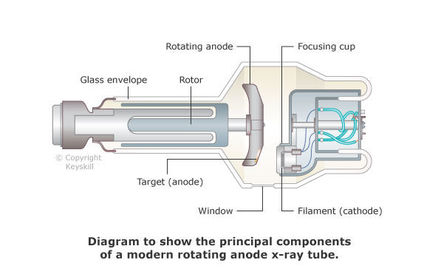
- The actual focal spot is the whole circumference of the disc so is much greater than in the stationary anode.
- The heat generated is spread over a much larger area therefore larger exposures can be made while the effective focal spot remains the same.
- A molybdenum rod is used as it is a poor conductor of heat so prevents the motor rotating the disc from overheating.
- Heat is lost by radiation through the vacuum and the glass envelope into the oil bath.
- The size of the emerging x-ray beam is very large and must be controlled (for safety reasons) by collimation.
-
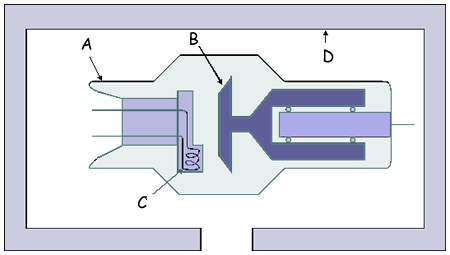
Name each part and their purpose
-
- A. Glass envelope; provides support and electrical insulation for the anode and cathode. and to maintain a vacuum in the tube. (the presence of gases in the tube would allow electricity to move freely, rather than only in the x-ray beam).
- B. Anode; to convert electronic energy into radiation and to dissipate heat. Tungsten enhances these functions.
- C. Cathode; to expel the electrons from the electrical circuit and focus them into a well defined beam aimed at the anode.
- D. Housing; encloses and supports the contents, acts as a shield and absorbs radiation, dissipates heat, the space between the housing and inserts is filled with oil, which provides electrical insulation and transfers heat from the insert to the housing surface.
Informationen
- Beschreibung
- Diagnostic Imaging (LO2) Folienset am Parts of the X-ray Machine , erstellt von Laura Smith am 21/10/2016.
- Erstellt von
- Laura Smith · Okt 2016
- Aktualisiert
- 3 Feb 2018
- Aufrufe
- 1.486
- Bewertung