
Karteikarten
Rates, equilibrium and pH
Karten in diesem Stapel (37)
- 1Rate of ReactionThe change in concentration of a reactant or product per unit time
- 2How do you write a rate equation?rate = k[A][B]
(the order in respect to the reactant is shown as the power) - 3Half-lifeThe time taken for the concentration of the reactant to reduce by half
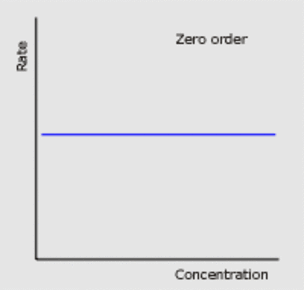
(first order = constant half-life) - 4What does the rate-concentration graph look like for a zero order reactant?
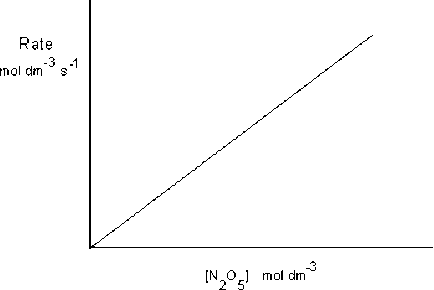
- 5What does the rate-concentration graph look like for a first order reactant?
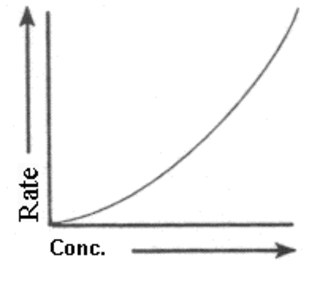
- 6What does the rate-concentration graph look like for a second order reactant?
- 7Rate-determining stepThe slowest step in the reaction mechanism of a multi-step reaction
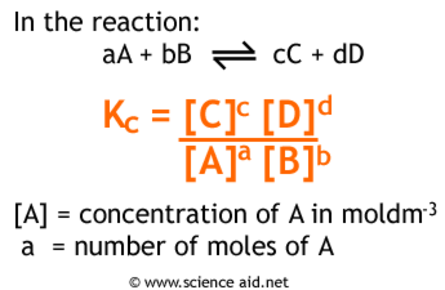
- 8What is the general expression for Kc
- 9Dynamic equilibriumWhen the rate of the forward reaction is equal to the rate of the backward reaction, in a closed system.
- 10Standard conditions298K
100kPa (1atm)
1moldm^-3 - 11Homogenous equilibriumAn equilibrium in which all the species making up the reactants and products are in the SAME state
- 12Kc only changes withTemperature
- 13If Kc is more than one the equilibrium shifts to the ...Right and favours the products
- 14If Kc is less than 1 the equilibrium shifts to the...Left and favours the reactants
- 15How is Kc value affected by temperature?Increase in Kc - rise in temp if the forward reaction is endothermic (equilibrium shift to the right)
Decrease in Kc - rise in temp if the forward reaction if exothermic (equilibrium shift to the left) - 16An acidA proton donor
- 17A baseA proton acceptor
- 18AlkaliA base that dissolved in water to form OH- ions
- 19NeutralisationA chemical reaction in which an acid and a base react together to produce a salt and water
- 20Acid + Carbonate =salt + carbon dioxide + water
( remember - the ionic equation varies with states of the carbonate) - 21Acid-base pairA pair of two species that transform into each other by gain or loss of a proton
- 22What is the general expression for the acid dissociation constant (Ka)?
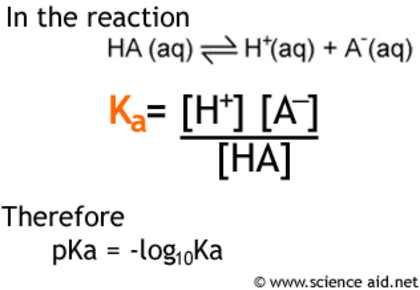
- 23How do you work out the pH of a STRONG acid?[H+] = [HA]
(due to complete dissociation)
pH = -log [H+] - 24How do you calculate the pH of a WEAK acid?
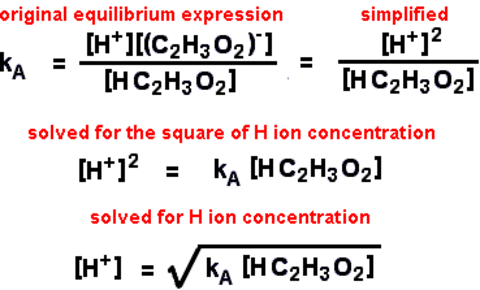
- 25What is the expression for the ionic product of water, Kw?
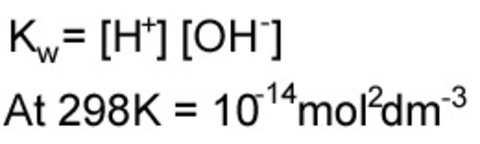
- 26What are the two methods for calculating the pH of a strong base?pOH and Kw
(remember [OH-] = base concentration due to complete dissociation) - 27What is a buffer solution?A mixture of a weak acid (HA) and its conjugate base (A-) that minimises pH changes on addition of small amounts of acid or base.
- 28General buffer equation.
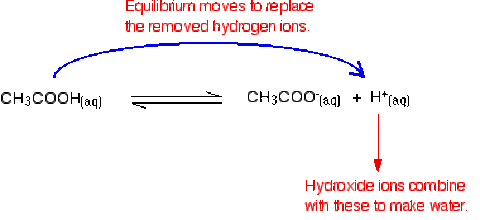
- 29How do you work out the [H+] of a buffer solution? (which can then be used to calculate the pH)
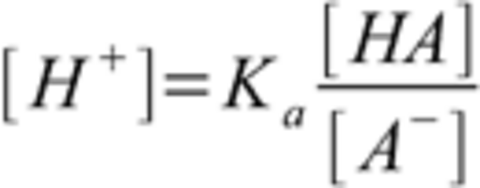
- 30Define equivalence pointThe point in a titration at which the volume of one solution has reacted exactly with the volume of a second solution
(there are no reactants in excess) - 31The end point is...The point in a titration is the point at which the indicator changes colour.
(the point at which there are equal concentrations of the weak acid and conjugate base forms of the indicator) - 32What indicator would be used for a strong acid - weak base titration? And state the colour changeMethyl orange
Red (acid) --> Orange --> Yellow (base) - 33What indicator would be used for a weak acid - strong base titration? And state the colour change.Phenolphthalein
pink (base) --> colourless (acid)
Very sudden change - 34Titration curve: Where is the equivalence point?
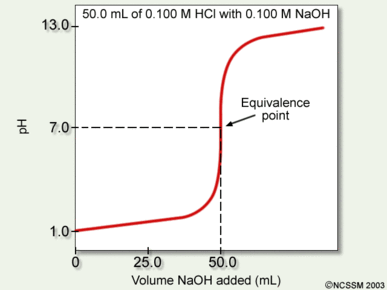
- 35Define enthalpy change of neutralisationThe energy change that accompanies the neutralisation of an aqueous acid by an aqueous base/alkali to form one mole of water under standard conditions.
- 36Determining enthalpy change of neutralisation. How do you work out the energy change? (m = mass of solutions)
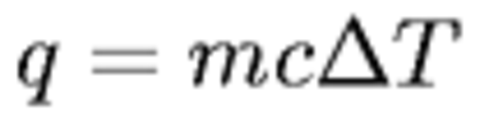
- 37Calculate enthalpy change of neutralisation. Remember: n = moles of limiting reactant
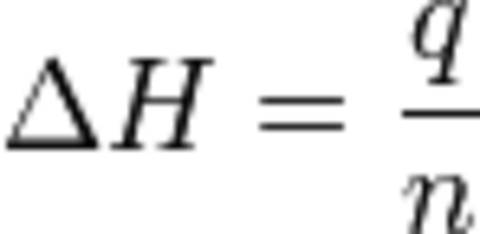
Informationen
- Beschreibung
- OCR Chemistry A spec
- Erstellt von
- Gelöschter Nutzer · Nov 2016
- Aktualisiert
- 1 Dez 2016
- Aufrufe
- 31
- Tags
- Verlauf
-
- Erstellt von sophie.holland96 · 17 Feb 2014
- Kopiert von Tariq hudda · 30 Nov 2016
- Bewertung