
Mindmap
Biology~AS

Inhalt der Mindmap
Biology~AS
Biological molecules
- Carbohydrates
- Sugars, Starch, Glycogen, Cellulose
- Starch
- α glucose
- Plants
- Medium-term storage
- Tight double helix
- Branched areas allow hydrolysis
- Cellulose
- β glucose
- Plants
- Cell wall
- Straight chains
- Hydrogen bonds between chains
- Glycogen
- α glucose
- Animals
- energy storage
- Starch
- Monosaccharides
- All carbohydrates made from
- Monomers
- Glucose, galactose and fructose
- Same no. of atoms diff. arrangement
- Glucose
- α glucose
- H then OH
- β glucose
- OH then H
- α glucose
- 2 make a disaccharide
- Glucose, galactose and fructose
- Disaccharides
- Condensation reaction
- Forms glyosidic bond
- Loss of water molecule
- Condensation reaction
- Polysaccharides
- Sugars, Starch, Glycogen, Cellulose
- Lipids
- contain C, H little O
- Dissolve in solvents NOT water
- phospholipids
- Hydrophobic 'tails'
- 2 fatty acid tails
- Hydrophillic 'heads'
- Glycerol + phosphate group
- Hydrophobic 'tails'
- Saturated-solid no C=C
- Max. no. of H atoms
- Unsaturated kink C=C
- Triglycerides
- Condensation reaction
- Ester Bond
- Carboxyl group
- Condensation reaction
- NOT POLYMERS
- Proteins
- Contains C, O, H, N, S
- Amino acid is monomer
- Acidic Carboxyl group
- Joined by Condensation reaction
- Peptide bond
- Amino Group
- Structure
- Primary
- Linear sequence of amino acids
- Peptide bonds only
- secondary
- Polypeptide chain coiled or twisted
- α helix
- β sheet
- Hydrogen & peptide bonds
- Polypeptide chain coiled or twisted
- Tertiary
- Compact globular chain
- Disulphide (covalent) Ionic Hydrogen & peptide bonds
- Quaternety
- More than one poplypeptide chain
- Primary
- Globular
- Metabolic functions
- Tertiary structure
- Compact shape
- Not stable
- Compact shape
- Tertiary structure
- Metabolic functions
- Fibrous
- Structural functions
- Long chains wound into helix
- Linked by cross bridges
- very stable
- Linked by cross bridges
- Long chains wound into helix
- Structural functions
- Carbohydrates
Biochemical tests
- Test for reducing sugar
- Add Benedicts Heat in water bath
- +ve result: brick red colour
- Test for non reducing sugar
- Heat in water bath w/h HCL Neutralise w/h NaOH Add Benedicts Heat in water bath
- +ve result: brick red colour
- Test for startch
- Add Iodine
- +ve result: turns blue/black
- Test for proteins
- Add Biuret Solution
- +ve result: turns lilac
- Tests for lipids
- Add ethanol and shake
- +ve result: cloudy white
- Test for reducing sugar
DNA and RNA
- DNA
- Structure
- DNA is a polymer
- made up of nucleotides
- Nucleotide
- Nitrogenous base
- Adenine===Thymine Guanine===Cytosine
- Phosphate group
- Deoxyribose sugar
- 5 carbon
- One less oxygen than RNA
- Phosphodiester bonds
- Between Bases phosphate and sugar
- Nitrogenous base
- Polynucletide chains
- Joined by hydrogen bonds
- Via condensation reactions
- reativley weak
- Double helix makes stronger
- Joined by hydrogen bonds
- DNA is a polymer
- Replication
- DNA Polymerase
- DNA Helicase
- Hydrolysis
- Condensation reaction
- Semi-Conservative Replication
- Evidence
- Meselson and Stahl
- Evidence
- Structure
- RNA
- Differences to DNA
- Ribose sugar
- Single standed
- Adenine===Uracil Guanine===Cytosine
- Shorter
- Differences to DNA
- DNA
ATP
- Adenosine Triphosphate
- Nucleotide derivative
- Adenosine
- Nucleotide derivative
- Use
- Energy stored in high energy bonds between phosphate groups
- Coupled w/h other reactions
- Active transport
- Minimises energy loss
- Coupled w/h other reactions
- Phosphorylation
- Energy stored in high energy bonds between phosphate groups
- Differences
- No. phospahte
- ATP
- Three
- ADP
- Two
- AMP
- One
- ATP
- No. phospahte
- Adenosine Triphosphate
Cells
- Eukaryotic cells
- Animal and Plant
- Nucleus
- Nucleolus
- RNA and ribosomes made
- Nuclear pore
- allows movement of mRNA
- Holes in the membrane
- Nucleolus
- Cell membrane
- Phospholipid bilayed
- Polar hydrophillic heads
- Polar means electrons are not equally shared
- Non-polar hydrophobic fatty acids
- Non-polar means electrons are equally shared
- cholesterol sits between phospholipids
- gives membrane more stability
- Polar hydrophillic heads
- Glycoprotein
- acts as antigen
- Recognise as self
- acts as antigen
- Glycolipid
- extrinsic protein
- Lying on the surface of bilayer
- Intrinsic protein
- all the way through the bilayer
- Fluid mosaic model
- constantly changes shape
- Phospholipid bilayed
- Cytoplasm
- Semi-liquid
- most chemical reactions happen here
- contains dissolved ions
- Ribosomes
- aid manufacture of proteins
- Mitochondria
- Double membrane
- Enclosing a semi-fluid
- energy release
- Aerobic respiration
- ATP
- Double membrane
- Endoplasmic Reticulum
- Smooth
- no ribosomes
- Rough
- Ribosomes
- Smooth
- Golgi body
- Flattened sacks separated by a membrane
- vesicle
- Transport vessel
- Made of phospholipds
- Centrioles
- microtubles
- Nucleus
- Plants only
- Chloroplast
- Contains chlorophyll
- Enable photosynthesis
- Vacuole
- Important for structure
- contains mineral ions in water
- Cell wall
- Structure
- Chloroplast
- Animal and Plant
- Eukaryotic cells
Microscopy
- Resolution
- The smallest distance between two particles which allows them to be distinguished as separate artlicles
- Half the wavelength of the medium used
- Microscopes
- TEM
- Best resolution
- Beam of electrons pass through specimen
- Detected on a fluorescent screen
- Thin sections of specimen needed
- SEM
- 3D image
- Specimen coated in heavy metals
- Thicker structures can be seen
- Electrons do not have to pass through sample
- Resolution is lower than TEM
- TEM
- Magnification
- Resolution
Enzymes
- Inhibitors
- Competetive
- Non-competetive
- Stucture
- Proteins
- Globular
- Active site
- A specific pattern of amino acids that is complementary to a particular substrate
- Model
- Lock and key
- Induced fit
- Proteins
- Biological catalyst
- Effects on rate of reaction
- Temperature
- Increase in temp Increase in RoR Until optimum
- Increase in kinetic energy
- More successful collisions
- More enzyme-substrate complexes formed
- Increase rate of reaction
- More enzyme-substrate complexes formed
- More successful collisions
- Increase in kinetic energy
- Higher than optimum
- High temp. causes the bonds in the tertiary structure to break
- Denatures active site
- Less enzyme-substrate complexes are formed
- Decrease rate of reaction
- Less enzyme-substrate complexes are formed
- Denatures active site
- High temp. causes the bonds in the tertiary structure to break
- Increase in temp Increase in RoR Until optimum
- pH
- Not optimum
- Excess H+ and OH- ions
- Interfere with charges in bonds of tertiary structure
- Causes them to break
- Less enzyme substrate complexes formed
- Decrease rate of reaction
- Less enzyme substrate complexes formed
- Causes them to break
- Interfere with charges in bonds of tertiary structure
- Excess H+ and OH- ions
- optimum
- No excess H+ and OH- ions
- Not optimum
- Substrate conc
- <----
- Enzyme conc
- Increase
- More enzymes to collide w/h substrate
- More enzyme-substrate complexes formed
- Increase rate of reaction
- Up to a point
- Increase rate of reaction
- More enzyme-substrate complexes formed
- More enzymes to collide w/h substrate
- Decrease
- Less enzymes to collide w/h substrate
- Less enzyme-substrate complexes formed
- Decrease rate of reaction
- Less enzyme-substrate complexes formed
- Less enzymes to collide w/h substrate
- Increase
- Temperature
- Inhibitors
Diffusion
- Osmosis
- Water potential
- Higher the Ψ purer the water
- 0Ψ= pure water
- From an are of high Ψ to an area of low Ψ
- Higher the Ψ purer the water
- Solute potential
- Partially permeable membrane
- Cells
- Plant
- Turgidity
- plasmolysis
- Animal
- haemolysis
- Plant
- Water potential
- Definition
- The natural passive net movement of the particles within a gas or a liquid from a region of high concentration gradient to an area of lower concentration until a dynamic equilibrium is reached
- Passive
- Not requiring energy
- Net movement
- overall movement
- dynamic equilibrium
- Equal overall but still particles moving
- Osmosis
Active Transport
- Against the conc. gradient
- From an area of low to high
- Requires energy
- In the form of ATP
- Uses carrier proteins
- At like pumps
- Uses
- Small Intestine
- Uptake of glucose and amino acids
- Plant roots
- Absorption of mineral ions
- Kidneys
- Excretion of hydrogen ions and urea
- Muscle cells
- Exchange of K and Na ions and minerals
- Small Intestine
- Against the conc. gradient
Cell replication
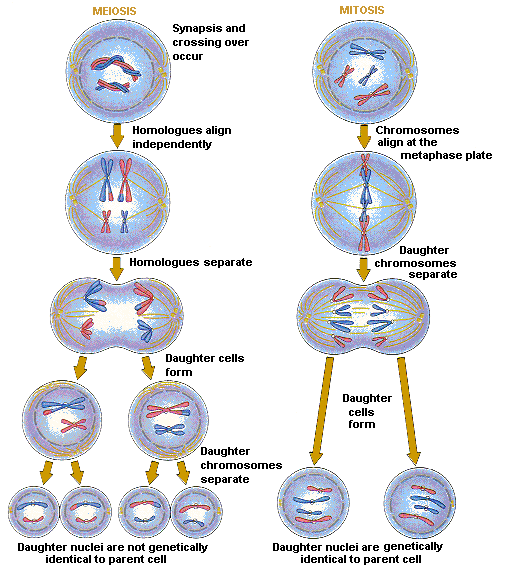
- Meiosis
- Genetic variation
- Recombination of homologous chromosomes
- Crossing over
- Independent segregation of homologous chromosomes
- Order in which chromosomes line up along side their homologous pair
- Recombination of homologous chromosomes
- Mutations
- 1 in a billion bases replicated is a mistake
- These mutations can be passed on but not every offspring will have them
- 1 in a billion bases replicated is a mistake
- Meiosis I
- First division
- Meiosis II
- second division
- Genetic variation
- Mitosis
- Interphase
- S
- DNA replicated
- G1
- period of cell growth
- G2
- 2nd period of cell growth
- S
- Prophase
- Chromosomes condense
- nuclear envelope disinigrates
- Metaphase
- chromosomes align at the equator
- Anaphase
- Chromosomes pulled apart by spindle fibres
- Telophase
- Nuclei separate
- Daughter nuclei are genetically identical
- Interphase
- Meiosis
Digestion
- Enzymes
- Carnohydrases
- Starch to maltose
- Amalyse
- Salivary and pancreatic
- Maltose to glucose
- Maltase
- Hydrolysis
- Hydrolysis
- Breaks glycosidic bond
- Amalyse
- Starch to maltose
- Lipases
- Triglycerides
- Lipase
- Monoglycerides
- Fatty acids
- Glycerol
- Triglycerides
- Proteases
- Endopeptidases
- Exopeptidases
- Dipeptidases
- Carnohydrases
- Absorption
- Carbohydrates
- Lipids
- Proteins
- Adaptations of small intestine
- Villi and microvilli
- Increase surface are
- Muscle tissue
- Remain in contact with food
- Blood flow
- Conc. gradient
- single cell
- Short diffusion pathway
- Villi and microvilli
- Enzymes
Water
- Dipolar
- Hydrogen bonds form between oxygen and water
- Of different water molecules
- Hydrogen bonds form between oxygen and water
- High specific heat capacity
- Hydrogen bonds
- more energy required to break these
- Boiling point increases
- more energy required to break these
- Hydrogen bonds
- Large latent heat of evaporation
- Lot energy require to evaporate 1 gram of water
- Why sweat is an effective way of cooling in animals
- Lot energy require to evaporate 1 gram of water
- Strong cohesion
- Tendency of water molecules to stick together
- Surface tension
- Allows water to be pulled up tubes
- xylem in plants
- Allows water to be pulled up tubes
- Surface tension
- Tendency of water molecules to stick together
- The role of inorganic ions
- H+
- Determining pH
- Function of enzymes
- Determining pH
- PO3+
- ATP
- storing energy
- DNA
- Structural role
- ATP
- Fe 2+/3+
- Haemoglobin
- Transport of oxygen
- Haemoglobin
- Na+
- Transport of glucose and amino acids
- Na/K pump
- Transport of glucose and amino acids
- H+
- Dipolar
Bilder und Dateien der Mindmap




Informationen
- Beschreibung
- Biology AS mind map
- Erstellt von
- Gelöschter Nutzer · Mär 2017
- Aktualisiert
- 12 Mär 2017
- Aufrufe
- 19
- Tags
- Verlauf
-
- Erstellt von Holly Bamford · 21 Sep 2015
- Kopiert von yasmeen khalifa · 12 Mär 2017
- Bewertung