
Karteikarten
Anti-epileptics
Karten in diesem Stapel (183)
- 1What are the first generation anti-epileptic drugs?Carbamazepine
Phenytoin
Phenobarbital
Ethosuximide
Valproic acid
Clonazepam - 2What are the second generation anti-epileptic drugs?Oxcarbazepine
Gabapentin
Pregabalin
Lamotrigine
Levetiracetam
Topiramate
Felbamate - 3Is the following drug a first or second generation anti-epileptic? CarbamazepineCarbamazepine: First
- 4Is the following drug a first or second generation anti-epileptic? PhenytoinPhenytoin: First
- 5Is the following drug a first or second generation anti-epileptic? PhenobarbitalPhenobarbital: First
- 6Is the following drug a first or second generation anti-epileptic? EthosuximideEthosuximide: First
- 7Is the following drug a first or second generation anti-epileptic? Valproic acidValproic acid: First
- 8Is the following drug a first or second generation anti-epileptic? ClonazepamClonazepam: First
- 9Is the following drug a first or second generation anti-epileptic? OxcarbazepineOxcarbazepine: Second
- 10Is the following drug a first or second generation anti-epileptic? GabapentinGabapentin: Second
- 11Is the following drug a first or second generation anti-epileptic? PregabalinPregabalin: Second
- 12Is the following drug a first or second generation anti-epileptic? LamotrigineLamotrigine: Second
- 13Is the following drug a first or second generation anti-epileptic? LevetiracetamLevetiracetam: Second
- 14Is the following drug a first or second generation anti-epileptic? TopiramateTopiramate: Second
- 15Is the following drug a first or second generation anti-epileptic? FelbamateFelbamate: Second
- 16Non-pharmacological therapy for epilepsy includes what?surgery, vagus nerve stimulation, deep
brain stimulation, diets - 17True or False Pharmacological treatment can control but not cure epilepsy.True
- 18True or False Status epilepticus is a medical emergency.True
- 19True or False Focal (partial) seizure initiates in a specific site.True
- 20What type of seizure is described below? minimal spread within brain; often clonic jerking, no diminished awareness, 20-60 sec durationSimple - Focal seizure
- 21What type of seizure is described below? localized onset but discharge spreads; alteration of consciousness (but not unconscious), automatisms (integrated motor behavior, e.g. lip smacking, button picking)Complex - Focal seizure
- 22What type of seizure is described below? focal seizure precedes a generalized tonic-clonic seizureSecondarily generalized - Focal seizure
- 23What type of seizure is described below? They start with a tingling in the right thumb. Then the thumb starts jerking. In a few seconds, the whole right hand is jerking. The jerking spreads up my arm. When it reaches the shoulder, I pass out and people tell me that my whole body starts to jerk.Focal Seizure with Secondary Generalization
- 24What is a Secondarily Generalized focal seizure?Focal seizure precedes a generalized
tonic-clonic seizure - 25What is a focal seizure?When the seizure initiates in a specific site.
- 26What is a Simple focal seizure?minimal spread within brain; often clonic jerking, no diminished awareness, 20-60 sec duration
- 27What is a Complex focal seizure?localized onset but discharge spreads; alteration of consciousness (but not unconscious), automatisms (integrated
motor behavior, e.g. lip smacking, button picking) - 28What is a generalized seizure?There is no evidence of localized onset.
- 29What type of seizure is describe below? tonic rigidity of all extremities, followed by relaxation, then by massive jerking of the body; patient is groggy/disoriented afterwards, urinary incontinence is common, 1-2 min durationTonic-clonic - Generalized
- 30What type of seizure is describe below? sudden onset, abrupt cessation; 10-45 sec duration; may occur >100 times per day; characterized by a spike and wave pattern on EEG; patient may simply stare (daydream) or show postural changes, autonomic phenomena, automatismsAbsence - Generalized
- 31What type of seizure is describe below? muscles spasm and limbs jerk; contractions and relaxations repeat rapidlyMyoclonic - Generalized
- 32What type of seizure is describe below? sudden loss of postural toneAtonic - Generalized
- 33What type of seizure is describe below? increased tone of all musclesTonic - Generalized
- 34What is a generalized Tonic seizure?Increased tone of all muscles
- 35What is a generalized Atonic seizure?Sudden loss of postural tone
- 36What is a generalized Myoclonic seizure?Muscles spasm and limbs jerk; contractions and relaxations
repeat rapidly - 37What is a generalized Absence seizure?Sudden onset, abrupt cessation; 10-45 sec duration; may occur >100 times per day; characterized by a spike and wave pattern on EEG; patient may simply stare (daydream) or show postural changes,
autonomic phenomena, automatisms - 38What is a generalized Tonic-clonic seizure?tonic rigidity of all extremities, followed by relaxation, then by massive jerking of the body; patient is groggy/disoriented afterwards, urinary incontinence is common, 1-2 min duration
- 39What type of seizure is described below? When it starts, she suddenly shrieks with this unnatural cry, then she falls, and every muscle in her body seems to be activated. Her teeth clench. Shortly after she falls, her arms and upper body start to jerk while her legs are more or less still stiff. This is the longest part of the seizure. Then it finally stops and she passes into a deep sleep.Generalized tonic-clonic seizure
- 40What type of seizure is described below?He is a 7 year old boy. He often “blanks out” for a few seconds. His teacher calls his name, but he doesn’t seem to hear her. He usually blinks a few times, and his eyes may roll up a bit. Then he is right back where he left off. Some days he has more than 50 of these spells.Generalized absence seizure
- 41What are the goals of therapy for epilepsy?Improve quality of life by:
Controlling seizures
Rarely are seizures eliminated; even occasional seizures are still a
concern for patients
Minimizing adverse effects
Usually lifelong treatment - 42What are the mechanisms of action of anti-epileptic drugs to inhibit excitability? Inhibit voltage dependent Na+ channels
Reduce the rate of Na+ channel opening; use dependent blockade
phenytoin, carbamazepine, oxcarbazepine, lamotrigine, topiramate, valproate
Inhibit glutamate receptors
NMDA – felbamate
AMPA – topiramate
Modulate glutamate release (putative)
Gabapentin, pregabalin, levetiracetam - 43What are the mechanisms of action of anti-epileptic drugs to increase inhibitory neurotransmission? Enhance GABA-A activity (positive allosteric modulation)
Phenobarbital, clonazepam, topiramate
Enhance GABA availability
Several proposed - 44What are the mechanisms of action of anti-epileptic drugs to Inhibit T-type Ca2+ channels? Neurons in thalamus are dependent on calcium channel pacemaker currents for depolarization
Depolarization of thalamic neurons activates cortical neurons
Ethosuximide, valproate - 45What is/are the mechanism(s) of action of Carbamazepine?Inhibit excitability
Inhibit voltage dependent Na+ channels
- Reduce the rate of Na+ channel opening; use dependent blockade
- At therapeutic concentrations, prolongs inactivated state of Na+ channel - 46What is/are the mechanism(s) of action of Phenytoin?Inhibit excitability
Inhibit voltage dependent Na+ channels
- At therapeutic concentrations, prolongs inactivated state of Na+ channel - 47What is/are the mechanism(s) of action of Phenobarbital?Increase inhibitory neurotransmission
Enhance GABA-A activity (positive allosteric modulation) - 48What is/are the mechanism(s) of action of Ethosuximide?Inhibit T-type Ca2+ channels
Neurons in thalamus are dependent on calcium channel pacemaker currents for depolarization
Depolarization of thalamic neurons activates cortical neurons
Limits 3Hz spike-wave - 49What is/are the mechanism(s) of action of Valproic acid?Inhibit excitability
Inhibit voltage dependent Na+ channels
Reduce the rate of Na+ channel opening; use dependent blockade
Inhibit T-type Ca2+ channels
Neurons in thalamus are dependent on calcium channel pacemaker currents for depolarization
Depolarization of thalamic neurons activates cortical neurons - 50What is/are the mechanism(s) of action of Clonazepam?Increase inhibitory neurotransmission
Enhance GABA-A activity (positive allosteric modulation) - 51What is/are the mechanism(s) of action of Oxcarbazepine?Inhibit excitability
Inhibit voltage dependent Na+ channels
Reduce the rate of Na+ channel opening; use dependent blockade - 52What is/are the mechanism(s) of action of Gabapentin?Inhibit excitability
Modulate glutamate release (putative) - 53What is/are the mechanism(s) of action of Pregabalin?Inhibit excitability
Modulate glutamate release (putative) - 54What is/are the mechanism(s) of action of Lamotrigine?Inhibit excitability
Inhibit voltage dependent Na+ channels
- Reduce the rate of Na+ channel opening; use dependent blockade
- At therapeutic concentrations, prolongs inactivated state of Na+ channel - 55What is/are the mechanism(s) of action of Levetiracetam?Mechanism of Action: Under investigation
Synaptic Vesicle Glycoprotein 2A (SV2A)
Likely modifies release of Glu / GABAA - 56What is/are the mechanism(s) of action of Topiramate?Increase inhibitory neurotransmission
Enhance GABA-A activity (positive allosteric modulation)
Inhibit excitability
Inhibit voltage dependent Na+ channels
- Reduce the rate of Na+ channel opening; use dependent blockade
Inhibit Excitability
Inhibit glutamate receptors
- AMPA – topiramate - 57What is/are the mechanism(s) of action of Felbamate?Inhibit Excitability
Inhibit glutamate receptors
NMDA – felbamate
Mechanism of Action: not fully characterized
Use-dependent block of postsynaptic NMDA - 58Neurons in thalamus are dependent on what for depolarization?Neurons in thalamus are dependent on calcium channel pacemaker currents for depolarization
- 59Depolarization of thalamic neurons activates what?Cortical neurons
- 60The following is a drug of choice for which type(s) of epileptic seizure? CarbamazepineFocal (Partial)
- 61The following is a drug of choice for which type(s) of epileptic seizure? LamotrigineFocal (Partial) and Primary GTC
- 62The following is a drug of choice for which type(s) of epileptic seizure? OxcarbazepineFocal (Partial)
- 63The following is a drug of choice for which type(s) of epileptic seizure? LevetiracetamFocal (Partial) Approved as adjunctive therapy only
and Primary GTC - 64The following is a drug of choice for which type(s) of epileptic seizure? ValproatePrimary GTC and Absence
- 65The following is a drug of choice for which type(s) of epileptic seizure? EthosuximideAbsence
- 66What are the drugs of choice for Focal (Partial) seizures?Carbamazepine
Lamotrigine
Oxcarbazepine
Levetiracetam*
* Approved as adjunctive therapy only - 67What are the drugs of choice for Primary GTC seizures?Valproate
Lamotrigine
Levetiracetam - 68What are the drugs of choice for Absence seizures?Ethosuximide
Valproate - 69What are the alternative drugs for Absence seizures?Clonazepam
Levetiracetam - 70What are the alternative drugs for Primary GTC seizures?Valproate
Lamotrigine
Levetiracetam - 71What are the alternative drugs for Focal (Partial) seizures?Valproate
Phenytoin
Topiramate
Gabapentin*
Pregabalin* - 72The following is an alternative drug for which type(s) of epileptic seizure? ValproateFocal (Partial)
- 73The following is an alternative drug for which type(s) of epileptic seizure? PhenytoinFocal (Partial) and Primary GTC
- 74The following is an alternative drug for which type(s) of epileptic seizure? TopiramateFocal (Partial) and Primary GTC
- 75The following is an alternative drug for which type(s) of epileptic seizure? GabapentinFocal (Partial)
Approved as adjunctive therapy only - 76The following is an alternative drug for which type(s) of epileptic seizure? PregabalinFocal (Partial)
Approved as adjunctive therapy only - 77The following is an alternative drug for which type(s) of epileptic seizure? ClonazepamAbsence
- 78The following is an alternative drug for which type(s) of epileptic seizure? LevetiracetamAbsence
- 79For which type of epileptic seizures is the following a drug of choice for? Alternative drug for? CarbamazepineDrug of Choice: Focal (Partial)
- 80For which type of epileptic seizures is the following a drug of choice for? Alternative drug for? LamotrigineDrug of Choice:
Focal (Partial) and Primary GTC - 81For which type of epileptic seizures is the following a drug of choice for? Alternative drug for? OxcarbazepineDrug of Choice: Focal (Partial)
- 82For which type of epileptic seizures is the following a drug of choice for? Alternative drug for? LevetiracetamDrug of Choice: Focal/Partial (Approved as adjunctive therapy only) and Primary GTC
Alternative: Absence - 83For which type of epileptic seizures is the following a drug of choice for? Alternative drug for? ValproateDrug of Choice: Primary GTC and Absence
Alternative: Focal (Partial) - 84For which type of epileptic seizures is the following a drug of choice for? Alternative drug for? EthosuximideDrug of Choice: Absence
- 85For which type of epileptic seizures is the following a drug of choice for? Alternative drug for? PhenytoinAlternative: Focal (Partial) and Primary GTC
- 86For which type of epileptic seizures is the following a drug of choice for? Alternative drug for? TopiramateAlternative: Focal (Partial) and Primary GTC
- 87For which type of epileptic seizures is the following a drug of choice for? Alternative drug for? GabapentinAlternative: Focal (Partial)
Approved as adjunctive therapy only. - 88For which type of epileptic seizures is the following a drug of choice for? Alternative drug for? PregabalinAlternative: Focal (Partial)
Approved as adjunctive therapy only. - 89For which type of epileptic seizures is the following a drug of choice for? Alternative drug for? ClonazepamAlternative: Absence
- 90Which type of anti-epileptic is described below? Oldest non-sedating, anti-seizure drug Effective but no longer drug of choice because of pharmacokinetics, adverse effects and drug interactionsPhenytoin
- 91The following are the Pharmacokinetics for which drug? Many PO formulations available – IR / ER formulations 90% _____ in vascular space is bound to albumin At steady-state, 10% ______ in vascular space, 90% tissue Takes up to 6 weeks to achieve steady state, depending ondosePhenytoin
- 92What are the Pharmacokinetics of Phenytoin? Many PO formulations available – IR / ER formulations
90% of phenytoin in vascular space is bound to albumin
At steady-state, 10% phenytoin in vascular space, 90% tissue
Takes up to 6 weeks to achieve steady state, depending on dose
Metabolism: dose-dependent capacity-limited pharmacokinetics (zero order metabolism)
MUST MONITOR SERUM LEVELS
10-20 mg/L is common therapeutic range - 93The following is true for what drug? Metabolism: dose-dependent capacity-limited pharmacokinetics (zero order metabolism) MUST MONITOR SERUM LEVELS 10-20 mg/L is common therapeutic rangePhenytoin
- 94Why are there dramatic increases in plasma phenytoin with small increases in dose?Caused by dose-dependent
metabolism - 95What are the dose related adverse effects (seen in CNS) of Phenytoin?List in order of Increasing serum concentration
Nystagmus – common at therapeutic levels
Dizziness, sedation – seen with IV loading
Diplopia, ataxia – require dose reduction
Involuntary movements – seen at high doses
May interfere with learning - 96The following are the dose related adverse effects (seen in CNS) of which drug? Nystagmus – common at therapeutic levels Dizziness, sedation – seen with IV loading Diplopia, ataxia – require dose reduction Involuntary movements – seen at high doses May interfere with learningPhenytoin
- 97What are the chronic therapy related adverse effects of Phenytoin? Gingival hyperplasia (40%)
Acne / Hirsuitism / Coarsening of facial features
Folate and Vitamin D deficiencies (megaloblastic anemia, osteomalacia)
Vitamin D and Calcium supplementation appropriate
No routine supplementation with folate - can affect phenytoin levels - 98The following are the chronic therapy related adverse effects of which drug? Gingival hyperplasia (40%) Acne / Hirsuitism / Coarsening of facial features Folate and Vitamin D deficiencies (megaloblastic anemia, osteomalacia) Vitamin D and Calcium supplementation appropriate No routine supplementation with folate - can affect phenytoin levelsPhenytoin
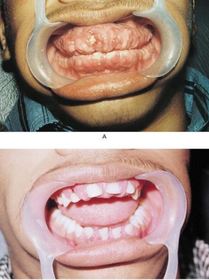
- 99What is shown here? For what drug is it a chronic therapy related adverse effect?Gingival hyperplasia - chronic therapy related adverse effect of Phenytoin (40%)
Upper – after 2 yrs of
unsupervised PHT therapy
Lower – 3 months after
removal of PHT - 100The following describes what the drug-to-drug reactions of what anti-epileptic? Significant enzyme induction CYP2B6, CYP2C19, CYP2C8, CYP2C9, CYP3A4, P-glycoprotein Warfarin: _____ can decrease anticoagulant effect Can reduce blood levels of contraceptive hormones Interactions due to plasma protein binding e.g. valproate inhibits plasma protein binding and inhibits metabolism of _______FPhenytoin
- 101What are the drug-drug interactions of Phenytoin? Significant enzyme induction
CYP2B6, CYP2C19, CYP2C8, CYP2C9, CYP3A4, P-glycoprotein
Warfarin: Phenytoin can decrease anticoagulant effect
Can reduce blood levels of contraceptive hormones
Interactions due to plasma protein binding
e.g. valproate inhibits plasma protein binding and inhibits metabolism of phenytoin - 102The following are the contraindications / precautions of what anti-epileptic? Contraindication: IV use for patients with sinus bradycardia, sinoatrial block, second- and third-degree heart block Precaution: black box warning on rate of IV administration (<50mg/min) Teratogenic riskPhenytoin
- 103What are the contraindications / precautions of Phenytoin? Contraindication: IV use for patients with sinus bradycardia, sinoatrial block,
second- and third-degree heart block
Precaution: black box warning on rate of IV administration (<50mg/min)
Teratogenic risk - 104The following are the Pharmacokinetics of which anti-epileptic? Induces its own metabolism; t1/2 ~36 hr ~20 hr Induces metabolism of phenytoin, ethosuximide, valproate, clonazepam Drug level affected by CYP3A4 inducers (phenytoin, phenobarbital), inhibitors Reduces blood levels of contraceptive hormonesCarbamazepine
- 105What are the Pharmacokinetics of Carbamazepine? Induces its own metabolism; t1/2 ~36 hr ~20 hr
Induces metabolism of phenytoin, ethosuximide, valproate, clonazepam
Drug level affected by CYP3A4 inducers (phenytoin, phenobarbital), inhibitors
Reduces blood levels of contraceptive hormones - 106The following are the Dose related adverse effects of which anti-epileptic? CNS • Transient diplopia; ataxia • Dizziness, drowsiness, nausea, anorexia - common upon initiation; tolerance develops Hyponatremia, common but mildCarbamazepine
- 107What are the dose related adverse effects of Carbamazepine? CNS
• Transient diplopia; ataxia
• Dizziness, drowsiness, nausea, anorexia
- common upon initiation; tolerance develops
Hyponatremia, common but mild - 108The following are idiosyncratic adverse reactions to which anti-epileptic? • Rare serious blood dyscrasias • Skin rash (5%) • Stevens-Johnson syndrome (1:10,000) - HLA-B*1502Carbamazepine
- 109What are the idiosyncratic adverse reactions to Carbamazepine?• Rare serious blood dyscrasias
• Skin rash (5%)
• Stevens-Johnson syndrome (1:10,000)
- HLA-B*1502 - 110The following are the contraindications/precautions of which anti-epileptic? HLA-B*1502, common in Asians, linked to 10X increased incidence of Stevens-Johnson syndrome Recommended to test Asians for this allele prior to initiating carbamazepine therapy Teratogenic riskCarbamazepine
- 111What are the contraindications/precautions of Carbamazepine?HLA-B*1502, common in Asians, linked to 10X increased incidence of Stevens-Johnson syndrome
Recommended to test Asians for this allele prior to initiating carbamazepine therapy
Teratogenic risk - 112True or False Valproate is a drug of choice for women of childbearing potential.False
Valproate is no longer a drug of 1st choice for women of childbearing potential - 113Which anti-epileptic is described below? No longer a drug of 1st choice for women of childbearing potential Effective and well tolerated so used for many seizure types Also used for migraine prophylaxis and bipolar disorderValproate
- 114The following are the Pharmacokinetics of which anti-epileptic? 90% protein bound – can be significant Many enzymes responsible for valproate metabolism - (2A6, 2B6, 2C9, UGT, etc.)Valproate
- 115What are the Pharmacokinetics of Valproate? 90% protein bound – can be significant
Many enzymes responsible for valproate metabolism
- (2A6, 2B6, 2C9, UGT, etc.) - 116The following are the drug-drug interactions for which anti-epileptic? Fewer drug interactions than phenytoin or carbamazepine Enzyme inducers can increase valproate clearance Can increase plasma levels of carbamazepine metabolite, phenytoin, phenobarbital, ethosuximide, lamotrigine and tricyclic antidepressantsValproate
- 117What are the drug-drug interactions of Valproate? Fewer drug interactions than phenytoin or carbamazepine
Enzyme inducers can increase valproate clearance
Can increase plasma levels of carbamazepine metabolite,
phenytoin, phenobarbital, ethosuximide, lamotrigine and tricyclic antidepressants - 118The following are the Dose related adverse effects of which anti-epileptic? • GI discomfort (tolerance) • CNS: dizziness /tremor • Weight gain / alopecia • Thrombocytopenia • Monitor for liver function • Hyperammonemia VPA inhibits urea synthesis and can increase renal production of ammonia. Hyperammonemia usually asymptomatic; but may alter mental statusValproate
- 119What are the Dose related adverse effects of Valproate?• GI discomfort (tolerance)
• CNS: dizziness /tremor
• Weight gain / alopecia
• Thrombocytopenia
• Monitor for liver function
• Hyperammonemia
VPA inhibits urea synthesis and can increase renal production of ammonia.
Hyperammonemia usually asymptomatic; but may alter mental status - 120The following are idiosyncratic adverse reactions to which anti-epileptic? • Fulminant hepatitis • Acute pancreatitis • Stevens-Johnson syndrome (rare) • Menstrual abnormalities / polycystic ovariesValproate
- 121What are the idiosyncratic adverse reactions to Valproate?• Fulminant hepatitis
• Acute pancreatitis
• Stevens-Johnson syndrome (rare)
• Menstrual abnormalities / polycystic
ovaries
Teratogenic risk
Lamotrigine often used instead
Not used in children <3 yrs
because of risk of liver failure - 122The following are adverse effects of which anti-epileptic? Nausea, vomiting, hiccups, behavioral changesEthosuximide
- 123What are the adverse effects of Ethosuximide?Nausea, vomiting, hiccups, behavioral changes
- 124What are the drug-drug interactions of Ethosuximide?Metabolism inhibited by valproate
- 125The following are the drug-drug interactions of what anti-epileptic? Metabolism inhibited by valproateEthosuximide
- 126Which type of anti-epileptic is described below? Used in children more than adults Febrile seizures Infrequently used for seizures due to adverse effects, and risksPhenobarbital
- 127True or False Phenobarbital is rarely used in children.False
It is used in children more than adults. - 128The following are the adverse reactions of what anti-epileptic? Sedation, tolerance, dependence, respiratory depressionPhenobarbital
- 129What are the adverse reactions of Phenobarbital?Sedation, tolerance, dependence, respiratory depression
- 130The following are the drug-drug interactions of which anti-epileptic? Significant enzyme induction - CYP1A2, CYP2A6, CYP2B6, CYP2C8, CYP2C9, CYP3A4 Reduces blood levels of contraceptive hormonesPhenobarbital
- 131What are the drug-drug interactions of Phenobarbital? Significant enzyme induction
- CYP1A2, CYP2A6, CYP2B6, CYP2C8, CYP2C9, CYP3A4
Reduces blood levels of contraceptive hormones - 132The following are the contraindications / precautions of which anti-epileptic? Do not use in patients with history of sedative addiction Risk of dependence is high Teratogenic riskPhenobarbital
- 133What are the contraindications / precautions of Phenobarbital? Do not use in patients with history of sedative addiction
Risk of dependence is high
Teratogenic risk - 134The following are the adverse effects of which anti-epileptic? Sedation, tolerance, dependenceClonazepam
- 135What are the adverse effects of Clonazepam?Sedation, tolerance, dependence
- 136The following are the contraindications / precautions of which anti-epileptic? Caution in patients with history of sedative dependenceClonazepam
- 137What are the contraindications / precautions of Clonazepam?Caution in patients with history of sedative dependence
- 138The following are the drug-drug interactions of which anti-epileptic? Metabolized by CYP3A4Clonazepam
- 139What are the drug-drug interactions of Clonazepam?Metabolized by CYP3A4
- 140What anti-epileptic is described below? Adjunctive therapy in children with focal seizures and generalized tonic clonic seizures Monotherapy in >16 yr old for focal seizures Also used in absence Also used in bipolar disorderLamotrigine
- 141What are the uses of Lamotrigine? Adjunctive therapy in children with focal seizures and generalized tonic clonic seizures
Monotherapy in >16 yr old for focal seizures
Also used in absence
Also used in bipolar disorder - 142The following are the Pharmacokinetics for which anti-epileptic? Does not induce or inhibit CYP enzymes Metabolism induced by carbamazepine, phenobarbital, phenytoin Oral contraceptives can reduce ______ levels Metabolism inhibited by valproate ***Starting dosage and escalation schedule dependent upon concomitant therapyLamotrigine
- 143What are the Pharmacokinetics for Lamotrigine? Does not induce or inhibit CYP enzymes
Metabolism induced by carbamazepine, phenobarbital, phenytoin
Oral contraceptives can reduce ______ levels
Metabolism inhibited by valproate
***Starting dosage and escalation schedule dependent upon concomitant therapy - 144The following are the adverse effects of which anti-epileptic? Dizziness, headache, nausea, insomnia Skin rash (including Stevens-Johnson) More common with higher starting dose, rapid escalation and concomitant valproate therapy; Discontinue if rash occurs Titration Schedule on new start (go slow)Lamotrigine
- 145What are the adverse effects of Lamotrigine? Dizziness, headache, nausea, insomnia
Skin rash (including Stevens-Johnson)
More common with higher starting dose, rapid escalation and concomitant
valproate therapy;
Discontinue if rash occurs
Titration Schedule on new start (go slow) - 146To which anti-epileptic does the following statement apply? Fewer cognitive adverse effects vs. other commonly-used antiepileptic drugs (controversial)Lamotrigine
- 147Which anti-epileptic is described below? Focal and generalized tonic clonic seizures Also used for migraine prophylaxis, weight managementTopiramate
- 148What are the uses of Topiramate? Focal and generalized tonic clonic seizures
Also used for migraine prophylaxis, weight management - 149The following are the adverse effects of which anti-epileptic? Somnolence, nervousness, confusion, difficulty with speech, impaired concentration and memory Mild parasthesias Reduces blood levels of contraceptive hormonesTopiramate
- 150What are the adverse effects of Topiramate? Somnolence, nervousness, confusion, difficulty with speech, impaired concentration and memory
Mild parasthesias
Reduces blood levels of contraceptive hormones - 151For which anti-epileptic does the following statement apply? Weight loss common (80% patients; 3-4% bodyweight loss)Topiramate
- 152Which anti-epileptic is described by the following? Focal seizures in adults (not approved for generalized tonic-clonic) Off label use for bipolar disorderOxcarbazepine
- 153What are the uses of Oxcarbazepine? Focal seizures in adults (not approved for
generalized tonic-clonic)
Off label use for bipolar disorder - 154Which anti-epileptic is described below? Chemically similar to carbamazepine; possibly useful in patients who fail other therapies due to poor seizure control or adverse effects Adverse effects similar to carbamazepine; higher incidence of hyponatremia; do not use in patients with severe hypersensitivity to carbamazepine Less enzyme-inducing activity than carbamazepine Affected by CYP3A4 inducersOxcarbazepine
- 155True or False Oxcarbazepine is possibly useful in patients who fail other therapies due to poor seizure control or adverse effects.True
- 156True or False Oxcarbazepine should be used for patients with severe hypersensitivity to carbamazepineFalse
Adverse effects similar to carbamazepine; higher incidence of
hyponatremia; do not use in patients with severe hypersensitivity to carbamazepine - 157What are the uses of Gabapentin? Adjunct for Focal Seizures in adults and
children
Modest efficacy
Also used for neuropathic pain - 158What are the uses of Pregabalin? Adjunct for Focal Seizures in adults
Modest efficacy
Also used for neuropathic pain - 159The following describes which anti-epileptic? Adjunct for Focal Seizures in adults Modest efficacy Also used for neuropathic painPregabalin
- 160The following describes which anti-epileptic? Adjunct for Focal Seizures in adults and children Modest efficacy Also used for neuropathic painGabapentin
- 161The following are the pharmacokinetics for which drug? 100% renal eliminationGabapentin and Pregabalin
- 162What are the pharmacokinetics for Gabapentin?100% renal elimination
- 163What are the pharmacokinetics for Pregabalin?100% renal elimination
- 164The following are the adverse effects for which anti-epileptic? Mild drowsiness, weight gain (modest), lower extremity edemaGabapentin, Pregabalin
- 165The following are the drug-drug interactions of which anti-epileptic? No significant drug interactionsGabapentin and Pregabalin
- 166What are the uses of Levetiracetam? Adjunct for Focal and generalized tonic-clonic seizures
Commonly used in monotherapy as well - 167What are the drug-drug interactions of Levetiracetam?No clinically significant drug interactions
Not an inhibitor or inducer of CYP enzymes - 168The following are the adverse effects of which anti-epileptic? CNS disturbances (irritability, depression, aggression, hallucinations) more common than with other anti-epileptic drugsLevetiracetam
- 169What are the adverse effects of Levetiracetam?CNS disturbances (irritability, depression, aggression, hallucinations) more common
than with other anti-epileptic drugs - 170The following are the Pharmacokinetics of which anti-epileptic? Renal elimination (>70%)Levetiracetam
- 171What are the Pharmacokinetics of Levetiracetam?Renal elimination (>70%)
- 172The following describes which anti-epileptic? Indication: Focal and generalized tonic-clonic seizures Reserved for failure of alternate anti-epileptic drugs due to severe idiosyncratic reactionsFelbamate
- 173What are the uses of Felbamate? Indication: Focal and generalized tonic-clonic seizures
Reserved for failure of alternate anti-epileptic drugs due to
severe idiosyncratic reactions - 174The following are the adverse reactions of which anti-epileptic? Aplastic anemia – 1:5,000 incidence; occurs within 1 year of initiation; 30% mortality Hepatic failure – 1:30,000 incidence; occurs within 1 year of initiation; 50% mortalityFelbamate
- 175What are the adverse reactions to Felbamate? Aplastic anemia – 1:5,000 incidence; occurs within 1 year of
initiation; 30% mortality
Hepatic failure – 1:30,000 incidence; occurs within 1 year of
initiation; 50% mortality - 176What is described below? Significant interest in the epilepsy community Anecdotal reports of efficacy; safety and efficacy data are limited Small trials with oral _______ indicate short-term use is safe but study design prevents conclusions on efficacy Concerns with negative effects on brain development with long term ________ More studies are currently underwayCannabinoids – fyi (not testable)
- 177What should be done if monotherapy fails?Choose alternate monotherapy agent and repeat process
- 178What should be done if monotherapy fails with several drugs?Try adjuvant therapy
Concern is management of adverse effects of two drugs - 179Which AEDs reduce blood levels of contraceptive hormone?Carbamazepine, phenobarbital, phenytoin, felbamate, lamotrigine, oxcarbazepine,
topiramate - 180True or False Status epilepticus is a medical emergency; IV lorazepam is used to stop the seizures. IV phenytoin is then initiated for longer term controlTrue
- 181What is done for status epilepticus?Status epilepticus is a medical emergency; IV lorazepam is used to stop the seizures. IV phenytoin is then initiated for longer
term control - 182True or False Antiepileptics are gradually increased to therapeutic concentrations to minimize adverse effects and are withdrawn gradually to reduce the risk of inducing seizuresTrue
- 183True or False Blood level monitoring is often required to maintain therapeutic levels.True
Especially for drugs that affect drug metabolizing enzymes
Informationen
- Beschreibung
- Der Nutzer hat seine Fachbereichs-Information gelöscht. Karteikarten am Anti-epileptics, erstellt von Gelöschter Nutzer am 22/03/2017.
- Erstellt von
- Gelöschter Nutzer · Mär 2017
- Aktualisiert
- 22 Mär 2017
- Aufrufe
- 54
- Verlauf
-
- Erstellt von Victoria Wright · 19 Mär 2017
- Kopiert von Victoria Wright · 22 Mär 2017
- Bewertung