
GCSE Maths: Understanding Pythagoras' Theorem
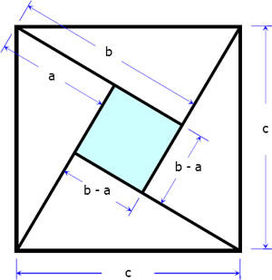
Folien in diesem Satz (4)
-
Understanding Pythagoras' Theorem
- Pythagoras was a famous Greek mathematician and philosopher, and his theorem - known to us simply as "Pythagoras' Theorem" - is his most famous contribution to mathematics.
- In essence, the theorem concerns triangles containing a right angle (where two perpendicular lines intersect to create an angle of 90 degrees).
- Over the next few slides, we'll deal with Pythagoras' Theorem in greater detail, looking at what it states, how it is represented as an equation, and how it may be applied to find a missing value.
- To complete the slide set, there will also be related quizzes and flashcards to further consolidate your understanding of this hugely important mathematical relation.
-
- How Do I Use it?
- The Pythagoras theorem deals with the lengths of the sides of a right triangle. It is used any time we have a right triangle,
- know the length of two sides, and want to find the third side.
- It is often written in the form of the equation:
- a2 + b2 = c2
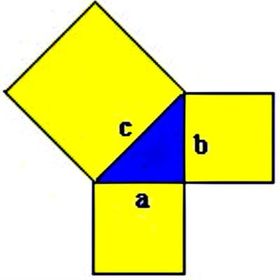
- The theorem states that:
- The sum of the squares of two legs of a right triangle ('a' and 'b' in the triangle shown opposite) is equal to the square of the length of the hypotenuse ('c').
-
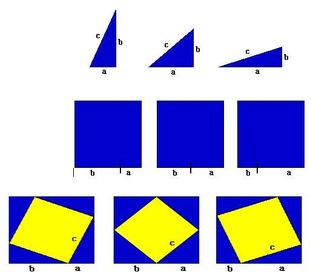
- Let's start by looking at a square whose side length is (a+b).
- Inside the blue square let's construct a yellow square of
- side length c. Its corners must touch the sides of the blue square.
- The remainder of the space will consist of four blue congruent abc
- triangles. Here it is for our example squares:
- In each case, the area of the larger blue square is equal to the sum of the areas of the blue triangles and the area of the yellow square. Since the area of a square is (sidelength)2 and the area of a triangle is 1/2(base)(height), we can write the equation:
- (a+b)2 = c2 + 4[(1/2)ab]
- Simplifying:
- (a+b)2 = c2 + 4[(1/2)ab]
- (a+b)(a+b) = c2 + 2ab
- a2 + 2ab + b2 = c2 + 2ab
- Now subtract the 2ab from both sides of the equation, and we have the Pythagorean theorem:
- a2 + b2 = c2
- Bildunterschrift: Pythagoras theorem
Informationen
- Beschreibung
- GCSE Maths: Pythagoras theorem - info, visuals, quizzes and applications to help you get to grips with one of the most famous theorems in all of mathematics.
- Erstellt von
- Gelöschter Nutzer · Apr 2017
- Aktualisiert
- 3 Apr 2017
- Aufrufe
- 29
- Tags
- Verlauf
-
- Erstellt von Landon Valencia · 9 Sep 2015
- Kopiert von Micheal Heffernan · 9 Sep 2015
- Kopiert von daniella noel · 3 Apr 2017
- Bewertung