
Notizen
Global History Regents Review Notes (Scientific Revolution)
Inhalt der Notizen (1)
Seite 1
Scientific Method
Dependent on observation and experimentation
State the problem
Gather information on the problem
Form a hypothesis
Experiment to test the hypothesis
Record and analyze data
State conclusion
Repeat steps above
Copernicus (Polish)
1543 - published On the Revolutions of the Heavenly Spheres
Propose
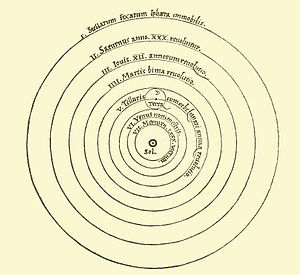
heliocentric (sun-centered) model of universe
Sun at center, 7 planets revolve around sun
Many people rejected his theories because they contradicted previous thinking
Knowledge
and religious teaching based on classical thinkers
Galileo (Italian)
Invented first telescope
Observed four moons around Jupiter
Saw exactly how earth moved around the sun
People attacked his observations because they contradicted views about the world
Condemned by the Church because his finds challenged Christian teachers that heavens were fixed, unmoving and perfect
1633 - tried before the Inquisition
Ended up saying that the earth stood motionless in the center to avoid death
Bacon (English)
Rejected Aristotle's scientific assumption
Challenge scholarly traditions of the medieval universities
Stress
experimentation and observation
Newton (English)
At 24, he discovered the theory to explain why planets moved
Discovered the idea of gravity
1887 - published Mathematical Principles of Natural Philosophy, which explains the law of gravity
Helped developed Calculus

Scientific REvolution
Informationen
- Beschreibung
- Notes on the Scientific Revolution for the Global History Regents
- Erstellt von
- Jen Molte · Mai 2014
- Aktualisiert
- 21 Nov 2016
- Aufrufe
- 279
- Tags
- Bewertung