
Karteikarten
270- Fetal Circulation & Fetal-Postnatal Derivatives

Karten in diesem Stapel (48)
- 1Blood in umbilical vein has a PO2 of about what?Blood in umbilical vein has a Po2 of
≈ 30 mm Hg - 2Blood in umbilical vein is ≈ 80% saturated with what?O2
- 3What are the 3 important shunts in fetal circulation?Ductus venosus
Ductus arteriosus
Foramen ovale - 4Blood entering fetus through the umbilical vein is conducted via the what?Ductus Venosus
- 5Blood entering fetus through the umbilical vein is conducted via the ductus venosus into the what?IVC
- 6Blood entering fetus through the umbilical vein is conducted via the ductus venosus into the IVC, bypassing what?Bypassing hepatic
circulation. - 7Most of the highly Oxygenated blood reaching the heart via the IVC is directed through the what?Foramen ovale
- 8Most of what blood reaching the heart via the IVC is directed through the Foramen Ovale?Highly Oxygenated Blood
- 9Most of the highly Oxygenated blood reaching the heart via the IVC is directed through the foramen Ovale and pumped into the what?Aorta
to supply the head and body - 10Most of the highly Oxygenated blood reaching the heart via the IVC is directed through the foramen Ovale and pumped into the aorta to supply what?The head and body.
- 11Deoxygenated blood from the SVC passes through the RA, to the RV, to the main pulmonary artery, to the Ductus arteriosus, to the what?Descending aorta
- 12Deoxygenated blood from the SVC passes through the what (?), to the RV, to the main pulmonary artery, to the Ductus arteriosus, to the Descending aorta?Deoxygenated blood from the SVC
passes through the RA, to the RV, to the main pulmonary artery, to the Ductus arteriosus, to the descending aorta. - 13What type of blood from the SVC passes through the RA, to the RV, to the main pulmonary artery, to the Ductus arteriosus, to the descending aorta?Deoxygenated Blood
- 14Deoxygenated blood from where passes through the RA, to the RV, to the main pulmonary artery, to the Ductus arteriosus, to the descending aorta?SVC
- 15Shunt is due to what?Deoxygenated blood from SVC passes through the RA, to the RV, to the main pulmonary artery, to the Ductus arteriosus, to the descending aorta; shunt is due to high fetal pulmonary artery resistance (due
partly to low O2 tension). - 16Deoxygenated blood from SVC passes through what?Deoxygenated blood from SVC passes through the RA, to the RV, to the main pulmonary artery, to the Ductus arteriosus, to the descending aorta; shunt is due to high fetal pulmonary artery resistance (due
partly to low O2 tension). - 17At birth, infant takes a breath. What does this lead to?Decreased resistance in pulmonary vasculature leads to increased left atrial pressure vs right atrial pressure; foramen ovale closes (now called fossa ovalis); increase in O2 (from respiration) and decrease in prostaglandins (from placental separation) leads to closure of ductus arteriosus.
- 18At birth, infant takes a breath. What leads to increased left atrial pressure vs right atrial pressure?Decreased resistance in pulmonary vasculature leads to increased left atrial pressure vs right atrial pressure.
- 19At birth, infant takes a breath. What does Decreased resistance in pulmonary vasculature leads to?Increased left atrial pressure vs right atrial pressure
- 20At birth, infant takes a breath. What happens to the foramen ovale?Foramen ovale closes (now called fossa ovalis).
- 21At birth, infant takes a breath. What happens to O2?Increase in O2 from respiration
- 22At birth, infant takes a breath. What happens to prostaglandins?Decrease in prostaglandins (from placental separation)
- 23At birth, infant takes a breath. Decrease in prostaglandins leads to what?Closure of ductus arteriosus.
- 24What helps close PDA? Leading to what?Indomethacin helps close PDA leads to ligamentum arteriosum (remnant of ductus arteriosus).
- 25Indomethacin helps close what?PDA leading to igamentum
arteriosum (remnant of ductus arteriosus). - 26Is the O2 in the dark red area high, moderate, low, or very low?High
- 27Is the O2 in the light pink area high, moderate, low, or very low?Moderate
- 28Is the O2 in the light blue area high, moderate, low, or very low?Low
- 29Is the O2 in the dark blue area high, moderate, low, or very low?Very low
- 30What is 3 pointing at?Ductus arteriosus
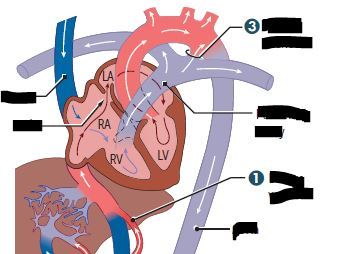
- 31What is 1 pointing at?Ductus venosus
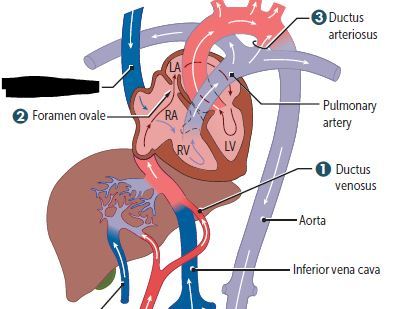
- 32—Superior vena cava
- 33—Pulmonary
artery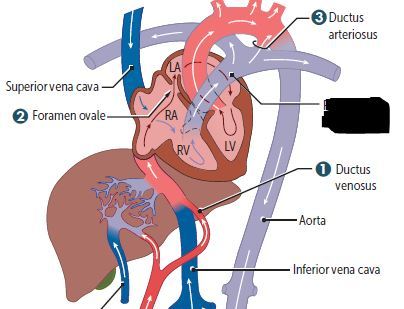
- 34—Foramen ovale
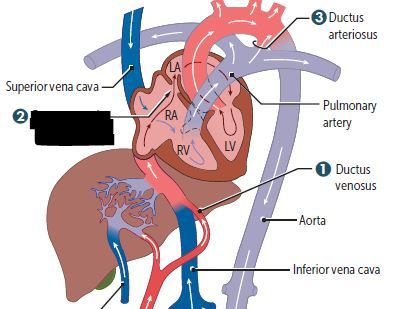
- 35—Aorta
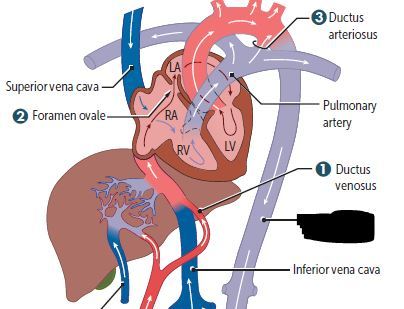
- 36—Inferior vena cava
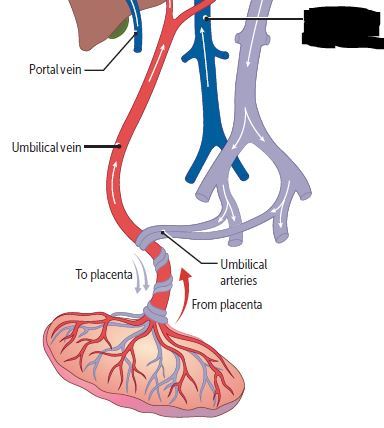
- 37—Umbilical vein
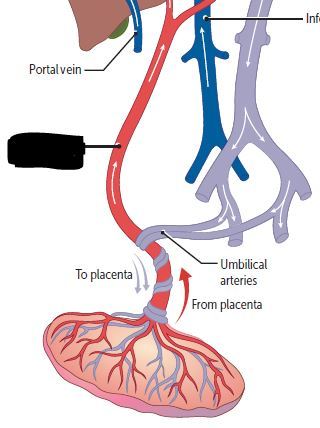
- 38—Umbilical arteries
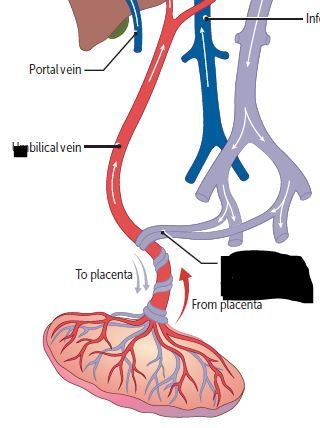
- 39—Portal vein
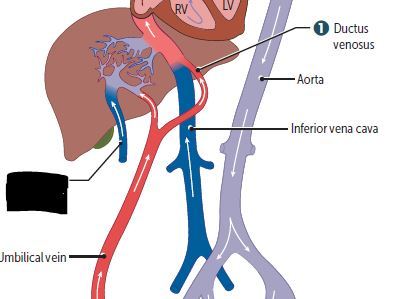
- 40What keep PDA open?Prostaglandins E1 and E2 kEEp PDA open.
- 41Fetal-postnatal derivatives AllaNtois ---> urachusMediaN umbilical ligament
- 42What is Urachus part of?Urachus is part of allantoic duct between
bladder and umbilicus. - 43Fetal-postnatal derivatives Ductus arteriosusLigamentum arteriosum
- 44Fetal-postnatal derivatives Ductus venosusLigamentum venosum
- 45Fetal-postnatal derivatives Foramen ovaleFossa ovalis
- 46Fetal-postnatal derivatives NotochordNucleus pulposus
- 47Fetal-postnatal derivatives UmbiLical arteriesMediaL umbilical ligaments
- 48Fetal-postnatal derivatives Umbilical veinLigamentum teres hepatis (round ligament)
Contained in falciform ligament.
Informationen
- Beschreibung
- Der Nutzer hat seine Fachbereichs-Information gelöscht. Karteikarten am 270- Fetal Circulation & Fetal-Postnatal Derivatives, erstellt von Gelöschter Nutzer am 30/05/2017.
- Erstellt von
- Gelöschter Nutzer · Mai 2017
- Aktualisiert
- 30 Mai 2017
- Aufrufe
- 15
- Verlauf
-
- Erstellt von Victoria Wright · 15 Mai 2017
- Kopiert von Victoria Wright · 30 Mai 2017
- Bewertung