
Karteikarten
273 - Cardiac output variables
Karten in diesem Stapel (52)
- 1What are the Cardiac output variables?Stroke volume, contractility, myocardial oxygen demand, preload, afterload, ejection fraction
- 2Stroke Volume is affected by what? What is the mnemonic device to remember it?Stroke Volume affected by Contractility,
Afterload, and Preload.
Mnemonic: SV CAP - 3What is affected by Contractility, Afterload, and Preload?Stroke volume
- 4High SV with: High or Low Contractility (eg, anxiety, exercise)?High
- 5High SV with: High or Low Preload (eg, early pregnancy)?High
- 6High SV with: High or Low Afterload?Low
- 7A failing heart has high or low SV?A failing heart has low SV (systolic and/or diastolic dysfunction)
- 8Contractility increases with what?C
- 9Contractility (and SV) increase with: Catecholamine stimulation via what receptor?Catecholamine stimulation via β1 receptor
- 10Contractility (and SV) increase with: Stimulation of what via β1 receptor?Catecholamine stimulation via β1 receptor
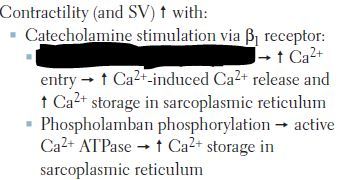
- 11—Ca2+ channels phosphorylated
- 12—Increased Ca2+ entry
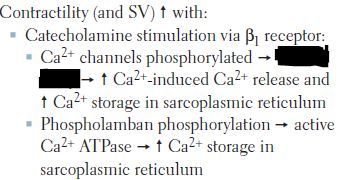
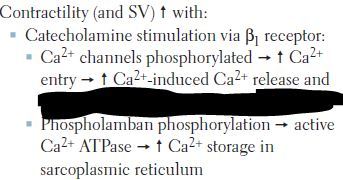
- 13—Increased Ca2+-induced Ca2+ release
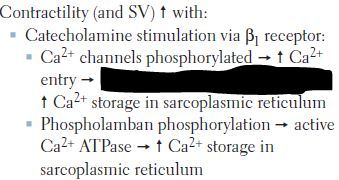
- 14—Increased Ca2+ storage in sarcoplasmic reticulum
- 15—Phospholamban phosphorylation
- 16—active
Ca2+ ATPase
- 17—Increased Ca2+ storage in
sarcoplasmic reticulum
- 18Contractility (and SV) increase with: Increased or decreased intracellular Ca2+?Increased
- 19Contractility (and SV) increase with: Increased or decreased extracellular Na+?Decreased extracellular Na+
(decreased activity of Na+/Ca2+ exchanger) - 20Contractility (and SV) increase with:Digitalis (blocks Na+/K+ pump
- 21—increased intracellular Na+
- 22—Decreased Na+/Ca2+ exchanger activity
- 23—Increased intracellular Ca2+
- 24Contractility (and SV) decrease with what?S
- 25Does Contractility increase or decrease with the following? β1-blockade (decreased cAMP)Decrease
- 26Does Contractility increase or decrease with the following? HF with systolic dysfunctionDecrease
- 27Does Contractility increase or decrease with the following? AcidosisDecrease
- 28Does Contractility increase or decrease with the following? Hypoxia/hypercapniaDecrease
- 29Does Contractility increase or decrease with the following? Non-dihydropyridine Ca2+ channel blockersDecrease
- 30Does Contractility increase or decrease with the following? Catecholamine stimulation via β1 receptorIncrease
- 31Does Contractility increase or decrease with the following? Increased intracellular Ca2+Increase
- 32Does Contractility increase or decrease with the following? Decreased extracellular Na+Increase
- 33Does Contractility increase or decrease with the following? DigitalisIncrease
- 34MyoCARDial O2 demand is increased by what?H
- 35Wall tension follows what law?Wall tension follows Laplace’s law:
Wall tension = pressure × radius
Wall stress = (pressure × radius)/
(2 × wall thickness) - 36Laplace's Law Wall tension = ?Wall tension = pressure × radius
- 37Laplace's Law pressure × radius = ?Wall tension
- 38Laplace's Law (pressure × radius) / (2 × wall thickness) = ?Wall stress
- 39Laplace's Law Wall stress = ?(pressure × radius) /
(2 × wall thickness) - 40How is Preload approximated?Preload approximated by ventricular EDV;
depends on venous tone and circulating blood volume. - 41VEnous vasodilators (eg, nitroglycerin) do what to preload?VEnous vasodilators (eg, nitroglycerin)
decrease prEload. - 42Preload approximated by ventricular EDV; depends on what?Preload approximated by ventricular EDV;
depends on venous tone and circulating blood volume. - 43Afterload is approximated by what?Afterload approximated by MAP.
- 44Increased afterload leads to what?Leads to increased pressure which leads to increased wall tension per Laplace's law.
- 45What compensates for increased afterload? How does it compensate?LV compensates for increased afterload by thickening (hypertrophy) in order to decrease wall tension.
- 46What do Arterial vasodilators do to afterload?Arterial vasodilators (eg, hydrAlAzine)
decrease Afterload. - 47What do ACE inhibitors and ARBs do to preload? To afterload?ACE inhibitors and ARBs decrease both preload and afterload.
- 48What does chronic hypertension (increased MAP) lead to?Chronic hypertension (increased MAP) leads to LV hypertrophy.
- 49Ejection Fraction EF = ?EF = SV / EDV
EF = (EDV-ESV) / (EDV) - 50Left ventricular EF is an index of what?Left ventricular EF is an index of ventricular
contractility. - 51What happens to EF in systolic HF?EF decreases in systolic HF
- 52What happens to EF in HF with preserved ejection fraction (HFpEF)?EF normal in HF with preserved ejection
fraction (HFpEF).
Informationen
- Beschreibung
- Der Nutzer hat seine Fachbereichs-Information gelöscht. Karteikarten am 273 - Cardiac output variables, erstellt von Gelöschter Nutzer am 30/05/2017.
- Erstellt von
- Gelöschter Nutzer · Mai 2017
- Aktualisiert
- 30 Mai 2017
- Aufrufe
- 18
- Verlauf
-
- Erstellt von Victoria Wright · 29 Mai 2017
- Kopiert von Victoria Wright · 30 Mai 2017
- Bewertung