
Karteikarten
274 - Starling Curve, Resistance, Pressure, Flow
Karten in diesem Stapel (38)
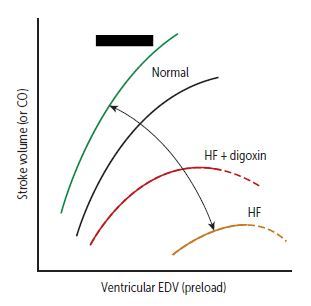
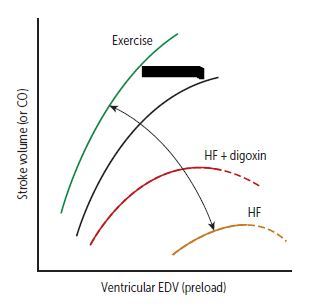
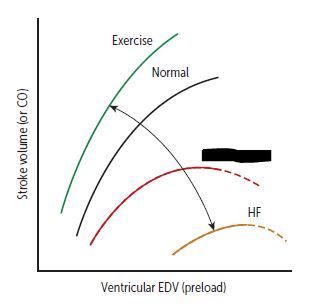
- 1Starling Curve Force of contraction is proportional to what?Force of contraction is proportional to enddiastolic length of cardiac muscle fiber
(preload). - 2Starling Curve Enddiastolic length of cardiac muscle fiber (preload) is proportional to what?Force of contraction is proportional to enddiastolic length of cardiac muscle fiber
(preload). - 3Starling Curve What do catecholamines do to contractility?Increase contractility
- 4Starling Curve What do positive inotropes (eg digoxin) do to contractility?Increase contractility
- 5Starling Curve What does loss of myocardium (eg MI) do to contractility?Decrease contractility
- 6Starling Curve What do β-blockers (acutely) do to contractility?Decrease contractility
- 7Starling Curve What do non-dihydropyridine Ca2+ channel blockers do to contractility?Decrease contractility
- 8Starling Curve What does dilated cardiomyopathy do to contractility?Decrease contractility
- 9Starling Curve There is increased contractility with what?With catecholamines, positive
inotropes (eg, digoxin). - 10Starling Curve There is decreased contractility with what?With loss of myocardium (eg, MI),
β-blockers (acutely), non-dihydropyridine Ca2+ channel blockers, dilated cardiomyopathy. - 11—Exercise
- 12—Normal
- 13—HF + digoxin
- 14—HF
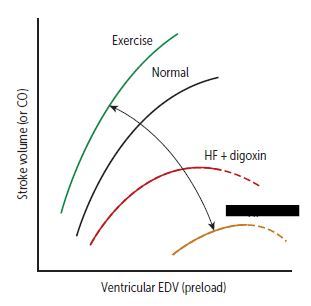
- 15—Stroke volume (or CO)
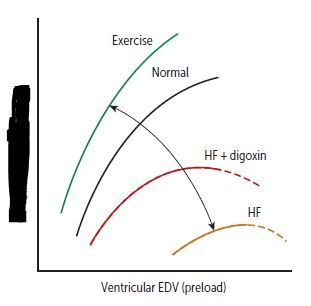
- 16—Ventricular EDV (preload)
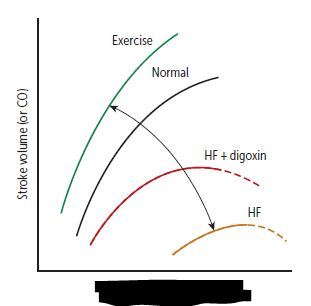
- 17Resistance, pressure, flow ΔP = ?ΔP = Q × R
- 18Resistance, pressure, flow Q × R = ?ΔP = Q × R
- 19Resistance, pressure, flow Similar to Ohm’s law: ΔV = ?Similar to Ohm’s law: ΔV = IR
- 20Resistance, pressure, flow Volumetric flow rate (Q) = ?flow velocity (v) ×
cross-sectional area (A) - 21Resistance, pressure, flow flow velocity (v) × cross-sectional area (A) = ?Volumetric flow rate (Q) = flow velocity (v) ×
cross-sectional area (A) - 22Resistance, pressure, flow driving pressure (ΔP) / flow (Q) = ?Resistance
- 23Resistance, pressure, flow (8η (viscosity) × length) / (πr4) =?Resistance
- 24Total resistance of vessels in series?Look in book
RT = R1 + R2 + R3 . . . - 25Total resistance of vessels in parallel?Look in book
1/RT = 1/R1 + 1/R2 + 1/R3.... - 26What have the highest total cross-sectional area?Capillaries have highest total cross-sectional area and lowest flow velocity.
- 27What have the lowest flow velocity?Capillaries have highest total cross-sectional area and lowest flow velocity.
- 28What drives flow from high pressure to low pressure?Pressure gradient drives flow from high pressure to low pressure.
- 29Pressure gradient drives flow from what to what?Pressure gradient drives flow from high pressure to low pressure.
- 30What account for most of TPR?Arterioles account for most of TPR.
- 31Arterioles account for most of what?Arterioles account for most of TPR.
- 32What provide most of blood storage capacity?Veins provide most of blood storage capacity.
- 33Veins provide most of what?Veins provide most of blood storage capacity.
- 34Viscosity depends mostly on what?Viscosity depends mostly on hematocrit.
- 35What depends mostly on hematocrit?Viscosity depends mostly on hematocrit.
- 36What happens to viscosity in hyperproteinemic states (eg, multiple myeloma)?Viscosity increases
- 37What happens to viscosity in polycythemia?Viscosity increases
- 38What happens to viscosity in anemia?Viscosity decreases
Informationen
- Beschreibung
- Der Nutzer hat seine Fachbereichs-Information gelöscht. Karteikarten am 274 - Starling Curve, Resistance, Pressure, Flow, erstellt von Gelöschter Nutzer am 30/05/2017.
- Erstellt von
- Gelöschter Nutzer · Mai 2017
- Aktualisiert
- 30 Mai 2017
- Aufrufe
- 21
- Verlauf
-
- Erstellt von Victoria Wright · 29 Mai 2017
- Kopiert von Victoria Wright · 30 Mai 2017
- Bewertung