
Notizen
Notes on Acids and Bases
Inhalt der Notizen (2)
Seite 1
Acids and alkalis
Acids: Produce an excess of hydrogen ions (\(H^{+}\)) when they dissolve in water
Alkalis/bases: Produce an excess of hydroxide ions(\(OH^{-}\)) when they dissolve in water
High concentration of hydrogen ions leads to a lower pH and a more acidic solution.
High concentration of hydroxide ions leads to a higher pH and a more basic solution.
If the concentration of hydrogen ions is increased by 10, the pH decreases by 1.
If the concentration of hydrogen ions is decreased by 10, the pH increases by 1.
If a strong and a weak acid are present in equal concentrations, then the strong acid will have a higher pH because it is more dissociated and hence has a higher concentration of hydrogen ions.
Seite 2
Neutralisation
Neutralisation by metal oxides:
\(\text{Acid + metal oxide}\rightarrow\text{salt + water}\)
Example:
\( MgO (s) + 2HCl(aq) \rightarrow MgCl_2 + H_2O (l) \)
\(\text{Magnesium oxide + hydrochloric acid} \rightarrow \text{ Magnesium chloride + water}\)
This is the reaction that takes place when antacids are taken to ease indigestion
Neutralisation by soluble bases (also known as alkalis)
Hydrogen ions in the acid react with hydroxide ions from the alkali to form water
The other ions from the acid in the alkali stay in solution as a dissolved salt
Investigating neutralisation
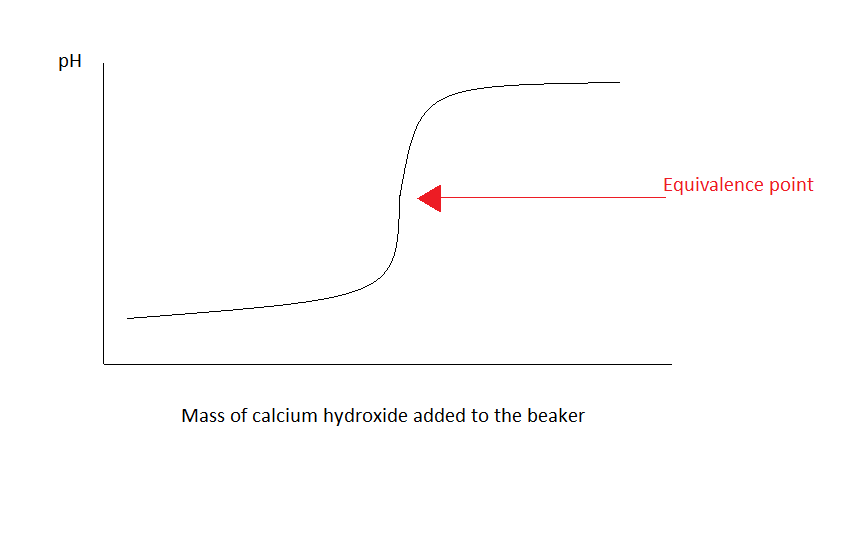
Place HCl in a beaker and record its pH using a pH probe or Universal Indicator Paper
Add a weighed amount of calcium hydroxide to the beaker and measure the pH again.
Repeat this several times, plotting a graph of pH versus mass of calcium hydroxide added to the beaker
Informationen
- Beschreibung
- Der Nutzer hat seine Fachbereichs-Information gelöscht. Notiz am Notes on Acids and Bases, erstellt von Gelöschter Nutzer am 30/06/2017.
- Erstellt von
- Gelöschter Nutzer · Jun 2017
- Aktualisiert
- 30 Jun 2017
- Aufrufe
- 16
- Verlauf
-
- Erstellt von Niamh Ryan · 27 Jun 2017
- Kopiert von Niamh Ryan · 30 Jun 2017
- Bewertung