
Notizen
Electrolysis for AQA Comb
Inhalt der Notizen (6)
Seite 1
Basic Principles of Electrolysis
Electrolysis: Chemical decomposition produced by passing an electric current through a liquid or solution containing ions.
Electrolyte: An ionic substance with freely moving ions. Electrolytes conduct electricity.
Cation: A positively charged ion
Anion: A negatively charged ion
Electrolysis uses electricity to break down an electrolyte.
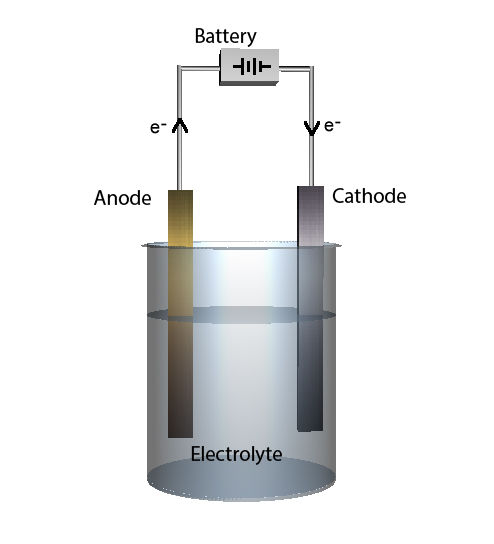
Two electrodes (usually a carbon or a metal) are connected to a d.c. current and placed in the electrolyte.
The positive electrode is called the anode
The negative electrode is called the cathode
The ions migrate towards the electrode with the opposite charge
Cations collect at the cathode
Anions collect at the anion
Seite 2
Oxidation and Reduction (HT Only)
Reduction: Loss of oxygen or gain of electrons
Oxidation: Gain of oxygen or loss of electrons
Use the mnemonic OILRIG to help you to remember this
Oxygen Is Loss, Reduction Is Gain
Anions lose electrons at the anode
Cations gain electrons at the cathode
This results in charged ions becoming atoms or molecules
Example: In the electrolysis of molten zinc chloride (\(ZnCl_2\)), \(Zn^{2+}\) ions are attracted to the cathode, where they gain two electrons and become zinc atoms. At the same time, chloride ions are attracted to the anode where they lose electrons to form chlorine molecules.
These changes can be represented by half equations, which show what takes place at each electrode:
Cathode reaction \(Zn^{2+} + 2e^- \rightarrow Zn\) Reduction
Anode reaction: \(2Cl^- \rightarrow Cl_2 + 2e^-\) Oxidation
Seite 3
Manufacture of Aluminium
Very reactive metallic elements are extracted from ores by electrolysis
Because they are higher up in the reactivity series than carbon, they cannot be displaced from their oxides by carbon
The usual source of aluminium is the ore, bauxite.
This is treated chemically to leave a white aluminium oxide powder, \(Al_2O_3\), commonly known as alumina
Alumina has a very high melting point .
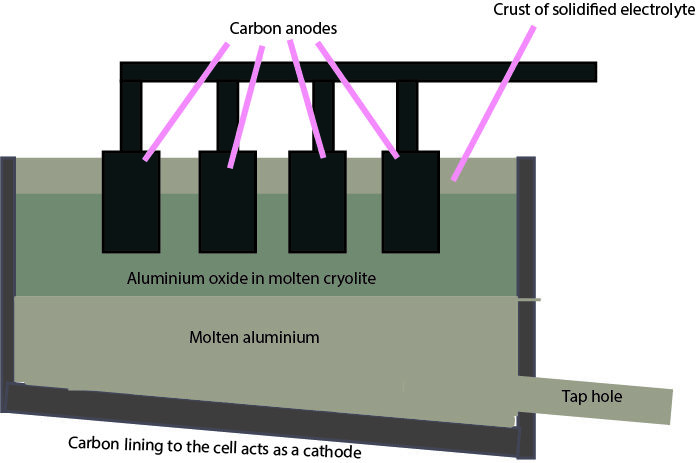
Therefore, in order for it to be electrolysed, it has to be dissolved in molten cryolite
Acts as a solvent for the alumina
Cryolite also has a high melting point
Cathode:
Attracts Al ions where they gain electrons to form aluminium metal
\(Al^{3+}+3e^- \rightarrow Al\)
Anode:
Attracts oxide ions
Lose electrons and form oxygen gas
Oxygen gas reacts with carbon anodes, so they have to be replaced from time to time
\(2O^- \rightarrow O_2 + 4e^-\)
Seite 4
Electrolysis of an Ionic Compound
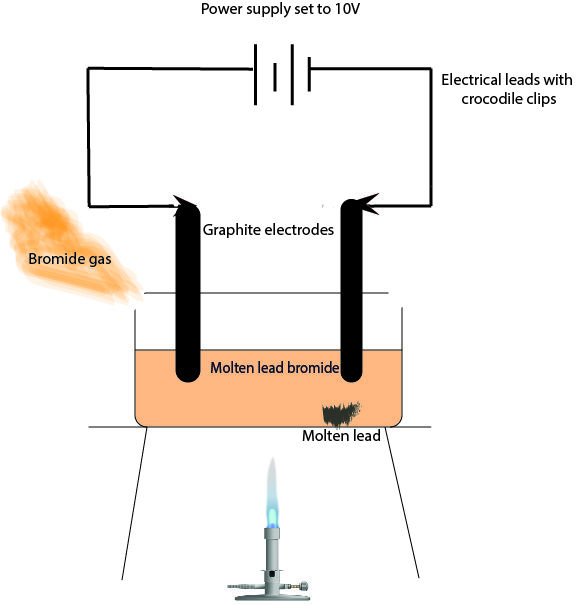
Lead bromide has a high melting point and so must be heated in a crucible so that it will melt
Cathode:
Zinc ions are changed into zinc atoms as they gain electrons
\(Zn^{2+}(l) +2e^- \rightarrow Zn (s) \)
Anode:
Bromide ions are changed into bromine gas as they give up electrons to the anode
\(2Br^-(l) \rightarrow Br_2(g) +2e^-\)
Note: The above details are given for lead chloride, but a similar situation will occur if any other ionic compound is used. The anions will attracted to the anode where they will be oxidised. THe cations will be attracted to the cathode where they will be reduced
Seite 5
Electrolysis of Copper(II) chloride
When salts dissolve in water, positive and negative ions that can move through the water molecules are released
Electrolysis can be used, in some cases, to separate these two types of ions
Cathode:
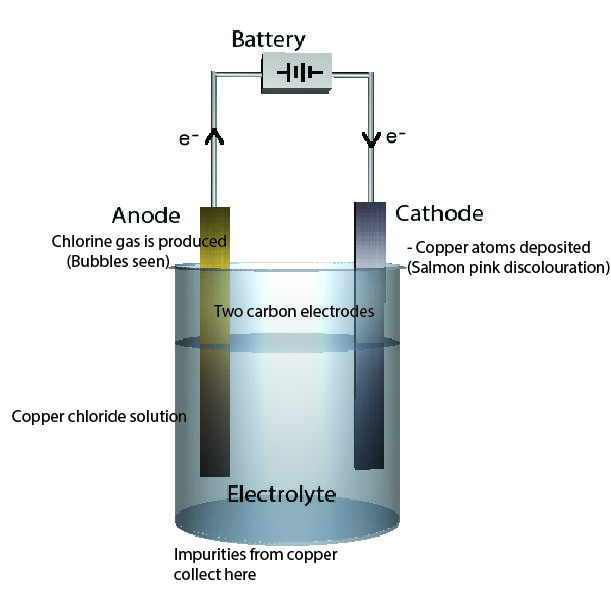
Copper ions are attracted to the cathode, where they gain electrons to form copper atoms
The salmon pink discolouration seen at the cathode is a thin layer of copper metal
\(Cu^{2+}(aq) +2e^- \rightarrow Cu (s) \)
Anode:
Chloride ions are attracted to the anode, where they lose electrons and combine to form molecules of chlorine gas
Bubbles can be see at the anode - this is the chlorine gas
\(2Cl^-(aq) \rightarrow Cl_2(g) +2e^-\)
Note:
This is not the case for solutions of ionic salts containing more reactive metals such as sodium
Water also decomposes to form hydrogen and hydroxide ions
Hydrogen ions gain electrons more easily than sodium and so will be preferentially reduced
Hydrogen gas will be seen at the cathode
The reactive metal remains in solution
Seite 6
Electrolysis of water
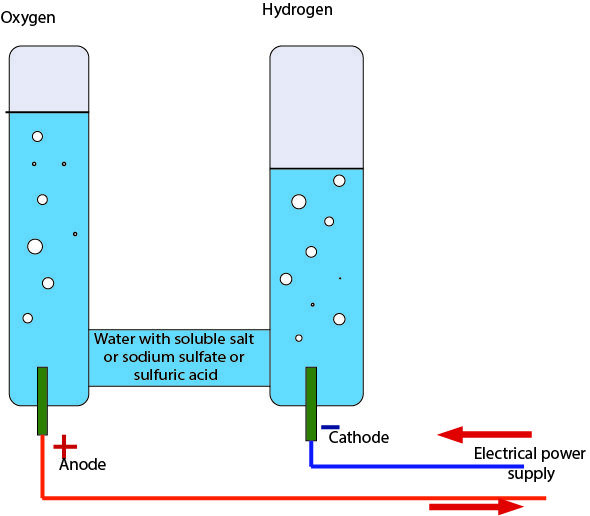
The electrolysis of water with sodium sulfate or sulfuric acid breaks it down into hydrogen and oxygen gases. This is because hydroxide is discharged more readily than sulfate ions and hydrogen ions are discharged more readily than sodium ions.
Since the formula of water is \(H_2O\), twice as much hydrogen as oxygen gas will be produced.
The apparatus used to carry out this experiment is known as a Hofman Voltameter
The Hofman Voltameter has platinum electrodes.
(REMEMBER! A voltmeter is used to measure potential difference or voltage, in this case we are using a voltAmeter!)
Anode:
Oxidation reaction
\(4OH^-(aq) \rightarrow 2H_2O(l) + O_2(g) + 4e^-\)
Cathode
Reduction reaction
\(4H^+(aq) + 4e^- \rightarrow 2H_2(g)\)
The electrolysis of water with sodium chloride will produce hydrogen and chlorine.
Informationen
- Beschreibung
- Der Nutzer hat seine Fachbereichs-Information gelöscht. Notiz am Electrolysis for AQA Comb, erstellt von Gelöschter Nutzer am 13/07/2017.
- Erstellt von
- Gelöschter Nutzer · Jul 2017
- Aktualisiert
- 13 Jul 2017
- Aufrufe
- 23
- Verlauf
-
- Erstellt von Niamh Ryan · 11 Jul 2017
- Kopiert von Niamh Ryan · 13 Jul 2017
- Kopiert von Niamh Ryan · 13 Jul 2017
- Bewertung