
Notizen
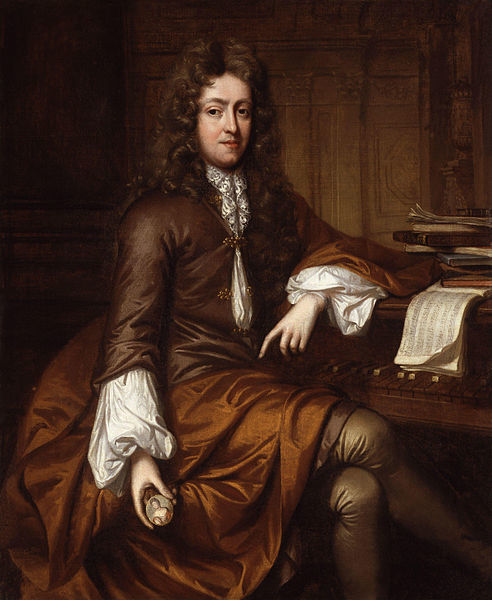
Henry Purcell: ‘Music for a While’
Inhalt der Notizen (5)
Seite 1
About the Piece:
Music for a While was written by Henry Purcell in 1692 and is the second of four movements from the music to the play Oedipus by John Dryden and Nathaniel Lee. The song comes from Act 1, Scene 3 of the play.
Oedipus is one of the most powerful of all Greek legends. Oedipus accidentally kills his father and, without realising it, marries his own mother. When he discovers the horror of what has happened, he plucks out his eyes and then commits suicide
Ground bass, also known as basso ostinato, was used widely in the Baroque era. It is a style in which the music is written above a repeating bass line. In instrumental music, this often features a set of melodic variations over this bass ‘ground’. Pieces in the ground bass style usually share similar features: a minor key, a simple rhythm, a slow tempo, and the use of chromatic notes to give the bass part melodic interest in its own right. The ground bass was usually 4 or 8 bars long, but in Music for a While, it is only 3 bars long.
As a traditional Baroque piece, there are no tempo or dynamic markings.
Music for a While features a solo voice accompanied by harpsichord, lute and bass viol (double bass).
The piece is in ternary form (ABA).
The full text of the song:
(Section A)
Music for a while
Shall all your cares beguile.
Wond’ring how your pains were eas’d
And disdaining to be pleas’d
Till Alecto free the dead
From their eternal bands,
(Section B)
Till the snakes drop from her head,
And the whip from out her hands.
(Section A1)
Music for a while
Shall all your cares beguile.
Seite 2
Introduction (Bars 1-3):
The start of Music for a While introduces the repeating bass line, played on the left hand of the harpsichord and the bass viol.
This bass line is triadic. The first chord is A minor, which suggests that this is the key. The use of a G# also shows the key of A minor. The last note of the ostinato, E, loops back to the starting note, A, creating a perfect cadence.
The use of chromatic notes (G#, C#) provides tonal ambiguity, creating an unsettling feeling for the listener.
Notice the use of ornaments, for example, a lower mordent (bar 1) and an appoggiatura (bar 2).
During the Baroque era, this bass line would have been written as figured bass, a type of musical shorthand for keyboard players.

Seite 3
Section A (Bars 4-21):
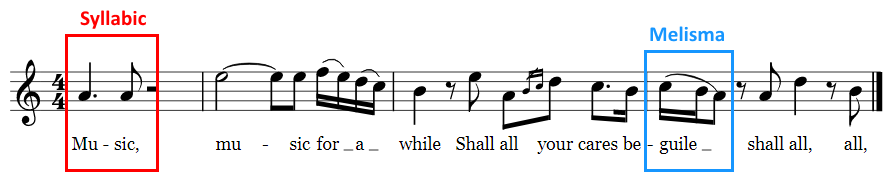
The solo soprano vocal line enters in bar 4 with the main melody (shown below).
Purcell uses several techniques to draw attention to the lyrics being sung in this song. The key word music is sung on the tonic note A then reinforced by repetition a fifth higher on the dominant note E at bar 5. The lyric is sung syllabically to make it stand out and is an example of word painting. Some other lyrics (such as the word all) are also repeated to draw attention. The quaver rest before shall all also makes the words stand out clearly.
There is alternative phrasing between the vocal line and the ground bass. The ostinato in the bass line is only 3 bars long, while the phrasing for the vocal line is 4 bars throughout the verse. Although the two lines start together in bar 4, they are out of sync within 4 bars. Purcell does this to make the song to sound like a continuous stream of music.
Purcell often uses dissonant intervals between the bass and melody to add feelings of anguish or pain to the music. A good example is the word pains in bar 12. The vocal line sings an E above a D minor chord. The E is not part of the chord and clashes noticeably with the F in the chord. This E begins a four-note melisma which places further stress on the word pains.
Bars 13–14 start to modulate to E minor (the dominant key) through the addition of a D# in the harpsichord part. The ground bass is also altered here. The melody and bass line resolve on the word pleas’d in bar 15 with a perfect cadence in E minor.
The song modulates again into G major, the relative of E minor, giving a more optimistic tone. Dissonance is heard between the vocal part and the bass line in bars 19–21 in the form of suspensions, which add to the expressive power of the music.
In bar 21, the bass line is altered again, shifting the piece into C major (the relative of A minor).
Seite 4
Section B (Bars 22-28):
The B section of the song starts in C major, which was established at the end of the last section.
The section starts with a bar of harpsichord link so that there is a clear distinction between the sections and to allow the vocalist to breathe.
The bass is similar to the shape of the ground bass from section A, and at the end of bar 22 we have another perfect cadence, this time in C major. This only lasts for one beat as there is then a perfect cadence back into the key of A minor between the second and third beat of bar 23.
The Tierce de Picardie (sharpened 3rd) on the word snakes makes this lyric stand out.
At this point the original form of the ground bass is heard, this time starting halfway through the bar rather than at the start of the bar. The voice comes in slightly before this so that, again, we do not have both parts starting or ending together. This creates a sense of tension and is slightly disturbing.
The repetition of the word drop on the offbeat and descending nature of the melody creates an onomatopoeic effect.
There is a shift to E minor at the beginning of bar 28. There is another Tierce de Picardie later in bar 28 with an E major chord: the third (G) has been sharpened to a G#, this leads the song back to A minor.

Seite 5
Section A1 (Bars 29-38):
The repeat to section A is short, repeating only the first two lines of text.
This forms a conclusion to and summary of the whole song. The section has three statements of the three-bar ground bass in its original form, followed by a final A minor chord.
The vocal line is embellished in the repeat, this is typical of this form of music (da capo aria). The amount and variation of embellishment depends on the vocal artist themselves and is not usually written down.
Because the harpsichord cannot sustain chords, the final chord of the piece is played as an arpeggio.
Informationen
- Beschreibung
- Der Nutzer hat seine Fachbereichs-Information gelöscht. Notiz am Henry Purcell: ‘Music for a While’, erstellt von Gelöschter Nutzer am 17/07/2017.
- Erstellt von
- Gelöschter Nutzer · Jul 2017
- Aktualisiert
- 17 Jul 2017
- Aufrufe
- 160
- Verlauf
-
- Erstellt von Antonia Blankenberg · 14 Jul 2017
- Kopiert von Antonia Blankenberg · 17 Jul 2017
- Bewertung