
Notizen
Haber Process
Inhalt der Notizen (3)
Seite 1
Ammonia
Ammonia is another name for the \(NH_3\) molecule.
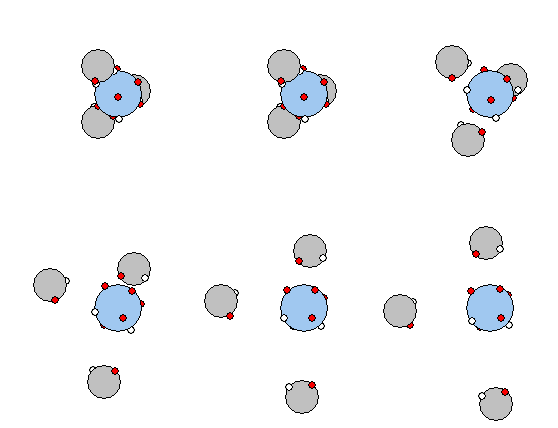
Ammonia is made due to the formation of three nitrogen-hydrogen single covalent bonds.
\(N_2 + 3H_2 \rightleftharpoons 2NH_3 \)
The diagram below provides a visual representation of the bond forming.
This process is reversible, which creates a problem for manufacturers - they do not want the ammonia they are trying to produce to break down into nitrogen and hydrogen again.
Ammonia is used for:
Nitrogen-rich plant fertiliser - without ammonia the world would not be able to grow enough food to feed its population
Explosives
Household cleaners
Dyes
Ammonia is produced industrially in a process called the Haber Process.
Seite 2
Conditions for the Haber Process
Certain conditions are required to make sure that the reversible reaction goes in the right direction.
These conditions are:
Moderately high temperatures - Around 450°C
High pressure - About 200 atmospheres
An iron catalyst
Why are these conditions most suitable?
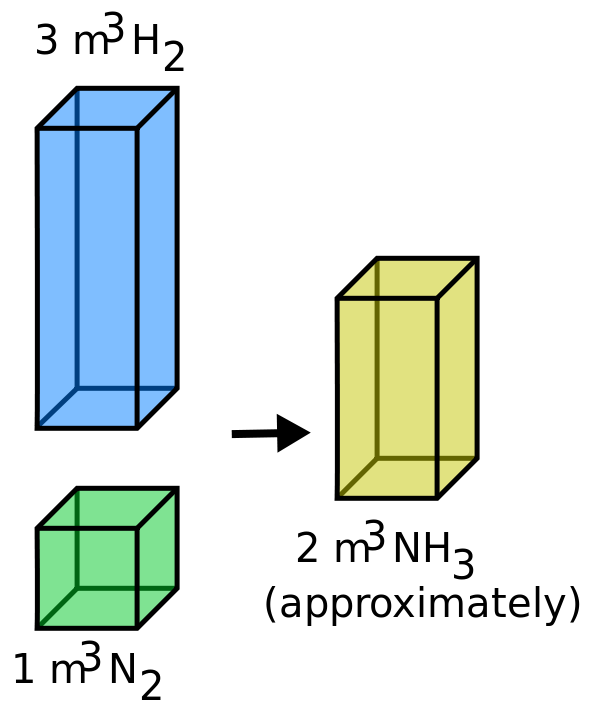
Because the reaction involves combining one mole of nitrogen with three moles of hydrogen ( a total of four moles of reactants) to produce two moles of ammonia (a total of two moles of products), high pressure will always favour the the forwards reaction, because its products take up less space. The pressure is not any higher than this because it is very expensive to run a plant that operates under high pressure conditions.
High temperature favours the backwards reaction (i.e. producing nitrogen and hydrogen from ammonia) . Therefore, one would think that low temperatures would be most suitable. However, if the reaction was carried out under low temperatures, the rate of reaction would be extremely slow and this would not be economical. Also, the catalyst only works effectively above about 400°C. Therefore, the temperature of 450°C is a compromise between these two factors.
The iron catalysts speeds up the rate of reaction by lowering the activation energy of the reaction. Osmium or uranium can also be used, but these are only available in small quantities. Ruthenium would allow the process to be carried out at lower temperatures, but it is expensive. The catalyst does not change the percentage yield.
These conditions give about a 15% yield of ammonia. The ammonia is liquified and removed. Unreacted hydrogen and nitrogen are passed through the system again and again so that in the end the overall yield is about 97%. This minimises the cost of raw materials.
The raw materials used in an industrial process are known as the feedstocks. Therefore, the feedstocks for the Haber process are air, natural and steam.
The hydrogen used in the Haber process is either producing as a by-product from catalytic cracking or by the steam reformation of natural gas.
Seite 3
Nitrogen fixing
Nitrogen fixation: Making nitrogen compounds from nitrogen in the air
Nitrogen fixation happens in three ways:
The Haber process produces ammonia from nitrogen.
Lightning breaks nitrogen down into reactive nitrogen atoms. These from nitrous oxides, which dissolve in rain. In the soil they form nitrates.
Nitrogen-fixing bacteria found in the soil and in the root nodules of leguminous plants, such as peas, beans and clover, fix nitrogen gas into nitrogen compounds. These bacteria use enzymes as a catalyst for these reactions.
Chemists are very interested in producing artificial catalysts that could mimic the behaviour of these enzymes. These enzymes work under ambient conditions. Processes such as the Haber process would be much cheaper if they could also operate under such conditions. Operating a plant at high temperature and pressure is costly and unsafe.

Informationen
- Beschreibung
- Der Nutzer hat seine Fachbereichs-Information gelöscht. Notiz am Haber Process, erstellt von Gelöschter Nutzer am 26/07/2017.
- Erstellt von
- Gelöschter Nutzer · Jul 2017
- Aktualisiert
- 26 Jul 2017
- Aufrufe
- 24
- Verlauf
-
- Erstellt von Niamh Ryan · 19 Jul 2017
- Kopiert von Niamh Ryan · 26 Jul 2017
- Bewertung