
Notizen
Key Conservative Thinkers
Inhalt der Notizen (5)
Seite 1
Study Tip: As you go through the various key conservative thinkers in history, always remind yourself to analyse how their individual ideas relate to conservative thinking regarding human nature, the state, society and economy.
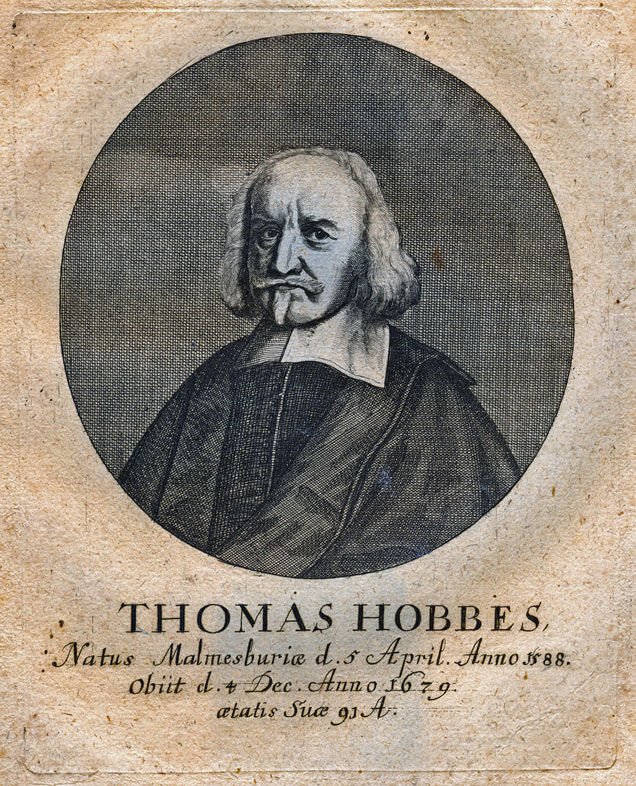
Thomas Hobbes (1588-1679)
Hobbes had a variety of beliefs about human nature
Human beings naturally desire to live well; they will never be satisfied with their power and will always want to acquire more
He believed all people were created equally
However, he argued the state of war, caused by competition, distrust and glory amongst men, was the natural state of humans beings
The state of war led Hobbes to investigate the importance of the question to what extent should we obey political authority
Hobbes outlines his main ideas in his famous book Leviathan 1651
He contended that a common power was required to keep men united
This power would work to maintain artificial harmony between people and would be held in the hands of one ruler or an assembly
The people make an agreement amongst themselves (social contract) to submit to this Sovereign
The only right that people would have to protest against a leader was if he made the direct threat to kill them and take their lives
If there was no order in the society life would be "solitary, poor, nasty, brutish, and short"
For there to be social order there must be a decisive and coercive role for the played by the Sovereign
"The obligation of subjects to the sovereign is understood to last as long, and no longer, than the power lasteth by which he is able to protect them."
Seite 2
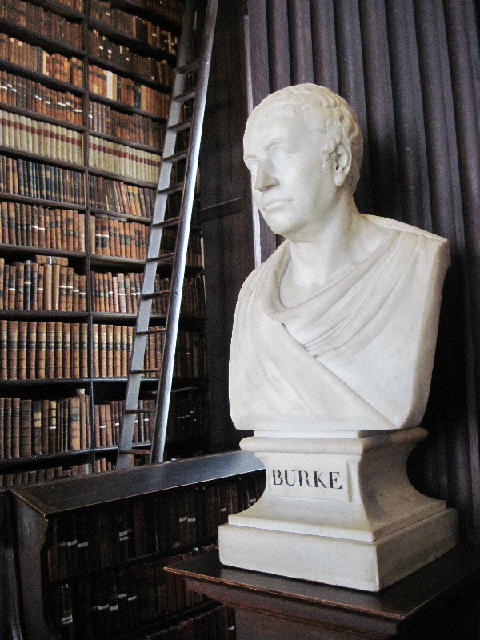
Edmund Burke (1729– 1797)
Edmund Burke is perhaps the most influential thinker in relation to British conservatism
Burke rejected the Enlightenment basis that humans are rational entities. He claimed people need to be viewed as both imperfect and imperfectible
Any system based upon the perfectibility of man is then contrary to our innate character
Burke believed that “society is but a contract between the dead, the living and those yet to be born"
This means people living in the present should not be arrogant enough to think they know what is best
Burke would argue that a true society, in the conservative view, would need to reflect on its past, ponder the present and meet the needs for future generations to come
This reflects upon the notion of empiricism; which is the theory that all knowledge is founded on experience derived from the senses
People should be sustaining the natural order to have it readily available for the enjoyment of future generations
He believed humans also seek security over what can be termed abstract notions of liberty and equality
Those who are elected to represent the people must have a higher level of wisdom than the public
Claimed his own social class could govern the nation on the basis of paternalism
Believed there was a natural hierarchy within the living organism of society; opposed a mechanistic view of society (liberalism)
The ruling elite benefit from the knowledge passed down through familial generations, thus they have a duty to care for others
Rejects the liberal view that technocratic experts are the best option for guidance; people should give adequate reflection to the past and be extremely vigilant when taking any course of action
Critique of the French Revolution:
His critique was based on the revolutions failed attempt to structure a utopian society established on the principles of 'liberty, fraternity and equality'
Burke argues this ignores social bonds that bind people together
Also, it marks an effort to replace accumulated wisdom of prior generations with abstractions
These revolutionaries placed their faith in destroying rather than preserving; they were wrong to think they could establish a new world from the ashes of the old
Critique of the American Revolution:
Some would argue that Burke was a supporter of the Americans during the Civil War
He did oppose many policies that the British government pursued; he believed the policies were driving the colonies to rebellion
Burke hoped that the colonists would think critically before engaging in a bloody and senseless war
Burke wanted to give the colonists a greater sense of belonging to the British polity through some constitutional means
He did not see independence as a wise choice of action, but cared very much for the Americans
"The only thing necessary for the triumph of evil is for good men to do nothing."
Seite 3
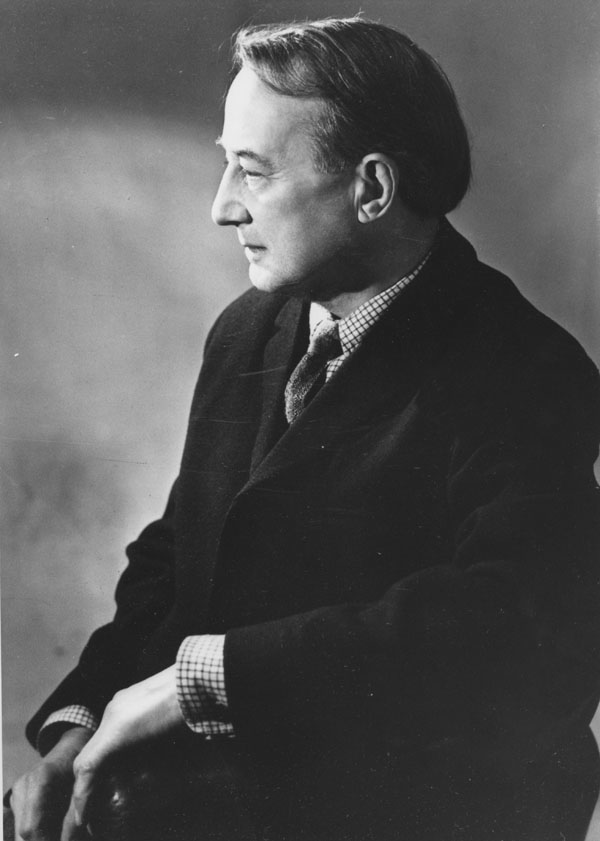
Michael Oakeshott (1901−1990)
"To be conservative, then, is to prefer the familiar to the unknown, to prefer the tried to the untried, fact to mystery, the actual to the possible, the limited to the unbounded, the near to the distant, the sufficient to the superabundant, the convenient to the perfect, present laughter to utopian bliss."
Oakeshott would argue that the realm of political ideas goes beyond the limits of our understanding
Rationalism and tradition:
Oakeshott argued that rationalism comes about as a result of tradition
Rationalism can be defined as an illusion that there are 'correct' answers to practical questions
Practical activity is rational, only when it rests on moral or casual laws whose truth can be illustrated
Traditional knowledge is about 'knowing how' to carry out practical activities
This acquires engaging in an activity and judgment in handling facts and rules
Therefore, the error in rationalism:
It is too simplistic to think making choices requires skill in technique of applying rules or calculating consequences
Further, knowledge that rationalism identifies as rational is itself the product of experience and judgment
Oakeshott outlines conservatism in his role of the state:
The state should be conceptualised as a ship that can be used to guard social harmony
He argues that the state cannot create a social utopia by reflecting on notions of social progress
People should merely seek to keep the ship afloat
Citizens should be sceptical of state intervention and social engineering
A true conservative, therefore, must be pragmatic
Moreover, he argues in 'On Human Conduct' there are two ways of comprehending social organisation:
Enterprise association: the state is seen as imposing universal purpose on its subjects; this is based on the ability of humans to grasp a universal 'good' (i.e. the Politics of Faith)
Civil association: a legal relationship; laws impose obligatory conditions of action (they do not require choosing one action over another though); this depends on the ability of humans to achieve this 'good' (i.e. the Politics of Scepticism)
According to Oakeshott, the Politics of Faith necessitates the prerequisite of power, because:
It permits people to believe they can achieve something good
It allows them to implement and carry out the policies required to achieve this good
The Politics of Scepticism rests mainly on the idea that governments should be primarily concerned with preventing bad things from happening
“In political activity . . . men sail a boundless and bottomless sea; there is neither harbour for shelter nor floor for anchorage, neither starting-place nor appointed destination. The enterprise is to keep afloat on an even keel.”
Seite 4
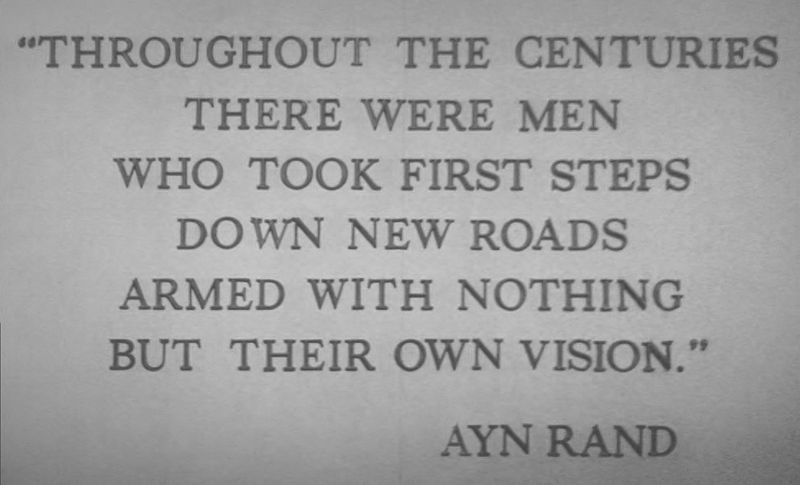
Ayn Rand (1905−1982)
Rand holds to conservative philosophy of objectivism, this can be termed ‘rational selfishness’
Objectivism rejects the notion that you are in any way obligated to do things that are labelled ‘morally right’
We have a duty to take our interests as first importance; Rand argued that altruism and self-sacrifice were immoral ideals
“The first right on earth is the right of the ego. Man’s first duty is to himself"
Holds to the idea that reality is real; men perceive reality through reason
Objectivism says man is an end in himself and therefore, allows for a degree of government regulation
The basis of Rand’s political philosophy rests on the presupposition that man has free will to make choices
Politics is a key component of Rand's philosophy and why?
An ideal political system for objectivists is laissez-faire capitalism; a system with a complete separation of state and economics
The primary role of the government is to protect the rights of the individual within the state
Rand argues that individual actors acting in cooperation with one another will seek to benefit themselves
Consequentially, this will benefit the system as a whole
Rand and wealth:
She contended that those who create wealth should be revered at the expense of those who seek to take it off others by force
Rand praised the creation of wealth above the attempts of the state to redistribute wealth in anyway
Wealth, Rand argued, ultimately ends up in the hands of electorally-important groups or those with the most political power
Thus, Rand promoted ethical egoism - we ought to act in our own self-interest (this is associated with the political right), while ethical altruism - moral duty to help our fellow man is linked to the political left
Rand's opposition to Collectivism and Statism:
"The political expression of altruism is collectivism or statism, which holds that man’s life and work belong to the state—to society, to the group, the gang, the race, the nation—and that the state may dispose of him in any way it pleases for the sake of whatever it deems to be its own tribal, collective good." (The Objectivist Newsletter, pp. 35, August 1962)
"A statist system—whether of a communist, fascist, Nazi, socialist or “welfare” type—is based on the . . . government’s unlimited power, which means: on the rule of brute force. The differences among statist systems are only a matter of time and degree; the principle is the same. Under statism, the government is not a policeman, but a legalized criminal that holds the power to use physical force in any manner and for any purpose it pleases against legally disarmed, defenseless victims.
Nothing can ever justify so monstrously evil a theory. Nothing can justify the horror, the brutality, the plunder, the destruction, the starvation, the slave-labour camps, the torture chambers, the wholesale slaughter of statist dictatorships." (The Objectivist Newsletter, pp. 44, October, 1962)
Seite 5
Robert Nozick (1938−2002)
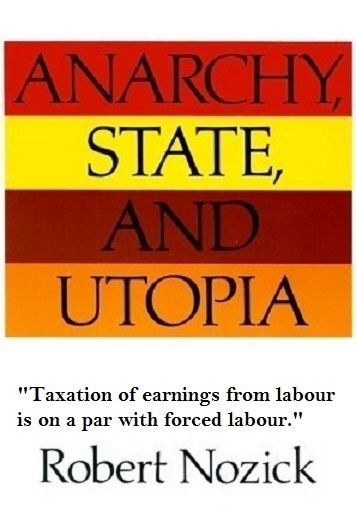
Falls on the libertarian-right of the political spectrum; best known for his debate with John Rawls on the function of justice. Most important work was Anarchy, the State and Utopia in which Nozick advocates minimal state.
Justice:
Nozick defends natural justice i.e. justice occurs naturally without the state interfering
Nozick argued that justice should be based upon moral entitlement
Kantian principle: the individual is an end in itself, and we are entitled to use our resources as we see plausible
Argued against state-imposed egalitarian measures as they would result in outcomes that benefited electorally significant groups in society
Minimal State:
Nozick’s minimal state is concerned with the enforcement of contracts and guarding against theft
Moreover, the distribution of goods due to free market processes is a just position
He criticises the redistribution of wealth, arguing that it undermines the rights of the individual
He believes that policies committed in the name of social justice are a state-justified robbery of wealth people had created
‘Tale of the slave’ - any form of redistribution of the state lends itself to allowing individuals gaining talents they don’t deserve
Redistributive policies reduce the status of the individual to that of a slave in pursuit of a collective goal
People need to avoid worshipping the state body
Nozick and Rand share similar views, Nozick is an advocate of free market capitalism, alongside the concept of individual sovereignty
Therefore, possession of bodily integrity is seen as a human right
Nozick promotes self-ownership; as humans we own our bodies, talents, abilities and labour
Informationen
- Beschreibung
- Der Nutzer hat seine Fachbereichs-Information gelöscht. Notiz am Key Conservative Thinkers, erstellt von Gelöschter Nutzer am 08/08/2017.
- Erstellt von
- Gelöschter Nutzer · Aug 2017
- Aktualisiert
- 8 Aug 2017
- Aufrufe
- 65
- Verlauf
-
- Erstellt von Andrew Burke · 20 Jul 2017
- Kopiert von Andrew Burke · 8 Aug 2017
- Bewertung