
Notizen
Punishment c.1700-c.1900
Inhalt der Notizen (4)
Seite 1
Changing Attitudes
Progression of crimes that carried the death penalty:
1688 - 50 crimes
1765 - 160 crimes
1810 - 222 crimes
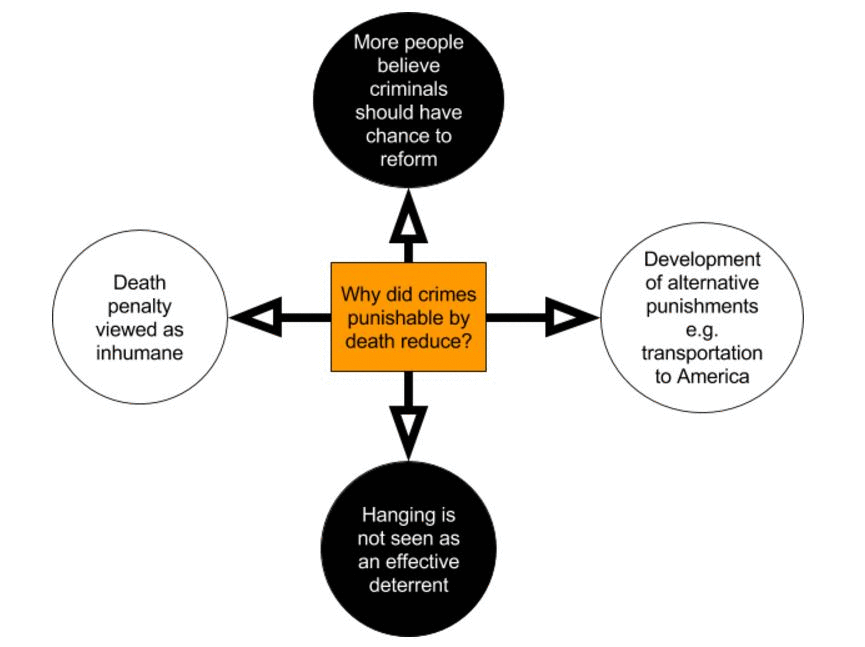
During the 19th century, many questioned the Bloody Code system and believed that a better alternative could be found. Changing attitudes led to the increased use of transportation and reforming of the prison service to carry out punishment for those who had committed crimes.
Seite 2
Transportation
The first convicts were sent over to the English colonies in North America at the start of the 17th century. However, after the American War of Independence, England no longer had control over colonies in North America and prisoners could no longer be sent there. Therefore, the alternative became Australia, which became part of the British Empire in 1770.
About 160,000 people went sent to Australia, of whom one-sixth were women. These people committed crimes mainly related to theft and were not violent criminals. Transportation was viewed as an effective deterrent and more humane than executing individuals.
Advantages of transportation:
Britain's prisons were not capable of holding large numbers of convicted criminals
Instead of spending funds on building new prisons, criminals were transported abroad
Prisoners would populate the new colony, they would work and produce goods on the land
Prisoners would strengthen British colonial power in unknown territories
Convicts were held in prison before the next ship headed out to Australia. The journey would take up to three months. During this time, convicts spent their time below deck, tied up in dirty, cramped conditions. Once they arrived in Australia, convicts were expected to work for the settlers who would provide them with basic food and housing. At the end of their seven year sentence, most convicts did not have the funds to return to Britain so they settled in Australian life.
Main information from 1:15 onwards in the video:
First Fleet - Behind the News (Einbetten)
Seite 3
Transportation Ends
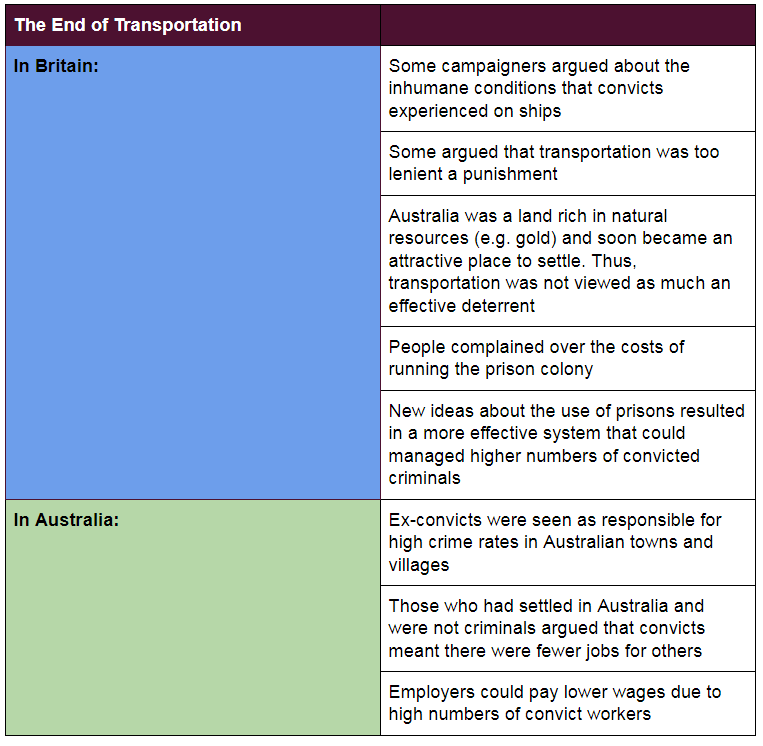
Transportation of criminals to Australia ended in 1868, this is best explained by the changing social and political attitudes in both Britain and Australia.
Seite 4
No More Public Execution
One of the main purposes of the Bloody Code was to deliver harsh punishments in order to deter criminals. Executions occurred in public to make significant point about the actions of criminals. Criminals would not be dealt with easily; public executions created an environment of fear. However, executions tended to attract large crowds and would mean additional business for traders and shopkeepers on these occasions.
People calling for a reform of the system argued that public execution was cruel and those who were sentenced to death should receive more dignity in execution. Moreover, public executions created a number of problems:
Those who attended were often drunk and took part in anti-social behaviour
Most attendees saw these occasions as a fun spectacle, rather than an warning for them to abide by the law of the land
Crowds would sometimes treated criminals as heroes and mocked authorities
Large crowd gatherings were opportunities for other crimes (e.g. pickpocketing)
Public executions ended in 1868.

Informationen
- Beschreibung
- Der Nutzer hat seine Fachbereichs-Information gelöscht. Notiz am Punishment c.1700-c.1900, erstellt von Gelöschter Nutzer am 14/08/2017.
- Erstellt von
- Gelöschter Nutzer · Aug 2017
- Aktualisiert
- 14 Aug 2017
- Aufrufe
- 17
- Verlauf
-
- Erstellt von Andrew Burke · 10 Aug 2017
- Kopiert von Andrew Burke · 14 Aug 2017
- Bewertung