
Notizen
Glacier Formation and Movement
Inhalt der Notizen (7)
Seite 1
Formation of Glacier Ice
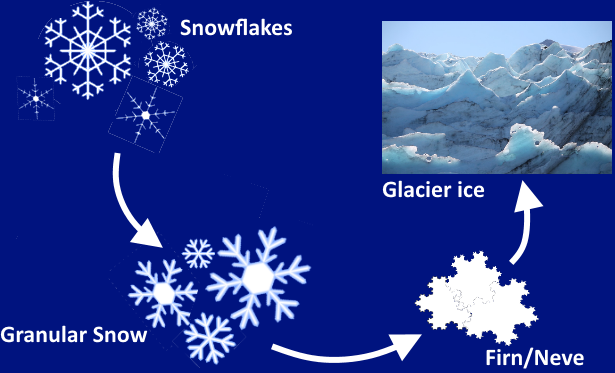
Glaciers begin to form when snow remains in the same area year-round. This is common in high-altitude areas and polar regions.
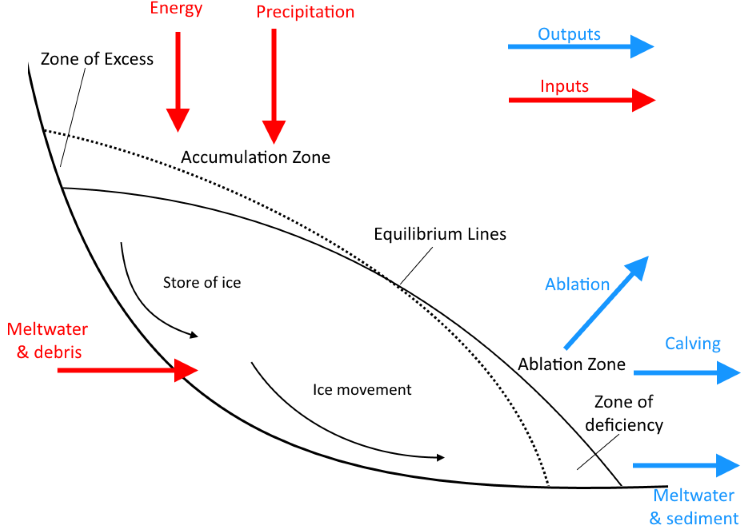
There area where snow falls is called the zone of accumulation.
As more and more snow falls, it is compacted. As snow becomes more compacted, the air is driven out and density increases.
Eventually, this process forms neve or firn (compacted snow). After 20-40 years the firn will turn into glacial ice which contains little air.
Near the end, or snout, of the glacier ice may melt. This is the zone of ablation and is more likely to occur in warm summer months.
The change from snowflakes to firn can be very quick in temperate areas (a few days) but much slower in polar areas (over a decade).
Seite 2
Glacier Mass Balance
Mass balance be defined as the gains and losses of the ice store in the glacier system.
Accumulation is a result of snowfall and other precipitation.
Ablation is when ice is lost from a glacier. Ice is lost through melting, sublimination (evaporation) or the breakaway of icebergs (calving).
Mass balance is measured by determining the amount of snow accumulated during winter, and later measuring the amount of snow and ice removed by melting in the summer.
The equilibrium point is the place where accumulation and ablation balance each other out
Seite 3
Annual Mass Balance
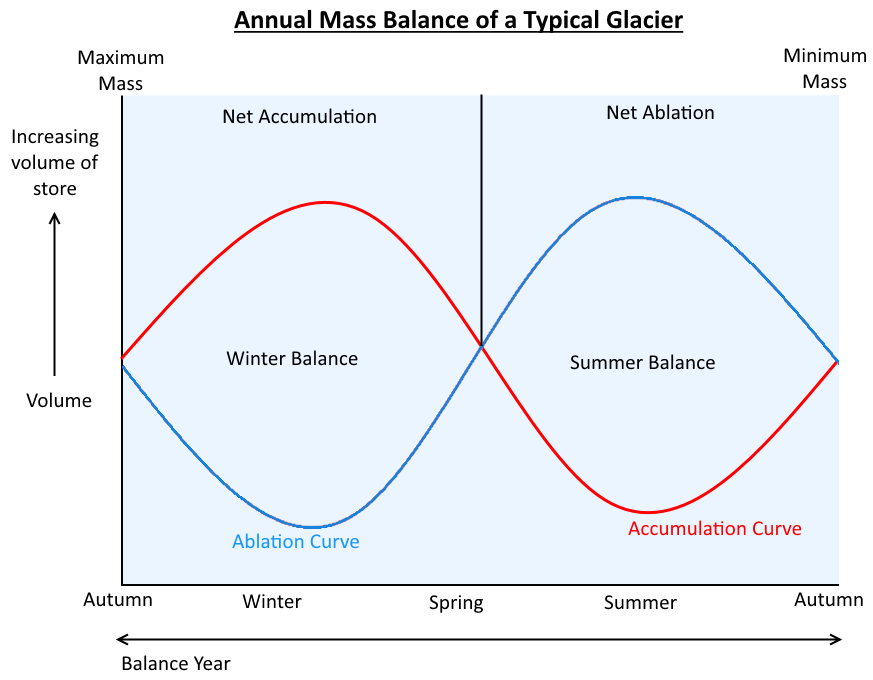
The mass balance year runs from autumn to autumn, when ice masses are at their smallest volume.
Generally, glaciers increase in size during the winter, this is a positive regime in the glacial budget. A positive regime causes the glacier to grow and advance at the front.
In summer there is more ablation than accumulation due to rising temperatures. This means that there is a negative regime in the glacial budget. A negative regime causes the glacier to shrink and retreat at the front.
If accumulation in winter is balanced by ablation in the summer, the annual net balance for the glacier is zero.
Trends in the annual net balance of glaciers is usually calculated on a ten-year basis.
The main techniques in measuring glacier net balance are:
Altimitry - measures the time taken by a radar pulse to travel from the satellite antenna to the surface and back to the satellite receiver, this measures the height of the glacier
Gravimetry - measurement of the strength of a gravitational field
Mass budget method - compares the amount of snow accumulation on the ice sheet and the amount of meltwater/calving leaving the glacier
Seite 4
Glacier Movement
The main driver of glacier movement is gravity. Ice sheets do not move as quickly as alpine glaciers because there is less slope and more mass involved.
The increasing downward force due to accumulation is called shear stress. Shear stress increases as the slope angle increases. Once the shear stress is great enough to overcome the forces of ice-strength and friction, the glacier moves away from the zone of accumulation.
The glacier stays in dynamic equilibrium as it moves towards the zone of ablation.
The speed of movement is dependent on the slope between the two zones and the weight of the glacier. The larger the imbalance between accumulation and ablation, the faster the glacier will have to move to stay in equilibrium.
Warm, wet-based glaciers experience greater levels of snowfall in the winter and more rapid ablation in the summer. This makes the imbalance between the accumulation and ablation zones greater, so the glacier moves quickly.
Cold-based glaciers have slower rates of accumulation and ablation. This means there isn't much of an imbalance and the glacier moves very slowly.
Seite 5
Basal Sliding
Basal sliding relates to the presence of meltwater underneath a glacier (this only applies to warm-based glaciers!). The pressure from the weight of the glacier generates a layer of water that helps the ice glacier move downslope. The meltwater acts as a lubricant for the movement of the glacier.
This type of motion is enhanced if the bed is soft sediment.
Creep occurs when stress builds up within a glacier, allowing the ice to behave with plasticity and flow. It occurs particularly when obstacles are met.
Enhanced basal creep is where ice deforms around irregularities on the surface.
Regulation creep is where basal ice deforms under pressure and behaves with plasticity.
Seite 6
Internal Deformation
Internal deformation occurs in cold-based glaciers only.
Internal deformation occurs when the weight of the ice causes the deformation of ice crystals. This takes place most readily near the glacier bed, where pressures are highest.
There are two types of internal deformation:
intergranular flow is when individual ice crystals deform and begin to move in relation to each other
laminar flow is when ice begins to move in individual layers
Subglacial Bed Deformation
This is where the surface underneath a glacier is made of weak or unconsolidated rock.
The weight of the glacier can deform the sediment, bringing the ice with it.
This accounts for 90% of the forward motion of glaciers.
Seite 7
Velocity of Glacier Ice
Warm-based glaciers are generally faster than cold-based glaciers due to meltwater providing lubrication. Warm-based glaciers move even faster when moving over softer sediment.
Glacier speeds can range from 3m to 100m per year.The highest velocities occur during a glacial surge. This is when glaciers collapse after ice builds up to a critical level in the accumulation zone.
Factors affecting glacier velocity:
Altitude, temperature and inputs
Lithology
Mass balance
Slope
Size of the glacier
Informationen
- Beschreibung
- Der Nutzer hat seine Fachbereichs-Information gelöscht. Notiz am Glacier Formation and Movement, erstellt von Gelöschter Nutzer am 15/08/2017.
- Erstellt von
- Gelöschter Nutzer · Aug 2017
- Aktualisiert
- 15 Aug 2017
- Aufrufe
- 87
- Verlauf
-
- Erstellt von Antonia Blankenberg · 10 Aug 2017
- Kopiert von Antonia Blankenberg · 15 Aug 2017
- Bewertung