
Notizen
Glacial Processes A-Level

Inhalt der Notizen (4)
Seite 1
Weathering in Glacial Environments
The amount and rate of glacial weathering and erosion depends on a range of factors including:
the temperature
local geology
slope gradient
velocity and weight of the glacier,
thickness of the glacier
size of the glacier's load
There are 4 main weathering processes in cold environments:
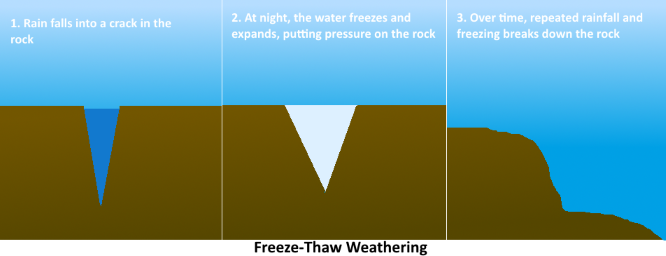
Freeze-thaw weathering:
Small cracks in the rock surface fill with water from precipitation or melted ice
As temperatures drop, the ice on the surface is the first to freeze over
When the rest of the ice freezes, it expands, putting pressure on the rock and causing the crack to become bigger
This process is repeated as the larger cracks fill with water and freeze
Carbonation
This is the slow dissolution of limestone due to rainfall (weak carbonic acid), producing calcium bicarbonate.
This is a type of chemical weathering.
Hydrolysis
Hydrolysis is the breakdown of minerals in rocks to form new clay minerals.
This is caused by water and dissolved carbon dioxide.
It is more common in igneous and metamorphic rocks that contain feldspar and silicate materials.
This is a form of chemical weathering.
Dilation/Pressure Release
Dilation is where the removal of weight either by erosion of rock or melting of ice that reduces pressure on bedrock allowing fractures to open up.
These fractures appear parallel to erosion surfaces as the bedrock adjusts to unloading.
Seite 2
Glacial Erosion
Glaciers break down rock through freeze-thaw action.
This follows the same process as freeze-thaw weathering.
Plucking often accompanies this process when glaciers are involved. This process is also referred to as glacial quarrying.
As a glacier moves through a valley, pressure is put on the valley sides and bottom.
The friction from this creates heat, causing the edge of the glacier to melt.
Meltwater fills cracks in the rock surface and freezes.
As the glacier continues to move, it drags this ice with it, pulling away some of the rock.
As the rock is carried by the glacier, it can scrape away at the side of the valley and erode it.
This process is called abrasion.
Very large boulders being carried by the glacier can do more damage than smaller ones.
Fracture and traction occur as a result of the crushing effect of the ice passing over rock.
Variations in pressure over different areas lead to basal melting.
This aids the plucking process.
Dilation occurs similarly to the weathering process.
Meltwater erosion acts both mechanically (similar to fluvial erosion) and chemically.
Rotational Scouring occurs as layers of rock debris accumulates on the surface of a glacier from valley sides.
Over successive winters, the rock debris becomes embedded within the compressed ice.
Bands of slowly rotating frozen rock are then scraped over the bedrock as the glacier moves downhill.
Seite 3
Transportation
Glaciers transport supraglacial and englacial debris.
Supraglacial debris is carried on the surface of the glacier.
Englacial debris is carried in the main body of the glacier.
The front of a glacier is called its snout. This acts as a bulldozer.
Glaciers mostly move due to gravity.
Due to friction and regelation (the melting point of the ice is lowered because it is under so much pressure from the weight of the glacier), glacier ice usually moves on a film of meltwater.
Glacial sediment usually occurs horizontally and vertically within glaciers due to the movement of the ice. Meltwater and glacial deformation can also move sediment within a glacier.
Extensional flow occurs when the gradient becomes steeper. The ice begins to move faster, ‘stretching’ the ice mass and becoming thinner through a series of fractures which form crevasses at right angles to the direction of flow.
Compressional flow occurs where the gradient becomes less steep or the ice encounters a major obstacle. This causes the ice mass to slow down, backing up. The crevasses in the ice close and there are thrust fractures as the ice mass compresses. The increased thickness of ice exerts greater pressure on bedrock and can result in more extensive pressure erosion.
Seite 4
Processes of Deposition
Lodgement:
Occurs underneath the ice mass.
Occurs when subglacial debris that was being transported gets lodged (stuck) on the glacial bed.
Friction between the subglacial debris and the glacial bed is greater than the force of the glacier moving.
This is commonly associated with glaciers carrying large amounts of debris.
These glaciers are often slow-moving, if not static.
Debris consists of relatively rounded clasts due to the grinding of the rock.
Ablation
Occurs when the glacier starts to melt/thaw.
Debris (supraglacial and englacial material) is dropped as there is nothing holding it up.
Produces angular debris that isn't compacted.
Deformation:
This occurs when sediments in weak bedrock are altered by the glacier moving over them.
Flow:
Occurs if high meltwater content causes the glacial debris to creep/slide during deposition.
Informationen
- Beschreibung
- Der Nutzer hat seine Fachbereichs-Information gelöscht. Notiz am Glacial Processes A-Level, erstellt von Gelöschter Nutzer am 15/08/2017.
- Erstellt von
- Gelöschter Nutzer · Aug 2017
- Aktualisiert
- 15 Aug 2017
- Aufrufe
- 30
- Verlauf
-
- Erstellt von Antonia Blankenberg · 22 Jun 2017
- Kopiert von Antonia Blankenberg · 10 Aug 2017
- Kopiert von Antonia Blankenberg · 15 Aug 2017
- Bewertung