
Notizen
Crime

Inhalt der Notizen (3)
Seite 1
Decriminalised Previous Offences
The 1900s, especially from the mid-1900s onwards, can be seen as a time when changing social attitudes led to former crimes being decriminalised.
Race Crime:
In the 1950s, there was a major influx of people from Commonwealth countries. Britain was became a multicultural hotspot and new laws were needed in order to cope with the growing number of minority groups in the country.
1968 - Race Relations Act: illegal to refuse jobs, housing or public services to anyone on the basis of their race, ethnicity or country of origin
Increasing immigration led to further defining of race crime in 2006, when, racial and religious crime was labelled a criminal offence
Abortion:
This was an action that became no longer seen as a crime in the 1900s. There are many views about abortion in society and people hold varying opinions. Further, there was a majority opinion that laws surrounding abortion should be changed. Up until 1967, it was illegal for a mother to terminate a pregnancy. However, a mother could terminate a pregnancy in the case that she might die as a result of the pregnancy.
If a women wanted an abortion for various other reasons she would resort to a 'backstreet abortion'. This led women to receiving abortions from someone who did not have proper medical training. Moreover, some women attempted to end their own pregnancies: alcohol, poison, and wire coat hangers were used. These methods were dangerous to a woman's health and could often result in death.
Growing liberal attitudes in the 1960s and mounting public opinion led MPs to change the law on abortion in 1967. The 1967 Abortion Act legalised abortion under the following circumstances:
the child would have serious disabilities
the mother was at serious mental or physical harm if she continued with the pregnancy
the limit for a legal abortion was 28 weeks in 1968
this limit has lowered over time with the advances in health and medicine
Abortion is still a hotly contested topic in the public sphere today and both sides of the debate remain strong.
Homophobic Crime:
Homosexuality was illegal in the United Kingdom up until 1967. In 1967, the Sexual Offences Act decriminalised homosexuality for men over the age of 21. This period of history has been described by many historians as the sexual revolution, beginning in the 1960s.
The introduction of the Criminal Justice Act in 2005 gave courts the right to punish more severely for hate crime such as homophobic crime. This new law meant that anyone attacked for being gay would be treated more severely by the authorities. Previously, such crimes were treated the same as any other crime.
Seite 2
Decriminalised Previous Offences
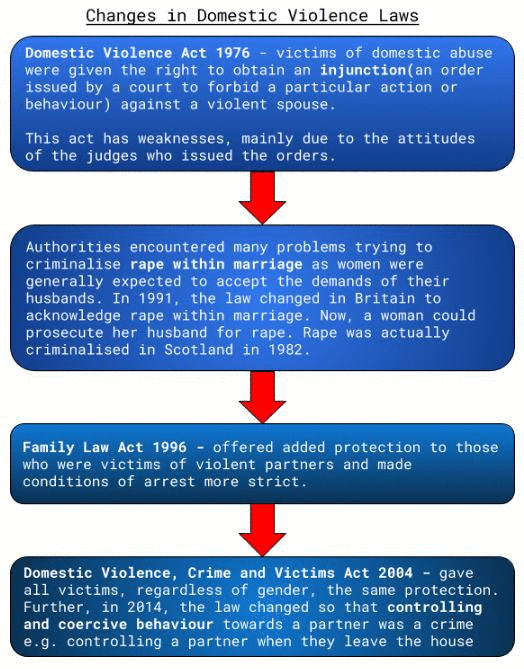
In the 19th century, many women had campaigned for equal rights and achieved success in some areas but little had been done in the way of domestic violence, until the 20th century.
Before the 20th century, it was generally accepted across society that fathers and husbands had the right to beat both women and children. There was no place of interference from personal businesses or authorities.
Why were authorities slow to act?
People felt the law should apply to public matters, authorities did not want to interfere in private family matters
Therefore, much violence of males was ignored
Men were convicted of 'criminal assault' if they beat their wives; they only receive light punishments
Before 1918, women had little political power
Politicians did not consider women's issues important at the time
Laws were made by and enforced by men
'Drunkenness and disorder' among the working class was the description for domestic violence
Women were too afraid to make complaints against their husbands
The Forces of Change:
Media: covered domestic violence stories. Further, television dramas began to deal with the challenges of domestic violence.
Political Power: 1918 some women were given the right to vote. Then, in 1928, women received the same voting rights as men. Women's concerns became increasingly evident and they could also be elected to parliament at this stage.
Role of the State: state was seen as an entity that could intervene in the life of the family in order to improve the quality of life for its citizens.
Campaigns: the Women's Liberation Movement (WLM) grew in strength in the 1960s. This created pressure on the government to change laws to account for the rights of women.
Seite 3
Social Crimes
As discussed in previous Crime and Punishment courses, 'social crimes' are crimes that people in society accept to some degree. Before the 20th century, these were crimes of poaching and smuggling. In the 20th century, social crimes consist of offences such as using illegal drugs or driving offences.
A prime example today is copyright theft. Millions of people download music, games and films from the internet. These are all subject to copyright laws but people do not view this behaviour as criminal. It is difficult to enforce laws when they are not supported by society in the first place.
Driving Crimes:
Society's opinion regarding crimes can change over time. This is true with driving and the unnecessary crimes of speeding and drink driving. It became illegal to drive a car while drunk for the first time in 1925. Further, in 1967, a new law came in setting a maximum limit of alcohol a person could have in their blood while driving.
However, it was still commonplace for people to drive home intoxicated in the 1970s. The government in Britain began an advertising campaign in the 1970s to highlight the dangers of drink driving. As people have become more aware of the dangers, attitudes have changed dramatically. Government campaigns regarding speeding in the late 20th century also had a similar effect. People began to see these activities as unacceptable, as they threatened the well-being over other civilians.
Drugs:
The Misuse of Drugs Act (1971) made many drugs illegal, however, the legalisation of some classes of drugs became controversial. People argue that taking drugs should be legal in the fact that it does not harm other people. While some argue, legalisation helps to tackle crimes associated with drugs.
Redefining Old Crimes
Terrorism:
Terrorism is the use of violence in order to achieve political aims or to force a government to do something. Terrorists are focused on recruiting people who sympathise with their cause and want to frighten others into following their way of life. An earlier example of terrorism, can be seen in the 17th century with Guy Fawkes and the Gunpowder Plot.
Throughout the 20th century, there have been many terrorist organisations that have functioned in Britain. For example, the Irish Republican Army (IRA) campaigned for Irish nationalism throughout the 1970s and 1980s in Britain. In more recent decades, the main threat has come from Al-Qaeda and ISIS, who spread their message through the internet. The actual number of terrorist attacks is minimal, but it causes severe public disorder.
Cybercrime:
This relates to crime on the internet or crime that is connected with digital technology. The access to modern technology allows criminals to commit crimes on a much greater scale than previously achieved.
Fraud:
This involves impersonating other people or businesses in order to illegally obtain money. In the past, people would of tricked individuals into giving them sensitive information. However, in the internet age, criminals send out emails to numerous people in the hope that some reply back with banking details. The methods of fraud have changed over time.
Human-Trafficking:
People from poor countries are brought into the United Kingdom and are forced to work for no wage or very low wages. This is a form of modern day slavery. Some women and children end up in prostitution and are often controlled by criminal gangs.
Human-trafficking is not a new crime as it was going on throughout the 19th century.
Extortion:
This involves securing money through the use of blackmail or threats. Previously, people did this over the phone or through letters. Nowadays, criminals utilise the internet for extortion. An example would be the Ransomware attacks on the National Health Service in May, 2017.
Copyright:
This is a legal right of the artist or company of a particular work in terms of recognition, use and distribution as creator of the work. This applies to books, games, films etc. Today, copyright is prevalent through the downloading of music, computer games, television shows etc. The internet makes all of this material easily accessible.
Informationen
- Beschreibung
- Der Nutzer hat seine Fachbereichs-Information gelöscht. Notiz am Crime , erstellt von Gelöschter Nutzer am 18/08/2017.
- Erstellt von
- Gelöschter Nutzer · Aug 2017
- Aktualisiert
- 18 Aug 2017
- Aufrufe
- 28
- Verlauf
-
- Erstellt von Andrew Burke · 16 Aug 2017
- Kopiert von Andrew Burke · 18 Aug 2017
- Bewertung