
Notizen
Methods of Separation
Inhalt der Notizen (6)
Seite 1
Separating Mixtures
In a mixture, the atoms or molecules of different substances are not chemically joined together. This means they can be easily separated by physical processes including:
Filtration: Involves separating the component of a mixture according to their size. Only small particles will pass through, with larger particles being retained by the filter.
Evaporation: Separates mixtures of solids and liquids by evaporating the liquid
Chromatography: Separates substances according to their solubility in a particular solvent
Distillation: Separates mixtures of liquids with different boiling points.
Seite 2
Filtration and Crystallisation
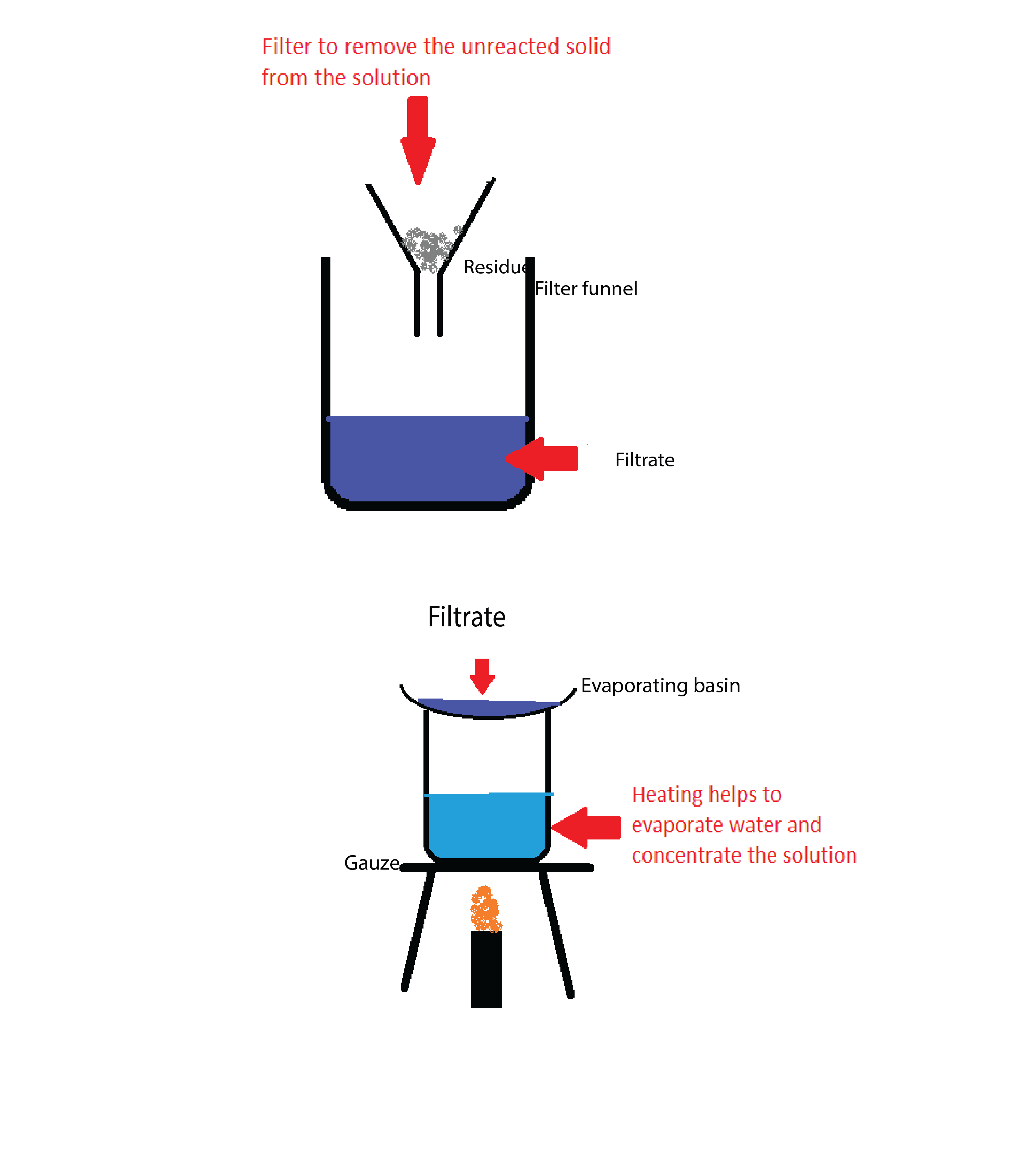
Filters can be used to separate mixtures.
They let smaller pieces and liquids through but trap larger pieces or insoluble substances.
Residue: The part remaining as a solid on the filter paper after a liquid passes through in the filtration procedure.
Filtrate: The fluid that passes through the filter paper.
Solvent: Other substances can dissolve in a solvent
Solute: A solute dissolves in other substances
Solution: A solution is formed when a solute dissolves in a solvent
Soluble : Will dissolve in other substances
Insoluble: Will not dissolve in other substances
Saturated solution: Contains the maximum amount of solute that can dissolve in that amount of solvent at that temperature
Solutes can be separated from solvents by evaporating the solvent to leave the solute behind. This process is known as crystallisation.
Solution Mining
Salt used for industrial purposes must be more pure than salt used for grit on roads.
Water is forced down a borehole in the rock salt, where salt dissolves in the water to form brine.
Brine is a concentrated salt solution.
The brine is heated until it forms a saturated salt solution.
The brine is then pumped to a purification plant where the salt isolated by crystallisation.
Seite 3
Simple distillation
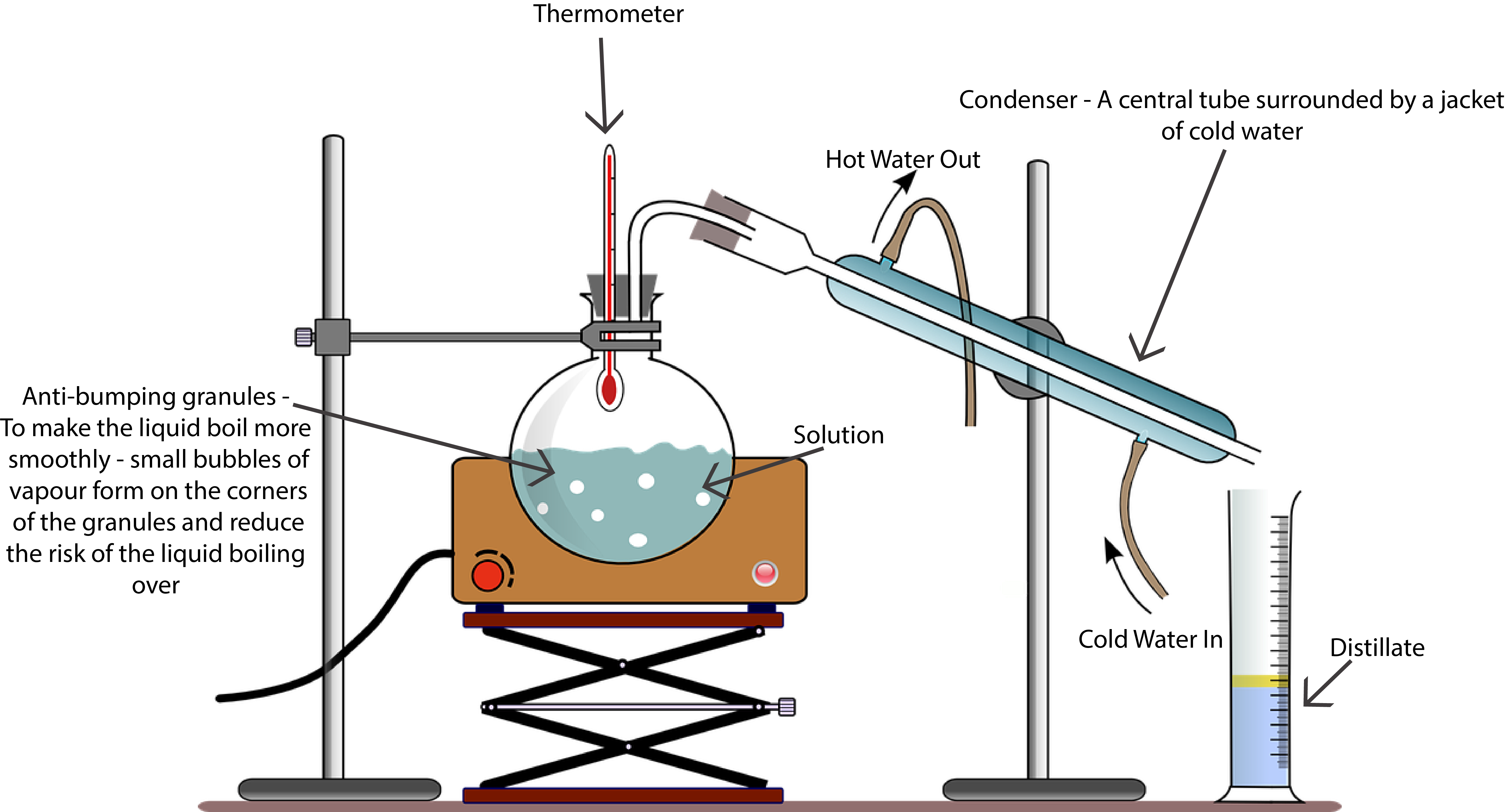
Distillation is a separation process which uses differences in boiling points to separate substances.
The type of distillation shown below would be suitable for a salty solution. The solid minerals would be left behind when the water boils at 100°C - they have a much higher boiling point than water. The condenser is cold, so the water vapour turns from steam back to water and drops into the graduated cylinder, thus separating it from the salts.
Seite 4
Fractional Distillation
Simple distillation is used to separate substances that have significant differences between their boiling points.
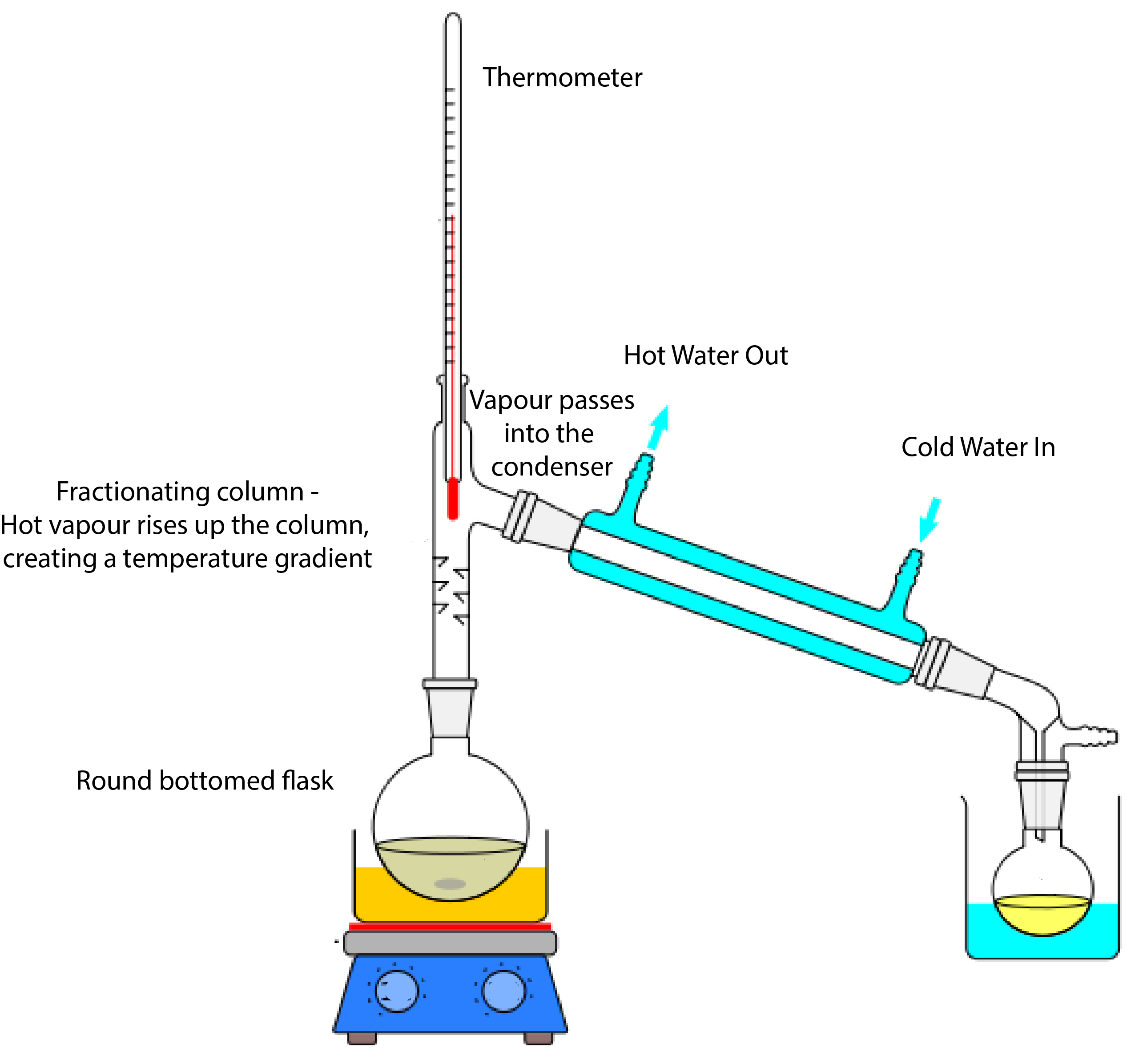
However, for mixtures of liquids that do not have significant differences between their boiling points, fractional distillation must be used. (Shown below)
As the column gradually heats up, a temperature gradient will develop - it will be hottest at the bottom. The vapour with the lowest boiling point will reach the top of the column first and pass into the condenser.
If you keep heating, fractions with higher boiling points will the rise up the column and can be collected later.
Fractional distillation may be used:
To separate the different products (fractions) in crude oil
To make alcoholic drinks such as whisky and vodka
To separate out the gases in air, after the air has been cooled and turned into a liquid at -200°C
Seite 5
Chromatography - Key Terms
Chromatography: A technique that can be used to identify and separate substances in a mixed solution
Paper chromatography is a simple technique based on the principle that some substances dissolve better in a solvent than others.
Thin Layer Chromatography is based on the principle that some substances adhere to the molecules of the stationary phase more strongly than others.
Paper chromatography can be used to:
Distinguish between pure and impure substances
Identify substances by comparing the pattern on the chromatogram with the patterns formed by known substances
Identify substances by calculating their \(R_f \text{ value. }\)
\(\text{ Stationary/ Immobile phase: }\) The solvent and dissolved substances move along this. In the case of paper chromatography, this is the paper. In the case of Thin Layer chromatography, the stationary/ immobile phase is aluminium oxide paste or silica gel
\(\text{ Mobile phase: }\) The solvent. This could be an aqueous solvent such as water, or a non-aqueous solvent such as ethanol
\(\text{ Chromatogram: }\) The paper with the separated components on it
\(R_f \text{ value: }\) The distance the compound has risen divided by the distance the solvent has risen. Both measurements are taken from the starting positions of the samples on the paper. This value depends on the mobile phase i.e. what solvent is used and the stationary phase i.e. what type of paper is use
\( R_f \text{ value= }\frac{\text{Distance moved by the spot}}{\text{Distance moved by the solvent}}\)
This value does not change if the chromatography conditions are the same.

Seite 6
How Chromatography Works
The startline, known as the baseline, should be drawn in pencil so that it doesn't run or smudge in the solvent.
The paper/TLC plate should be placed in the container so that the baseline is above the solvent. This means that the spots do not dissolve in the water.
The lid prevents the solvent from evaporating into the laboratory.
The solvent moves up the paper, carrying the spots with it.
Some spots move at different speeds according to their:
Solubility in the mobile phase
Strength of molecular adhesion to the stationary phase
The final result is known as the chromatogram.
If a substance is pure, only one spot will appear on the chromatogram.
Any colour which horizontally matches another is likely to be made up of the same molecule.
Sometimes the substances being separated are colourless. In this case, locating agents can be used to show where the spots are.
Locating agents bind to the chemicals in the spots. Sometimes, another chemical is then added, which reacts with the locating agent to produce a coloured spot, or the chromatogram is put under ultraviolet light and the locating agent glows to show where the spots are

Informationen
- Beschreibung
- Der Nutzer hat seine Fachbereichs-Information gelöscht. Notiz am Methods of Separation, erstellt von Gelöschter Nutzer am 22/08/2017.
- Erstellt von
- Gelöschter Nutzer · Aug 2017
- Aktualisiert
- 22 Aug 2017
- Aufrufe
- 44
- Verlauf
-
- Erstellt von Niamh Ryan · 31 Jul 2017
- Kopiert von Niamh Ryan · 2 Aug 2017
- Kopiert von Niamh Ryan · 22 Aug 2017
- Bewertung