
Quiz
OMM Questions
Erstelle ein kostenloses Konto, um dieses Quiz zu beenden
Speichere deinen Fortschritt und sieh dir dein Endergebnis an.
oder mit deiner E-Mail registrieren
Schon ein Konto? Anmelden
Fragen in diesem Quiz (63)
1Which of the following best illustrates the concept of mechanotransduction on a cellular level?
- AA contralateral relaxation of opposing muscles when the antagonist muscle is contracted
- BA hive occurring on the skin when someone is exposed to poison ivy
- CThe initiation of the clotting cascade secondary to exposure to von Willebrand factor from a damaged blood vessel
- DThyroid hormone release when thyroid receptors are triggered by thyroid stimulating hormone (TSH)
- EThe right atrium of the heart releasing a hormone secondary to stretch from heart failure
2Which of the following is a component of assessing the thoracic spine utilizing the area of greatest restriction screening?
- AWith the patient seated, press anteriorly on the thoracic spinous processes and alternate flexion and extension of the spine
- BWith the patient supine, place your hands along the mid-axillary line on either side of the rib cage and test for restriction by translating right and left
- CWith the patient prone, place your fingertips on the spinous processes, adding a force in a cephalad to caudad direction down the spine
- DWith the patient seated, sidebend the patient from both shoulders one side at a time and check for differences in sidebending right and left
- EWith the patient seated, use one hand to palpate the transverse processes and the other to grasp the patient’s ipsilateral shoulder and guide the thorax into extension, sidebending, and rotation from the patient’s ipsilateral shoulder
3A 13-year-old boy with a history of scoliosis presents to your office complaining of back pain. He states that this pain is worse with activity and prolonged standing. On examination you find that the area of greatest restriction is in the right lower thoracic region and the severity remains the same as you palpate laterally. There are several other regions of restriction which are moderate to almost just as severe as the right lower thoracic finding. You treat the right lower thoracic region and feel that the dysfunction in that region is resolved. Upon rescreening, you find that the dysfunctions in the other regions did not improve. What would you do next in your approach utilizing Dr. Stile’s area of greatest restriction (AGR) approach?
- AScreen just the upper extremity
- BAssess for a rib dysfunction
- CScreen just the lower extremity
- DRescreen the entire person
- EStop the OMM treatment
4A 55-year-old male painter presents to your office complaining of increased right neck and back pain for one week. You conduct a global assessment and find that the most severe restriction is in the thoracic region. You find increased tissue texture hypertonicity and decreased springing in the right T2-T7 paravertebral region. As you palpate laterally, the tissue is softer with more spring. Based on Stile’s Area of Greatest Restriction (AGR) screening, which region should you further inspect for specific somatic dysfunction contributing to this person’s pain?
- AThe lumbar region
- BThe upper extremity
- CThe rib cage
- DThe cervical region
- EThe thoracic region
5A 20-year-old male who was in a motor vehicle accident two days ago, presents to the office with a 36-hour history of neck and lower back pain. On physical exam, his neurologic and cardiac exams are negative and he has a left on left forward sacral torsion. Which of the following findings would lead you to this sacral diagnosis?
- ARight deep sulcus
- BPositive backward bending test
- CRight axis of rotation
- DRight posterior inferior lateral angle
- ESacral base prefers counter-nutation position
6A 70-year-old female with spinal stenosis and worsening low back pain over the past few months is brought into the office by her spouse. She complains of low back pain which is 8/10 in severity on a scale of 0 to 10. The pain is exacerbated by trying to stand erect. On physical exam, she is neurologically intact and she has a negative seated flexion test and a positive lumbosacral spring test. At this point, which of the following diagnoses might you consider?
- ALeft on left forward sacral rotation
- BRight unilateral sacral flexion
- CBilateral sacral extension
- DBilateral sacral flexion
- ERight on right forward sacral torsion
7A 27-year-old figure skater presents to the office after falling onto her buttocks on the ice. This resulted in pain radiating from her left buttock to her posterolateral thigh. She is neurologically intact with no pain superior to her lumbosacral junction. Which of the following is true regarding the muscle that is likely to be causing her radicular pain symptoms?
- AIt originates on the anterior-lateral surface of the sacrum
- BIt inserts into the lesser trochanter
- CIt functions as an internal rotator of the hip
- DIt functions as hip flexor
- EIt is innervated by the tibial nerve
8A 29-year-old female presents to the clinic with a chief complaint of painful menses. The anti-inflammatory medications and birth control pills she has tried offer little relief and she is concerned about their side effect profile. On physical exam, you find a positive seated flexion test on the right and a positive backward bending test. At this point, which of the following diagnoses might you consider?
- ALeft on left forward sacral torsion
- BLeft on right backward sacral rotation
- CRight unilateral sacral flexion
- DLeft unilateral sacral extension
- ERight unilateral sacral extension
9A 58-year-old male presents to your office complaining of constipation. He reports a low fiber diet and poor water consumption. Which of the following somatic dysfunctions is best associated with his complaint?
- AT4 extended rotated and side bent left
- BLeft externally rotated tibia
- CRight externally rotated hip
- DLeft outflare innominate
- ERight thigh adduction somatic dysfunction
10You are a medical student on rotation with a primary care physician. An 18-year-old female competitive horseback rider presents to the office with complaint of headache. History reveals she fell off a horse onto her “tailbone” four months ago and has had headaches about every other day since then. When presenting the case to the attending, you suggest a treatment plan including OMT in addition to pharmacologic management. You decide to treat the pelvis and sacrum to help alleviate the patient’s headache. Which of the following structures of the sacrum and pelvis directly influences the patient’s cranium?
- AFemoral triangle
- BDura attachment at S2
- CIschiorectal fossa
- DGreater sciatic foramen
- EFemoroacetabular joint
11A 19-year-old female presents to your office complaining of urinary urgency, frequency, and dysuria in addition to suprapubic pain for the past two days. She is afebrile and has no flank pain. After a urinalysis confirms a urinary tract infection and you prescribe the appropriate antibiotics, you decide to perform OMT to help relieve her pain, promote circulation and promote healing to her lower urinary tract. In which area would you expect to find the most severe somatic dysfunction?
- AThe pubic bones
- BThe fourth and fifth thoracic vertebrae
- CThe tibiofemoral joint
- DThe occipitoatlantal joint
- EThe seventh costochondral joint
12A 45-year-old male presents to your office with low back pain for the past 3 days. He admits to helping his mother move last weekend and tripping while carrying a large, heavy box. The standing flexion test is positive on the right. The ASIS compression test is positive on the left. You find the ASIS inferior on the left, the PSIS superior on the left, the medial malleolus inferior on the left. The pubic tubercles are even. What is true on the side for which you name the somatic dysfunction?
- AHamstrings and quadriceps are shortened
- BHamstrings are stretched and the quadriceps are shortened
- CHamstrings are shortened and the quadriceps are stretched
- DHamstrings and quadriceps are stretched
- EThe leg is anatomically or functionally longer
13Which of the following somatic dysfunctions is most closely associated with an “atypical vertebra”?
- AAA rotated right
- BC3 flexed, rotated, and sidebent right
- CC5 extended, rotated and sidebent right
- DC6 flexed, rotated and sidebent left
- EC7 neutral, sidebent right rotated left
14A 29-year-old male blackjack dealer presents to your office complaining of a three month history of bilateral cold hands associated with numbness and weakness in his hands, neck pain and shoulder pain. He states that it feels like his arms are swollen and the symptoms worsen after working a shift of dealing cards. Which of the following tests would you consider most useful for aiding with discovering this patient’s diagnosis?
- AAdson's test
- BDrop arm test
- CApprehension test
- DNeer's test
- EApley's scratch test
15Which of the following areas would least likely have a somatic dysfunction caused by acute hyperextension-hyperflexion injuries?
- AIlium
- BSacrum
- COcciput
- DTemporal bones
- ESternocleidomastoid
16You are on your family medicine rotation discussing cases with your colleagues at a morning lecture and one of your colleagues tells you he saw a 25-year-old man who had a left on right backward sacral torsion. Being skilled in osteopathic diagnosis, you know that the patient’s sacrum was:
- ARotated left on a cephalo-caudal axis
- BRotated left on a left oblique axis
- CRotated left on a right oblique axis
- DRotated right on a left oblique axis
- ERotated right on a right oblique axis
17A 32-year-old female basketball player presents to your office complaining of severe low back pain. She states that two weeks ago she fell backwards onto her buttocks after trying to block a shot. Nothing improves the pain and if she arches her back it becomes worse. The pain is sharp, non-radiating, and, on a scale of 0-10, she rates the pain as 8/10 in severity. Her neurological exam is normal. Examination reveals a right-sided posterior-inferior sacral inferior-lateral angle (ILA) which becomes more prominent during the backward bending test and a deep sacral sulcus on the left. L5 is rotated to the right. What is your sacral diagnosis?
- ALeft on left forward sacral torsion
- BLeft on right backward sacral torsion
- CLeft on right backward sacral rotation
- DRight on left backward sacral rotation
- ERight on right forward sacral torsion
18A 47-year-old male accountant presents to your office complaining of lower back pain after “twisting his back wrong” while zip-lining over an Alaskan rain forest two weeks ago. He states the pain is sharp, non-radiating and 5/10 in severity on a scale from 0-10. His neurological exam is normal and reveals a negative backward-bending test, a posterior-inferior left sacral inferior-lateral angle (ILA), a deep sacral sulcus on the right, and an L5 posterior transverse process on the right which becomes more symmetrical with the left transverse process during extension. What is your sacral diagnosis?
- ARight on right forward sacral torsion
- BRight on left backward sacral torsion
- CLeft on left forward sacral torsion
- DLeft on right backward sacral torsion
- ERight on right forward sacral rotation
19A 27-year-old male zoo-keeper presents to your office complaining of lower back pain. The left low back pain began two weeks ago after he twisted awkwardly while trying to break up a fight between a gorilla and a rabbit. He states the pain is sharp, non-radiating and 5/10 in severity on a scale from 0-10. His neurological exam is normal and reveals a negative backward-bending test, a posterior-inferior left sacral inferior-lateral angle (ILA), a deep sacral sulcus on the left, and L5 rotated to the left. What is your sacral diagnosis?
- ALeft unilateral sacral flexion
- BLeft unilateral sacral extension
- CLeft on left forward sacral rotation
- DRight unilateral sacral extension
- ERight unilateral sacral flexion
20A 25-year-old male presents to the emergency department after injuring his left ankle while playing soccer earlier in the day. Which of the following physical findings would most likely suggest that he needs an X-Ray before you consider treating him with osteopathic manipulation?
- AEcchymosis of the lateral aspect of the left ankle with mild edema
- BInability to bear weight immediately and point tenderness over the styloid process of the fifth
metatarsal - CAbility to bear weight immediately after the injury with no midfoot pain
- DMild edema and the ability to walk for 6 consecutive steps in the emergency department hall
- EMild edema and the ability to bear weight immediately after the injury
21A 65-year-old female patient with peripheral diabetic neuropathy presents to your office with a chief complaint of lower extremity weakness bilaterally for the past two months. The patient cannot stand and walk on her toes. What nerve root is most likely affected?
- AL2
- BL3
- CL4
- DL5
- ES1
22A 22-year-old with unresolved edema from an ankle sprain 3 weeks ago presents to your office today because her gymnastics coach told her a D.O. might be able to help her get back to peak performance sooner. Which of the following areas contains lymph nodes most proximal to her injury site?
- AThoracic aperture
- BPopliteal fossa
- CFemoral triangle
- DThoracic-abdominal diaphragm
- EPelvic diaphragm
23A 21-year-old female who is on the swim team, presents to your office complaining of a depressed rib on her right side. On physical exam, you find an exhalation dysfunction of ribs 1-4 on the right. Which is her key rib?
- ARib 1 on the right
- BRib 1 on the left
- CRib 4 on the right
- DRib 4 on the left
- ERib 2 bilaterally
24During inspiration in the bucket handle description, the lateral part of the rib moves:
- ASuperiorly
- BInferiorly
- CAnteriorly
- DPosteriorly
- EIn the sagittal plane
25In the Journal of the American Osteopathic Association (JAOA) Review Article by Cymet and Sinkov, they discuss some potential anatomical or historical factors from the patient that could potentially accelerate the onset of osteoarthritis of the hip joint. Which of the following is one of the factors they discussed?
- AHigh body mass index (BMI)
- BCoxa valga
- CExcessive femoral anteversion
- DA history of celiac disease
- EA history of asthma
26A patient has 10 degrees of transverse plane orientation of the hip joint and femoral neck. This is classified as:
- ADecreased anteversion
- BCoxa vara
- CExcessive anteversion
- DRetroversion
- ECoxa valga
27A 57-year-old female has loss of internal rotation of her left hip joint, and chondral inhomogeneity as seen on her MRI. She has difficulty tying her shoes, as well as difficulty putting her pants on and taking them off. She has had no recent trauma, and review of systems is otherwise negative. Which of the following is her most likely diagnosis?
- AOsteoarthritis
- BAnkylosing spondylitis
- CRheumatoid arthritis
- DTrochanteric bursitis
- EHip fracture
28A 41-year-old male seeks care for left ankle pain after a long hike. During your physical examination, you note that the left foot is freer in plantarflexion and internal rotation compared with the right foot. Which of the following would be a correct diagnosis of the left lower limb?
- APosterior fibular head
- BAnterior fibular head
- CPronation of the foot
- DEversion of the foot
- EExternal rotation of the tibia
29A 20-year-old patient presents with right knee pain and stiffness for the past two weeks without known trauma. On physical examination, there is significant reduction in both directions during active testing of the major motion of the right knee. Which of the following additional right-sided findings would best correlate with this reduced range of motion?
- ATenderness of the medial and lateral patella borders
- BTenderness of the fibular head
- CTenderness just inferior to the anterior tibial tubercle
- DTenderness of the lateral knee joint line
- ETenderness in the middle of the politeal fossa
30A 24-year-old football player sustains a strong lateral blow to the lateral part of the knee by a fellow player during a game. Which of the following is most likely true regarding this type of injury (assume that the patient can tolerate testing)?
- AAnterior drawer test is positive
- BValgus testing is negative
- CVarus testing is positive
- DMcMurry's test is negative
- EPatella grind test is positive
31A 60-year-old male with a history of heavy alcohol intake presents to your office with productive cough, tactile fever, chills, and fatigue for one week. His oral temperature is 99.8°F. His vital signs are otherwise within normal limits. Pertinent physical exam findings include normal heart sounds and positive tactile fremitus in the right lower lung field. Which spinal level would you expect to find increased and persistent red reflex, increased diaphoresis and drag, increased temperature, and bogginess without a firm, stiff end point?
- AT7-9
- BT10-L1
- CT11-L2
- DT2-4
- ET1-2
32A 17-year-old female presents to her gynecologist with irregular menses and mid-cycle pelvic pain. On abdominal exam, there is a palpable, tender mass, approximately 2cm x 2cm in the left lower quadrant. In which spinal region would you expect to find somatic dysfunction?
- AT10-L2
- BT1-2
- CT5-9
- DOA-C2
- EC6-7
33When visceral afferent neurons are excited by excessive or chronic physical distension or contraction, chemical changes such as inflammation, or localized changes in temperature, a cellular crosstalk or spillover effect can lead to which of the following?
- ASomatosomatic reflex
- BCrossed extension reflex
- CViscerosomatic reflex
- DVestibular-ocular reflex
- EDeep tendon reflex
34Which of the following Sir William Osler quotes is an example of the remapping process?
- A“Soap and water and common sense are the best disinfectants.”
- B"To confess ignorance is often wiser than to beat about the bush with a hypothetical diagnosis.”
- C“The first duties of the physician is to educate the masses not to take medicine.”
- D"Learn to see, learn to hear, learn to feel, learn to smell, and know that by practice alone you can become expert.”
- E“The good physician treats the disease; the great physician treats the patient who has the disease.”
35A 40-year-old obese female presents to the office complaining of a recent onset of heartburn. On structural exam, you firmly stroke the skin over the paravertebral muscles bilaterally and note the changes at the third to ninth thoracic level bilaterally. If this patient does indeed have a new reflux problem as you suspect, then, at the segment mentioned, this test would likely elicit:
- AIncreased drag
- BDecreased drag
- CPoor turgor
- DBlanching
- EErythema
36A 33-year-old male presents to the clinic with new onset of back pain after lifting some boxes two hours ago. The pain has been constant since then and is located across the lumbo-sacral junction bilaterally. Sitting makes it worse; cold packs have helped a little. He denies numbness, tingling, radiation of pain and weakness. Which of the following tissue changes would you expect to find related to this new complaint?
- AStringy muscle
- BRopy muscle
- CDry/atrophic skin
- DBlanching
- EIncreased skin drag
37An 8-year-old girl with a past medical history significant for near-sightedness had accidentally placed her right hand upon a hot burner at home. She reacted by instantaneously pulling her hand away from the noxious stimulus. Her body’s reaction in this case scenario correlates best with which osteopathic tenet or corollary?
- AThe human person is a unit
- BThe maintenance of a disease state has contributions from somatic manifestations
- CRational treatment is based on the previous principles
- DThe movement of body fluids is essential to the maintenance of health
- EThe nervous system plays a crucial part in controlling the body
38A 3-year-old girl presents to your office with a significant past medical history of torticollis since birth. You perform an osteopathic structural examination and note that her head and neck are slightly sidebent right and rotated to the left. In addition, you note greater prominence of the mastoid process on the side of the origin of the affected muscle. Which osteopathic tenet or corollary does her physical finding correlate with best?
- AThe human person is a unit, including mind, body, and spirit
- BThe body possesses self-regulatory mechanisms
- CStructure and function are reciprocally interrelated
- DThe movement of body fluids is essential to the maintenance of health
- EThe nervous system plays a crucial part in controlling the body
39A 78-year-old female’s recent laboratory work results show that her thyroid stimulating hormone (TSH) level is high, and her free T4 level is low. Which osteopathic tenet or corollary does this situation correlate with best?
- AThe human person is a unit, including mind, body, and spirit
- BThe body possesses self-regulatory mechanisms
- CStructure and function are reciprocally interrelated
- DRational treatment is based on the main osteopathic principles
- EThe somatic component is a manifestation of the disease state and could contribute to the maintenance of that state
40In the spinal (vertebral) column, which of the following occurs with pulmonary inspiration?
- AThere is a reduction of type II mechanics in the spine with pulmonary inspiration
- BThere is induction of type II mechanics in the spine with pulmonary inspiration
- CThe sagittal spinal curves flatten with pulmonary inspiration
- DThe frontal spinal curves flatten with pulmonary inspiration
- EThe sagittal spinal curves exaggerate with pulmonary inspiration
41Using the Rule of Threes, the spinous process of T11 would be located:
- AIn line with its own transverse processes
- BHalf-way between its own transverse processes, and the transverse processes of the vertebra just below (T12)
- CHalf-way between its own transverse processes, and the transverse processes of the vertebra just above (T10)
- DA full level below its own transverse processes, in line with the transverse processes of the vertebra below (T12)
- EA full level above its own transverse processes, in line with the transverse processes of the vertebra above (T10)
42A 37-year-old female was competing in her local bowling league for two days straight, and she aggravated her mid-to-lower back area with all the excessive competitive bowling maneuvers. She presents to you complaining of back pain and you find T8 flexed, rotated left, sidebent left. What is the problem with the facet(s)?
- AThe left facet is stuck closed, and cannot open
- BThe left facet is stuck open and cannot close
- CThe right facet is stuck closed and cannot open
- DThe right facet is stuck open and cannot close
- EBoth facets are stuck closed and cannot open
43A 21-year-old male presents with complaints of increased back pain ever since he started training for a half marathon. He never was an avid runner and started training 3 months ago. On examination you notice that he has flat feet bilaterally. You tell him that you highly suspect that his back pain is related to his flat feet. He asks how that is possible. You explain that this best illustrates which of the following osteopathic principles?
- AThe mind, body, spirit connection
- BThe body has a self-regulatory mechanism
- CDisease ensues when homeostasis is maintained
- DStructure and function are interrelated
- EThe nervous system plays a crucial part in controlling the body
44Which of the following correctly pairs the event with the correct year?
- A1840 - Dr. Andrew Taylor Still was born
- B1892 - The year the American School of Osteopathy opened
- C1935 - The Spanish flu pandemic infected about one-third of the world's population
- D1939 - DOs were first drafted into the military and thus fought in World War II
- E1983 - Louisiana was the last state to grant DOs licensure
45A 67-year-old male with a history of lower back pain and a left knee replacement surgery two weeks ago, presents to the emergency department with a 2 day history of cough, fevers, and chills. His work up shows that he has developed right lower lobe pneumonia. On examination he has increased swelling in both legs and decreased excursion of his rib cage with respiration. He states that he has not been moving as much since the knee replacement due to pain. Which of the following is true regarding treatment of this patient with osteopathic manipulative treatment?
- AOsteopathic manipulation has not been shown to be helpful for patients with pneumonia
- BTreatment of the thoracic cage can help with improving the rib cage excursion
- CLymphatic pumps would not help the swelling in the legs
- DDoming the diaphragm would cause the patient to hyperventilate
- ETreatment to the upper neck would not be effective for this patient’s pulmonary problem
46According to Smuck and colleagues, the biggest indicator of lower back pain (LBP) in the USA is:
- AExercise intensity has no impact on LBP
- BAs BMI increases so does the chance of LBP
- CSmoking had little effect on LBP
- DLBP was more common in women
- ELBP was more common in older men
47What type of contraction occurs when a muscle is actively contracted with no lengthening or shortening of the muscle?
- AIsometric contraction
- BConcentric contraction
- CEccentric contraction
- DActively lengthening the fibers
- EPassively contracting the muscles
48A 45-year-old male presents to your office with lower back pain. He has a sedentary job and spends more than half his day at work on a computer. He asks what he can do at home to improve his flexibility. One stretch you can demonstrate to improve his flexibility would be:
- AKnee extension to passively lengthen the hamstring muscles, and to hold it steady with no bouncing for 15-60 seconds
- BKnee extension to actively lengthen the hamstring muscles, and to hold it steady with no bouncing for 15-60 seconds
- CKnee flexion to passively lengthen the hamstring muscles, and to hold it steady with no bouncing for 15-60 seconds
- DHip extension to passively lengthen the hamstring muscles, and to hold it steady with no bouncing for 15-60 seconds
- ELie prone with arms extended. Lift arms, legs and head
49A 23-year-old professional hockey player presents with the chief complaint of pain in her left shoulder. Upon examination you find the range of motion of the shoulder to be the following: flexion to 120 degrees, extension to 45 degrees, abduction to 180 degrees, adduction to 45 degrees, internal rotation to 55 degrees, and external rotation to 45 degrees. Which of the following motions is her restriction?
- AFlexion
- BExtension
- CAbduction
- DAdduction
- EExternal rotation
50A 45-year-old female presents with the chief complaint of right sided shoulder pain for two weeks. She reports that the pain is achy and made worse with lifting heavy objects. You perform a test to localize the issue by flexing the elbow to 90 degrees, pronating the patient’s wrist and elbow, and asking the patient to supinate her arm while monitoring with your other hand on the humerus. She tells you that supinating her arm reproduces the pain. Which of the following is most likely causing her right shoulder pain based on your findings?
- ABiceps tendonitis
- BThoracic outlet syndrome
- CRotator cuff tear
- DShoulder dislocation
- EImpingement of the rotator cuff tendons
51As your patient abducts his arm 45 degrees, you notice that, with respect to the scapulohumeral joint rhythm:
- AThe scapular moves 30 degrees and the humerus moves 15 degrees
- BThe scapula moves 22.5 degrees and the humerus moves 22.5 degrees
- CThe acromioclavicular joint moves 22.5 degrees
- DThe scapula moves 15 degrees and the humerus moves 30 degrees
- EThe scapular moves 45 degrees and the humerus moves 45 degrees
52A 35-year-old construction worker presents to your office complaining of a painless and unexplainable mass on his wrist. On physical exam, you note an approximately 20 mm round and smooth swelling in thescapholunate area as well as restricted range of motion of the wrist. What is the most likely diagnosis?
- AKienbock's disease
- BOsteoarthritis
- CRheumatoid arthritis
- DGanglion cyst
- EEpithelial sarcoma
53A 54-year-old pianist presents to your office after playing a 4-hour recital. He complains of numbness and tingling over his 4th and 5th digits. After a thorough history and physical exam, you believe he is experiencing symptoms of nerve entrapment. A restriction through what anatomical area would most likely be responsible for his symptoms?
- ASupinator fossa
- BFlexor retinaculum
- CTarsal tunnel
- DGuyon's canal
- ERadial fossa
54Which muscle group is paired correctly with its action?
- AFlexor carpi ulnaris: wrist flexion and hand abduction
- BExtensor carpi ulnaris: wrist extension and hand abduction
- CFlexor carpi radialis: wrist flexion and hand adduction
- DPalmaris longus: wrist flexion and hand abduction
- EExtensor carpi radialis longus & brevis: wrist extension and hand adduction
55A 22-year-old male presents to your office complaining of moderate intermittent right elbow pain for the past week that is worse when he is playing hockey. He states that he started playing on a hockey team 4 weeks ago. On physical exam, there is tenderness upon palpation of his medial epicondyle. He experiences mild pain with full elbow extension and pain when he tries to flex his wrist against resistance. Which of the following muscles is most likely involved in this patient’s elbow pain?
- AExtensor digitorum muscle
- BExtensor carpi radialis brevis muscle
- CFlexor carpi radialis muscle
- DAbductor pollicis longus muscle
- EBrachioradialis muscle
56A 22-year-old male osteopathic medical student presents to your office with elbow pain. He was leaning on his right, flexed elbow while reading for several hours. When he changed position, he experienced tingling in his right elbow which radiated down his forearm. Performing which of the following special tests of the elbow would help to confirm your suspected diagnosis?
- AVarus stress test
- BValgus stress test
- CResisted wrist flexion
- DTinel's sign
- EForced wrist flexion
57A 73-year-old female presents to your office complaining of mild pain in her left elbow and not being able to reach as well since she had a surgical fixation of an elbow fracture 5 weeks ago. Physical exam reveals pain in the elbow elicited with left elbow extension. She can only extend to 45 degrees. How would the somatic dysfunction of her left elbow be named?
- ALeft elbow flexion dysfunction
- BLeft elbow extension dysfunction
- CLeft ulnohumeral abduction dysfunction
- DLeft ulnohumeral adduction dysfunction
- ELeft posterior radial head dysfunction
58A 20-year-old male presents to the office with severe upper back pain after hurting his back 1 day ago lifting a heavy box when moving into his dorm room. Chest x-ray reveals no fracture. Which of the following tissue texture changes would most likely indicate an acute somatic dysfunction finding if detected on palpation of his back?
- AIncreased moisture
- BMuscle atrophy
- CA lack of swelling or edema
- DSmooth texture
- ECool temperature
59A 15-year-old male with a history of scoliosis presents with increased back pain for the past couple of months. Images of his examination standing and forward bending are attached. Based on the attached images, which of the following movements would be the most significantly reduced with range of motion testing of the thoracic spine?
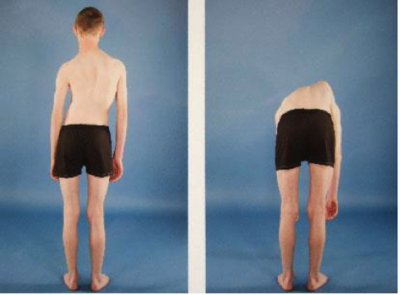
- ALeft rotation
- BForward flexion
- CRight rotation
- DLeft sidebending
- EExtension
60A 21-year-old male presents with localized back pain after twisting his back while playing basketball about 4 hours ago. On examination you localize the pain to the level of T8 on the right. With flexion, the right transverse process is more posterior and resists anterior springing compared to the left transverse process. In extension, the transverse processes are symmetrical bilaterally. Which of the following is the biomechanical etiology for his T8 somatic dysfunction?
- AThe left facet will not open
- BThe left facet will not close
- CThe right facet will not open
- DThe right facet will not close
- EThere is no facet restriction as this is a Type I dysfunction
61A 23-year-old male presents to your office complaining of left upper-back pain. After a complete history and exam, you diagnose a T5 flexed, rotated and sidebent left as the reason for the pain. At the level of T5 on T6, what would be the first step you would do in order to treat this patient with facilitated positional release?
- AExtend T5 on T6 until it is neither flexed nor extended
- BRotate T5 on T6 to the left
- CFlex T5 on T6 to increase the thoracic kyphosis
- DSidebend T5 on T6 to the left
- EAdd a compressive force down to the T5-T6 segment
62A 43-year-old male presents to your office complaining of right mid-back pain. As part of your exam, you note a T8 transverse process is posterior on the right. With flexion, it becomes more symmetrical on the left side. With extension, the right transverse process becomes even more posterior. You decide to treat it by putting the segment into extension, left sidebending and left rotation. This is the starting position for which of the following treatment modalities for this somatic dysfunction:
- AMuscle energy
- BStill technique
- CFacilitated positional release
- DMyofascial soft tissue technique
- ECounterstrain
63You are evaluating a weight lifter who is complaining of a tightness in his triceps, an elbow extensor. You note his triceps to be in spasm and decide to treat by fully extending the elbow while the patient does nothing other than lie comfortably on the treatment table. You hold the position until you note a softening of the triceps spasm. How would you classify this treatment?
- APassive - indirect
- BPassive - direct
- CActive - indirect
- DActive - direct
- EActive - direct then indirect
Informationen
- Beschreibung
- Quiz am OMM Questions, erstellt von jochamplin am 09/12/2014.
- Autor
- jochamplin
- Sprache
- English
- Aufrufe
- 606
- Verlauf
- Erstellt am 9 Dez 2014 · aktualisiert am 13 Dez 2016
- Bewertung
- Noch keine Bewertungen Bewerte dieses Quiz