
Quiz
General Physics - Vectors
Dieses Quiz hat ein Zeitlimit und öffnet sich deshalb im gewohnten Player.
Fragen in diesem Quiz (20)
1We say that the displacement of a particle is a vector quantity. Our best justification for this assertion is
- Adisplacement can be specified by a magnitude and a direction
- Boperating with displacements according to the rules for manipulating vectors leads to results in agreement with experiments
- Ca displacement is obviously not a scalar
- Ddisplacement can be specified by three numbers
- Edisplacement is associated with motion, where velocity is a vector
2Which of the following is an accurate statement?
- AA vector cannot have zero magnitude if one of its components is not zero
- BThe magnitude of a vector can be less than the magnitude of one of its components.
- CIf the magnitude of vector A is less than the magnitude of vector B, then the x-component of A is less than the x-component of B.
- DThe magnitude of a vector can be positive or negative.
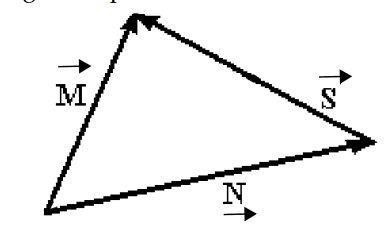
3In the given figure, express vector \(\vec S\) in terms of \(\vec M\) and \(\vec N\).
- A\[\vec S = -\vec M - \vec N\]
- B\[\vec S = \vec N - \vec M\]
- C\[\vec S = \vec M + \vec N\]
- D\[\vec S = \vec M - \vec N\]
4Check all statements that are true.
- AThe magnitude of a vector can never be less than the magnitude of one of its components
- BIf the magnitude of vector \(\vec A\) is less than the magnitude of vector \(\vec B\) , then the x component of
\(\vec A\) is less than the x component of \(\vec B\). - CIf all the components of a vector are equal to 1, then that vector is a unit vector.
- DIf \(|\vec A + \vec B|=A+B\) and \(|\vec A - \vec B|=A+B\), then \(\vec A\) and \(\vec B\) are parallel with each other.
- EIf two vectors point in opposite directions, their cross product must be zero.
- FIf two vectors are perpendicular to each other, their dot product must be zero.
5Which of the following diagram illustrates the relationship \(\vec c = \vec b - \vec a\)?
- A
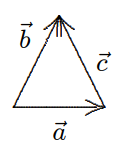
- B
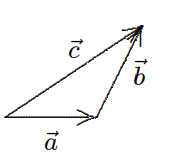
- C
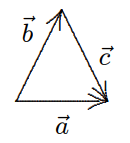
- D
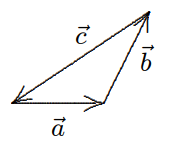
- A
6The vector \(\vec V_3\) in the diagram is equal to
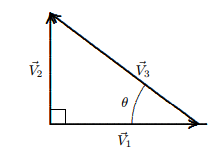
- A\(\vec V_1 - \vec V_2\)
- B\(\vec V_1 + \vec V_2\)
- C\(\vec V_2 - \vec V_1\)
- D\(\vec V_1 \cos \theta \)
- E\(\vec V_1 / (\cos \theta)\)
7Four vectors (\(\vec A, \vec B, \vec C, \vec D\)) all have the same magnitude. The angle \(\theta\) between the adjacent vectors is \(45^{\circ}\) as shown. The correct vector equation is
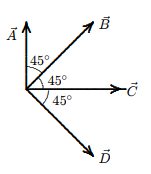
- A\(\vec A - \vec B - \vec C + \vec D = 0\)
- B\(\vec B + \vec D - \sqrt{2}\vec C=0\)
- C\(\vec A + \vec B = \vec B + \vec D\)
- D\(\vec A + \vec B + \vec C + \vec D = 0\)
- E\((\vec A + \vec C)/\sqrt{2} = -\vec B\)
8Vectors \(\vec A\) and \(\vec B\) lie in the \(xy\) plane. We can deduce that \(\vec A=\vec B\) if
- A\({A^2}_x+{A^2}_y={B^2}_x+{B^2}_y\)
- B\(A_x+A_y=B_x+B_y\)
- C\(A_x=B_x\) and \(A_y=B_y\)
- D\(\frac{A_y}{A_x}=\frac{B_x}{B_y}\)
- E\(A_x=B_y\) and \(A_y=B_x\)
9If the eastward component of vector \(\vec A\) is equal to the westward component of vector \(\vec B\) and their northward components are equal. Which one of the following statements about these two vectors is correct?
- AVector \(\vec A\) is parallel to vector \(\vec B\)
- BVectors \(\vec A\) and \(\vec B\) point in opposite directions.
- CVector \(\vec A\) is perpendicular to vector \(\vec B\)
- DThe magnitude of vector \(\vec A\) is equal to the magnitude of \(\vec B\).
- ENone of the statements.
10Which of the following operations will not change a vector?
- ATranslate it parallel to itself.
- BRotate it
- CMultiply it by a constant factor.
- DAdd a constant vector to it.
- ETranslate it perpendicular to itself.
- FNone of the choices.
11If \(\vec A\) and \(\vec B\) are nonzero vectors for which \(\vec A \cdot \vec B=0\), it must follow that
- A\(\vec A \times \vec B=0\)
- B\(\vec A\) is parallel to \(\vec B\).
- C\(|\vec A \times \vec B|=AB\)
- D\(|\vec A \times \vec B|=1\)
- ENone of the statements.
12For the vectors shown in the figure, find the magnitude and direction of vector product \(\vec A \times \vec C\), assuming that the quantities shown are accurate to two significant figures.
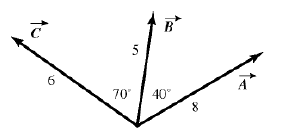
- A16, directed into the plane
- B16, directed out of the plane
- C45, directed into the plane
- D45, directed out of the plane
13What is the vector product of \(\vec A = 2.00 \hat i + 3.00 \hat j + 1.00 \hat k\) and \(\vec B = 1.00 \hat i - 3.00 \hat j - 2.00 \hat k\)?
- A\(-3.00 \hat i + 5.00 \hat j - 9.00 \hat k\)
- B\(-5.00 \hat i + 2.00 \hat j - 6.00 \hat k\)
- C\(5\)
- D\(2.00 \hat i -9.00 \hat j - 2.00 \hat k\)
- E\(-9\)
14What is the magnitude of the cross product of a vector of magnitude 2.00 m pointing east and a vector of magnitude 4.00 m pointing 30.0° west of north?
- A6.93
- B-6.93
- C4.00
- D-4.00
- E8.00
- F6.81
15Three forces are exerted on an object placed on a tilted floor. Forces are vectors. The three forces are directed as shown in the figure. If the forces have magnitudes \(\vec F_1 = 1.0 N, \vec F_2 = 8.0\) and \(\vec F_3 = 7.0 N\), where N is the standard unit of force, what is the component of the net force \(\vec F_{net}=\vec F_1+ \vec F_2+\vec F_3\) parallel to the floor?
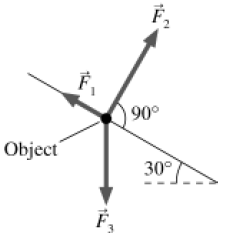
- A2.5N
- B5.1N
- C6.0N
- D7.8N
16Vectors A and B are shown in the figure. Vector \(\vec C\) is given by \(\vec C = \vec B -\vec A\). The magnitude of vector \(\vec A\) is 16.0 units, and the magnitude of vector \(\vec B\) is 7.00 units. What is the angle of vector \(\vec C\), measured counterclockwise from the +x-axis?
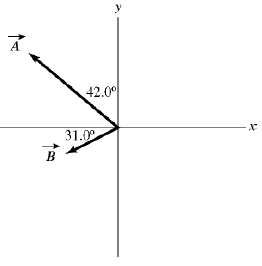
- A16.9°
- B22.4°
- C73.1°
- D287°
- E292°
- F68
17You walk 53 m to the north, then turn 60° to your right and walk another 45 m. Determine the direction of your displacement vector. Express your answer as an angle relative to east.
- A63° N of E
- B50° N of E
- C57° N of E
- D69° N of E
18Vectors \(\vec A\) and \(\vec B\) are shown in the figure. What is \(|-5.00\vec A + 4.00 \vec B|\)?
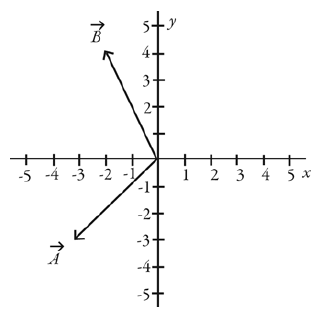
- A31.8
- B\(-32.0 \hat i - 2.00 \hat k\)
- C1028
- D34
- E\(-2.00\hat i - 32.0 \hat j\)
19If \(\vec A = 1.00 \hat i + 4.00 \hat j - 1.00 \hat k, \vec B = 3.00\hat i - 1.00 \hat j - 4.00 \hat k\) , and \(\vec C=-1.00\hat i + 1.00 \hat j\), then \(|(\vec A \times \vec B) \cdot \vec C|\)=?
- A18
- B\(12.00 \hat i - 6.00 \hat j - 12\hat k\)
- C\(-3.00\hat i -4.00 \hat j-4.00\hat k\)
- D\(6.00 \hat i - 12.00 \hat j - 12\hat k\)
- E\(12\sqrt{3}\)
- F-7
- G7
20In the figure, the magnitude of vector \(\vec A\) is 18.0 units, and the magnitude of vector \(\vec B\) is 12.0 units. What vector \(\vec C\) (magnitude and the angle it makes with the +x-axis taking counterclockwise to be positive) must be added to the vectors \(\vec A\) and \(\vec B\) so that the resultant of these three vectors points in the negative x-direction and has a magnitude of 7.50 units?
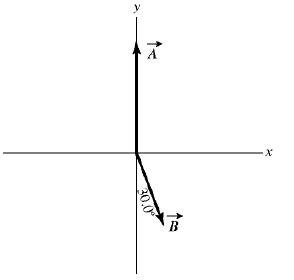
- A15.5, 209°
- B15.5, 151°
- CNone of the choices.
- D7.5, 151°
- E7.5, 209°
- F6.12, 209°
- G6.12, 151°
Informationen
- Beschreibung
- Prepared by: Justin Ruaya Vectors, Cross Product, Dot products, Angle between Vectors, Addition, Multiplication References: Giancoli, Physics for Engineers and Scientists Wolfson, Essential Physics Fundamentals of Physics
- Autor
- Justin Ruaya
- Sprache
- English
- Aufrufe
- 779
- Bewertung
- Noch keine Bewertungen Bewerte dieses Quiz