
Quiz
Obsessive-Compulsive and Related Disorders
Erstelle ein kostenloses Konto, um dieses Quiz zu beenden
Speichere deinen Fortschritt und sieh dir dein Endergebnis an.
oder mit deiner E-Mail registrieren
Schon ein Konto? Anmelden
Fragen in diesem Quiz (14)
1Test 1 Question 66. Susan reports to her primary care physician that she regularly picks at her skin, resulting in scabbing and scarring. She has tried to stop repeatedly but has not been successful. She often misses days of school because of scabs on her face from picking. Her most likely diagnosis is:
- AExcoriation disorder
- BTrichotillomania
- CObsessive–compulsive disorder
- DCocaine use
- EIchthyosis vulgaris
2Test 2 Question 115. Difficulty discarding possessions resulting in congested and cluttered living spaces is most characteristic of:
- AObsessive–compulsive disorder
- BObsessive–compulsive personality disorder
- CShubo-kyofu
- DAmphetamine use
- EHoarding disorder
3Test 2 Question 142. Obsessive–compulsive disorder is associated with abnormality of which one of the following neurotransmitters?
- ANE
- BSerotonin
- CMelatonin
- DAcetylcholine
- EDopamine
4Test 2 Question 149. A patient presents to your office with obsessive–compulsive disorder (OCD). She has been tried on several selective serotonin reuptake inhibitors (SSRIs) with little improvement. You decide to try a tricyclic. Which tricyclic has been shown to have significantly better efficacy in treating OCD than the others?
- ADesipramine
- BDoxepin
- CAmitriptyline
- DClomipramine
- ENortriptyline
5Test 3 Question 5. A middle-aged man has been referred to your office by a plastic surgeon. The man is seeking a face lift for his “excessively large cheeks.” The surgeon has not been able to find anything abnormal about the man’s face or skin, and when he comes to see you, you fail to see anything wrong either. The patient insists that his cheeks are grotesque and ruining his whole appearance. When pressed, he admits that others may not consider his cheeks to be as bad as he does. His most likely diagnosis is:
- AMalingering
- BSchizophrenia
- CSomatic symptom disorder
- DConversion disorder (functional neurological symptom disorder)
- EBody dysmorphic disorder
6Test 3 Question 112. Habit reversal is a type of therapy indicated for:
- ADevelopmental coordination disorder
- BTrichotillomania
- CObsessive–compulsive disorder
- DIntermittent explosive disorder
- EGambling disorder
7Test 4 Question 17. Which one of the following statements is not true regarding body dysmorphic disorder?
- AIt is a preoccupation with an imagined defect in appearance
- BIt is most commonly associated with a comorbid mood disorder
- CThe most common concerns involve facial flaws
- DTreatment with surgical, medical, dental, or dermatological care is usually successful
- EIf a slight physical anomaly is present the concern is markedly excessive
8Test 6 Question 72. Anterior capsulotomy and/or cingulotomy have been demonstrated to be effective in cases of treatment failure with which of the following severe disorders?
- ATourette’s syndrome
- BSchizophrenia
- CBipolar disorder
- DAntisocial personality disorder
- EObsessive–compulsive disorder
9Test 6 Question 116. Which of the following types of therapy is considered the “gold standard” for treatment of obsessive–compulsive disorder?
- AExposure with response prevention
- BMotivational enhancement therapy
- CDialectical behavior therapy
- DDynamic psychotherapy
- EPsychoanalysis
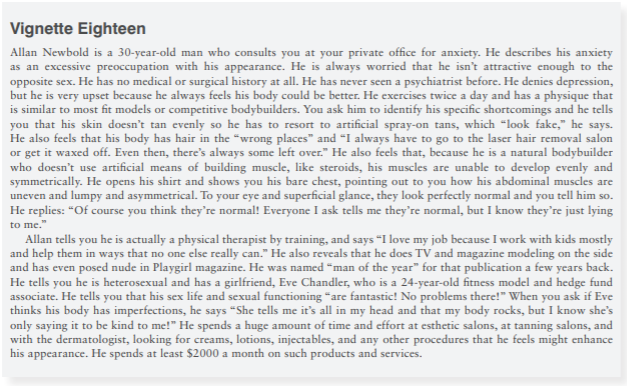
10Vignette 18 Question 1. The basic pathophysiology of the disorder that Allan is suffering from is believed to be related to:
- ADopamine
- BNorepinephrine
- CEpinephrine
- DSerotonin
- EGlutamate
11Vignette 18 Question 2. The psychodynamic explanation of Allan’s disorder and behavior is best described as:
- AEarly parental losses that lead to a self-focused neurosis
- BActing out behavior due to poor impulse control and poor frustration tolerance
- CThe displacement of a sexual or emotional conflict onto nonrelated body parts
- DArrested development in the anal phase of psychosexual development
- EAn unresolved Oedipal complex
12Vignette 18 Question 3. Which of the following factors are atypical of Allan’s most likely diagnosis? (Pick two of six)
- AThe fact that he is a man
- BThe fact that the onset of his disorder presented prior to 30 years of age
- CThe fact that Allan has never suffered a major depressive episode in the past
- DThe fact that Allan is unmarried
- EThe fact that Allan is a professional and is high-functioning
- FThe fact that Allan spends an extraordinary amount of money on himself
13Vignette 18 Question 4. Which of the following are considered appropriate treatments for Allan’s primary disorder? (Pick three of six)
- AClomipramine
- BBupropion
- CFluoxetine
- DModafinil
- EPhenelzine
- FCarbamazepine
14Vignette 18 Question 5. Which of the following is typically true about the course and prognosis of Allan’s primary disorder?
- AIt is usually gradual and insidious in onset
- BIt is usually of short duration and self-limited
- CIt has an undulating course with few symptom-free intervals
- DThe part of the body on which concern is focused typically remains the same over time
- EThe preoccupation with imagined defects is not usually associated with significant distress or impairment
Informationen
- Beschreibung
- Test I: 66 Test II: 115, 142, 149 Test III: 5, 112 Test IV: 17 Test V: none Test VI: 72, 116 Vignette 18
- Autor
- Eleanor garvey
- Sprache
- English
- Aufrufe
- 27
- Verlauf
- Erstellt am 14 Mär 2020 · aktualisiert am 14 Mär 2020
- Schlagwörter
- Bewertung
- Noch keine Bewertungen Bewerte dieses Quiz