
Quiz
Ohne Titel
Erstelle ein kostenloses Konto, um dieses Quiz zu beenden
Speichere deinen Fortschritt und sieh dir dein Endergebnis an.
oder mit deiner E-Mail registrieren
Schon ein Konto? Anmelden
Fragen in diesem Quiz (130)
1Which of the following experiments provided the first evidence that the amino acid sequence of a polypeptide chain contains all the information required to fold the chain into its native, three-dimensional structure?
- AWhen denatured ribonuclease is allowed to renature, it regains its catalytic activity.
- BWhen ribonuclease is treated with urea, it loses its catalytic activity.
- CWhen renatured ribonuclease is allowed to denature, it regains its catalytic activity.
- DAddition of mercaptoethanol causes ribonuclease to regain catalytic activity.
2Fibrous proteins differ from globular proteins in that
- Afibrous proteins can often contain several types of secondary structure, whereas globular proteins usually consist largely of a single type of secondary structure.
- Bfibrous proteins tend to serve structural functions, and globular proteins are more likely to be enzymes.
- Cglobular proteins are insoluble in water, and fibrous proteins are usually soluble.
- Dglobular proteins are more likely than fibrous proteins to have an elaborate quaternary structure.
3X-ray diffraction and nuclear magnetic resonance (NMR), two techniques used to solve the three-dimensional structure of molecules, differ in that
- ANMR is limited to molecules that can be crystallized.
- BNMR is better for analyzing large proteins.
- Conly molecules to be analyzed by NMR need to be labeled with isotopes.
- Donly x-ray diffraction is successful on all proteins.
4Two or more proteins that have little sequence similarity, but share the same major structural motif and have functional similarities, belong to the same
- Afamily.
- Bfold.
- Cmotif.
- Dsuperfamily
5Proline residues are most likely to occur in which of the following secondary structures?
- Aan α helix
- Ba β sheet
- Ca β turn
- Da coiled coil
6Tertiary structures such as the twisted β sheet and the β barrel form because of
- Athe natural tendency of parallel β strands to twist in a right-handed direction
- Bthe natural tendency of parallel β strands to twist in a left-handed direction .
- Chydrogen bonds between β strands and an α helix.
- Dhydrophobic collapse.
7Protein disulfide isomerase aids in the folding of proteins by
- Ashuffling hydrogen bonds between amino acids.
- Bshuffling disulfide bonds between amino acids.
- Creducing disulfide bonds between amino acids.
- Dcatalyzing the isomerization of cis and trans isomers of amino acids.
8Hydrogen bonds between amino acids in a polypeptide occur between which chemical groups?
- Athe C=O and C-H groups
- Bthe C=O and N-H groups
- Cthe C=O and C-R groups
- Dthe C=O groups
9The Hsp70 molecular chaperone proteins are more abundant in cells stressed by elevated temperatures because
- AHsp70 is needed to unfold proteins denatured by heat.
- BHsp70 is needed to destroy proteins denatured by heat.
- CHsp70 is needed to protect proteins that have been denatured by heat.
- DHsp70 is needed to stimulate the aggregation of proteins denatured by heat.
10A protein is in its native conformation when
- Ait is in any of its functional, folded states.
- Bit is thermodynamically least stable.
- Cit has the highest Gibbs free energy.
- Dit is unfolded.
11Which of the following is true about the difference between proteins with a rotational symmetry and proteins with a helical symmetry?
- AVirus coats, or capsids, can have only a rotational symmetry
- BIcosahedral proteins have a helical symmetry rather than a rotational symmetry.
- CProteins with rotational symmetry tend to form a closed structure, while proteins with helical symmetry tend to form an open structure.
- DProteins with rotational symmetry are less restricted in size than those with a helical symmetry.
12Which of the following is true about protein domains?
- AProtein domains lose their function when separated from the remainder of the polypeptide chain.
- BProtein domains often fold into stable globular units.
- CProtein domains lose their three-dimensional structure when separated from the remainder of the polypeptide chain.
- DA protein must have more than one domain to be functional.
- AProtein domains lose their function when separated from the remainder of the polypeptide chain.
13Which bonds are planar (cannot rotate) in a polypeptide backbone?
- AN-Cα bonds
- BCα-Cα bonds
- CCα-C bonds
- DC-N bonds
14Which of the following is true about sickle-cell anemia?
- APeople with sickle-cell anemia have sickle-cell hemoglobin molecules that form insoluble fibers.
- BPeople with sickle-cell anemia have inherited one or more alleles for sickle-cell hemoglobin.
- CPeople with sickle-cell anemia have normal levels of hemoglobin and normal numbers of erythrocytes.
- DPeople with sickle-cell anemia have a mutation in either the α or β hemoglobin chains.
15In what way do the Hsp70 class and the chaperonin class of proteins differ from each other?
- AOnly the chaperonin class forms elaborate protein complexes that contain a pocket into which unfolded proteins bind.
- BOnly the chaperonin class requires ATP hydrolysis.
- COnly the Hsp70 class of proteins is present in higher eukaryotes.
- DThe Hsp70 class will only help fold proteins under stress conditions, whereas the chaperonin class will help fold proteins under stress conditions and under normal conditions.
16During skeletal muscle contraction, which of the following narrows?
- Athe Z disk
- Bthe I band
- Cthe M line
- Dthe A band
17A protein in solution is more likely to maintain its native conformation wheni
- Aits hydrophobic residues are largely buried in the protein interior.
- Bthe number of hydrogen bonds within a protein is minimized.
- Cthe shell of water becomes more ordered.
- Dthe protein is least stable.
18Polyclonal antibodies
- Aare produced by different B cells, each responding to a different epitope within an antigen.
- Bare produced by different B cells, each responding to the same epitope within an antigen.
- Care produced by a population of identical B cells.
- Dare produced by B cells grown in cell culture.
19Which of the following is true about the role of ATP during skeletal muscle contraction?
- ABinding of ATP causes the myosin head to bind actin filaments.
- BAfter hydrolysis of ATP at the myosin head, Pi and ADP are immediately released.
- CThe hydrolysis of ATP at the myosin head causes myosin to tightly bind the next actin subunit.
- DThe release of Pi from myosin is needed for the "power stroke" that causes filament sliding.
20Why is the α-helix conformation in polypeptides such a stable form?
- AThe α helix structure is stabilized by hydrophobic interactions.
- BThe α helix structure is stabilized by disulfide bonds.
- CThe α helix structure is stabilized by proline residues.
- DThe α helix structure is stabilized by hydrogen bonds.
21Which of the following is true about the organization of skeletal muscle?
- AThe sarcoplasmic reticulum surrounds each muscle fiber.
- BSarcomeres contain a complete I band and a complete A band.
- CMyofibrils consist of repeating sarcomeres.
- DMyofibrils consist of numerous muscle fibers.
22Which of the following is true about the structure of all immunoglobulins?
- AAn antigen-binding site is formed by the combination of two heavy chains.
- BThe chains are linked by disulfide bonds
- CThey consist of two heavy chains and two light chains.
- DThe five classes of immunoglobulins each have their own characteristic type of light chain.
23 Which of the following is true about proteins and enzymes?
- AAll enzymes are catalytic.
- BAll proteins have active sites.
- CAll enzymes have binding sites.
- DAll proteins bind ligands.
24Which of the following binding constants represents the highest affinity?
- AKd = 1.5 x 10⁻⁹M
- BKa = 2.0 x 10⁸M-1
- CKa = 1.0 x 10⁷M-1
- DKd = 1.0 x 10⁻⁹M
25The dissociation constant (Kd) of the human insulin receptor for insulin is 1 x 10⁻¹⁰M. What does this mean?
- AIt means that when the concentration of the insulin receptor is 1 x 10⁻¹⁰M, half of the available insulin receptor sites are occupied.
- BIt means that when the concentration of insulin is 1 x 10⁻¹⁰M, all of the available insulin receptor sites are occupied.
- CIt means that when the concentration of insulin is 1 x 10⁻¹⁰M, half of the available insulin receptor sites are occupied.
- DIt means that when the concentration of the insulin receptor is 1 x 10⁻¹⁰M, all of the available insulin receptor sites are occupied.
26How does hemoglobin bind O2 cooperatively?
- AThe binding of one molecule of O2 to one subunit of hemoglobin enhances the affinity of other subunits for O2.
- BThe binding of one molecule of O2 to one subunit of hemoglobin enhances the assembly of other subunits to form a complete hemoglobin protein.
- CThe binding of one molecule of O2 to one hemoglobin protein enhances the binding of a molecule of O2 to a different hemoglobin protein.
- DThe binding of one molecule of O2 to one subunit of hemoglobin enhances the affinity of the same subunit for more molecules of O2.
27Which of the following is true about the difference between ELISA and immunoblot assays, both of which can be used to detect protein antigens?
- AOnly immunoblots allow for quantification of the presence of an antigen in a sample
- BOnly immunoblots enable an approximation of an antigen's molecular weight.
- COnly ELISA assays require a secondary antibody.
- DOnly ELISA assays require a purified protein antigen.
28What is the role of cytotoxic T cells (TC) in the immune response?
- AThey destroy virally infected cells to which they are complexed through their T-cell receptors.
- BThey produce cytokines and interleukins that stimulate the proliferation of immune cells.
- CThey produce immunoglobulins (antibodies) that bind bacteria or viruses and target them for destruction.
- DThey ingest large particles and cells by phagocytosis.
29A simple plot of V0 versus [S] is superior to a double-reciprocal plot (1/Vo versus 1/[S]) if you are trying to
- Adetermine Vmax.
- Bdetermine the type of inhibition.
- Cdetect allosteric regulation.
- Ddetermine the Km
30The Bohr effect, the effect of pH and CO2 concentration on the binding and release of oxygen by hemoglobin, dictates that
- Aoxygen binds hemoglobin better at low pH.
- Bthe binding of CO2 is inversely related to the binding of oxygen.
- Cthe binding of CO2 is inversely related to the binding of H+.
- Doxygen and H+ are bound at the same sites in hemoglobin.
31In feedback inhibition
- Athe end product of a pathway inhibits one of the enzymes in the pathway.
- Bthe initial substrate of a pathway inhibits one of the enzymes in the pathway.
- Can enzyme in a pathway inhibits one of the earlier enzymes in the pathway
- Dan intermediate in a pathway inhibits one of the earlier enzymes in the pathway.
32What is the role of the heme prosthetic group in hemoglobin?
- AThe heme group coordinates the subunits of hemoglobin.
- BThe heme group binds one molecule of oxygen in the center of the hemoglobin protein.
- CThe iron atom in the heme group is needed to irreversibly bind oxygen.
- DThe heme group binds a molecule of oxygen for each subunit of hemoglobin.
33How do IgG antibodies lead to the destruction of viruses?
- AVirus-specific antibodies coat the virus, causing the disruption of the virus.
- BVirus-specific IgG antibodies coat the virus and deliver it to macrophages for engulfment by phagocytosis.
- CVirus-specific IgG antibodies coat the virus and deliver it to cytotoxic T cells (TC).
- DVirus-specific IgG antibodies induce viruses to undergo apoptosis.
34Which of the following is not a function of hemoglobin?
- AIt delivers O2 to peripheral tissues.
- BIt delivers H+ to peripheral tissues.
- CIt delivers CO2 to the lungs.
- DIt removes CO2 from peripheral tissues.
35 Which of the following is true about zymogens?
- AZymogens are inactivated by inhibitor proteins.
- BProproteins are one type of zymogen.
- CZymogens cleave proteases.
- DZymogens are enzymatically inactive.
36 Which of the following is true about the T (tense) → R (relaxed) transition of hemoglobin?
- AThe binding of O2 to a subunit in the T state can cause the transition of other subunits to the R state.
- BThe T state of hemoglobin binds oxygen with a higher affinity than the R state.
- CWhen hemoglobin undergoes the T → R transition, the structures of the individual subunits change dramatically.
- DThe T state has a narrower pocket between &946; subunits than does the R state.
37An enzyme with a high turnover number has
- Aa high Kcat/Km.
- Ba high Vmax.
- Ca low Km
- Da high Kcat
38What is the biological advantage to the sigmoidal binding curve of hemoglobin for oxygen?
- AIt ensures that hemoglobin can bind oxygen only weakly.
- BIt allows hemoglobin to shift between low and high affinities for oxygen.
- CIt allows hemoglobin to bind oxygen irreversibly.
- DIt ensures that hemoglobin has a high affinity for oxygen.
39Which of the following is true about the phosphorylation of proteins?
- APhosphorylation of proteins is catalyzed by phosphatases.
- BPhosphoryation always activates enzymes.
- CProteins are usually phosphorylated at amino acids that have hydroxyl group-containing side chains.
- DThe specificity in phosphorylation is conferred solely by the amino acid to be phosphorylated.
40Which of the following is true about the role of enzymes in catalyzing chemical reactions?
- AEnzymes eliminate the activation energy of a reaction.
- BEnzymes alter the equilibrium of a reaction.
- CEnzymes are needed to catalyze only thermodynamically unfavorable reactions.
- DEnzymes enhance the rate of reactions.
41In what way does the binding of a substrate by an enzyme enhance catalysis?
- AIt increases the entropy between substrates.
- BThe binding energy of the enzyme-substrate interaction lowers the activation energy.
- CIt increases the interaction of the substrate with water
- DThe binding of a substrate prevents the enzyme from changing conformation.
42In the double-reciprocal plot, increasing the concentration of inhibitor
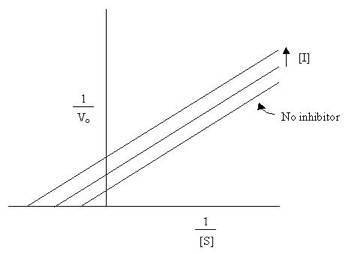
- Alowers the Km.
- Braises the Vmax.
- Clowers the Km / Vmax
- Draises the Km / Vmax
43Electrostatic interactions have which of the following effects upon protein structure?
- AThey ensure that charged residues never interact with each other
- BThey tend to cluster nonpolar residues in the interior of proteins.
- CThey prevent proteins from dissolving in water.
- DThey are a general term for the covalent bonds between pairs of cysteine residues.
- EThey tend to attract oppositely charged groups, frequently on the surface of the protein.
44Which of the following is true about cofactors that are essential to the activity of some enzymes?
- AA holoenzyme is the protein part of an enzyme that is not catalytically active until a cofactor is bound.
- BInorganic metal ions are examples of coenzymes.
- CCofactors that are covalently bound to an enzyme protein are called prosthetic groups.
- DAll enzymes are proteins.
45In competitive inhibition, increasing concentrations of the inhibitor will have the following effect on the kinetics of the enzyme:
- AVmax will stay the same.
- BThe reaction will cease because the inhibitor binds irreversibly.
- CKm / Vmax will stay the same.
- DKm will decrease
46Which of the following is true about allosteric enzymes?
- AAllosteric enzymes are always multimeric.
- BRegulatory sites (allosteric sites) on an allosteric enzyme are always different from the catalytic site.
- CSuicide inactivators are examples of allosteric modulators.
- DAllosteric enzymes always change the conformation of the active site in response to binding of an allosteric modulator.
47Which of the following enzymes fits in the class of enzymes known as hydrolases?
- Ahexokinase
- Bchymotrypsin
- Cglycogen phosphorylase
- Dtriose phosphate isomerase
48Which of the following is true about general acid-base catalysis?
- AIt requires the ions of water.
- BIt often involves covalent bonds formed between a metal ion and the substrate.
- CIt involves a transient covalent bond between the enzyme and the substrate.
- DAmino acid side chains on enzymes can act as proton donors or acceptors.
49The steady state of an enzyme-catalyzed reaction is reached when
- Athe concentration of enzyme-substrate complex equals the concentration of product.
- Bthe concentration of the enzyme-substrate complex is constant over time.
- Cthe rate of enzyme-substrate formation is constant.
- Dthe rate of appearance of product over time is constant.
50The active site of an enzyme is most complimentary to
- Athe transition state.
- Bthe product.
- Cthe enzyme itself.
- Dthe substrate.
51The term used to refer to how individual polypeptide chains of a protein having two or more chains are arranged in relation to each other is:
- Asecondary structure
- Btertiary structure
- Cquaternary structure
- Dprimary structure
52Which of the following amino acids has a tendency to destabilize a-helices?
- Atyrosine
- Bhistidine
- Cvaline
- Dproline
- Eglycine
53Which of the following is true about the free-energy changes involved in reactions that favor the formation of product?
- AThe activation energy is the difference between the substrate and product ground state free energies.
- BThe ground state free energy of the product must be lower than the ground state free energy of the substrate.
- CThe difference between the energy levels of the ground state and transition state is always negative.
- DEnzymes lower the overall free standard free-energy change (ΔG′°) of a reaction.
54Hydrophobic interactions have which of the following effects upon protein structure?
- AThey are a general term for the covalent bonds between pairs of cysteine residues.
- BThey tend to maximize the number of interactions between nonpolar residues and water.
- CThey prevent proteins from dissolving in water.
- DThey ensure that charged residues never interact with each other.
- EThey tend to cluster nonpolar residues in the interior of proteins.
55A b-meander is an example of a
- Asupersecondary structure.
- Bprimary structure.
- Ctertiary structure.
- Dsecondary structure.
- Equaternary structure
56The arrangement of the two alpha and two beta polypeptide chains in hemoglobin is an example of the ________ structure of a protein.
- Asepternary
- Bquaternary
- Cprimary
- Dsecondary
- Etertiary
57In an a-helix, the C=O group of each amino acid residue is hydrogen bonded to the N-H group of the amino acid ________ residues away in the primary sequence.
- A2
- B1
- C4
- D5
- E3
58There are ________ amino acid residues for each turn of an a-helix.
- Anone
- B4
- C3.6
- D3
- E2.6
59Which of the following statements about b-sheets is false?
- AThe bonds between the protein chains are perpendicular to the direction of the chains.
- BThe arrangement of atoms is very different from an a-helix.
- CThe sheets are held together by disulfide bonds, not hydrogen bonds.
- DThe peptide backbone in the b-sheet is almost completely extended.
- EThey can be parallel or antiparallel.
60Which of the following statements about fibrous proteins is true?
- AThey always consist largely of a-helices.
- BThey always consist largely of helices, but not necessarily a-helices.
- CThey are generally insoluble in water.
- DThey always have high contents of glycine and hydroxyproline residues.
- EThey always consist of b-sheets.
61Ramachandran angles designate
- Arotations around the bonds connecting adjacent peptide planes.
- Bthe quaternary structure of multimeric proteins.
- Cnone of these choices
- Dthe pitch and diameter of a-helices.
- Ethe number of residues and parallel vs. antiparallel nature of b-sheets.
62In myoglobin, heme is an example of
- Aa chaperone.
- Ba prosthetic group.
- Ca secondary structure.
- Da modified amino acid.
- Ea b-sheet.
63The effect of H+ on hemoglobin's affinity for oxygen is called the
- Acooperative effect.
- Bprion effect.
- CBohr effect.
- Dchaperone effect.
- ERamachandran effect.
64Which of the following statements concerning X-ray crystallography is true?
- AThe information is extracted from diffraction patterns using Fourier series.
- BThe technique requires proteins of very high purity.
- CAll of these statements are true.
- DThe technique is based upon the scattering of X-rays by electrons in the atoms of the crystal.
- EAll of these statements are false.
65Which of the following amino acid residues would you most likely find on the exterior surface of a globular protein at physiological pH?
- AMet
- BPhe
- CAla
- DLeu
- EGlu
66The basic structural unit of collagen, tropocollagen, has the following structure:
- Aa mixture of alpha-helices and beta-pleated sheets
- Ba triple-stranded extended helix
- Ca right-handed alpha-helix
- Da left-handed alpha-helix
- Ea beta-pleated sheet
67In the primary structure of tropocollagen, why must every third position be occupied by glycine?
- AThis prevents the glycine side chains from forming electrostatic interactions with one another.
- BThis prevents the glycine side chains from hydrogen bonding with one another.
- CThis ensures that the glycine side chains can form electrostatic interactions with one another.
- DEvery third position is on the inside of the triple helix, and only glycine is small enough to fit there.
- EThis ensures that the glycine side chains can hydrogen bond with one another.
68For an enzyme reaction obeying Michaelis-Menten kinetics, the horizontal part of a v versus [S] plot is indicative of
- Aa second-order reaction with respect to substrate.
- Ba mixed-order reaction with respect to substrate.
- Ca first-order reaction with respect to substrate.
- Da zero-order reaction with respect to substrate.
- Ethe completion of the reaction.
69Collagen fibers have a high content of which amino acids?
- Aproline, hydroxyproline, and tyrosine
- Bhistidine, tyrosine, and proline
- Calanine, phenylalanine, and isoleucine
- Dcysteine, methionine, and phenylalanine
- Eglycine, proline, and hydroxyproline
70Which of the following statements concerning the primary structure of proteins is true?
- AOnly it determines the three-dimensional structure of the protein and it is the order of the amino acids from N-terminus to C-terminus are true.
- BAll of these choices are true
- CIt determines the three-dimensional structure of the protein.
- DIt results from hydrogen bonds between C=O and N-H groups in the polypeptide chain.
- EIt is the order of the amino acids from N-terminus to C-terminus.
71Chaperones
- Anone of these choices
- Benhance O2-binding by hemoglobin.
- Care examples of supersecondary structures found in fibrous proteins
- Dare groups of atoms other than amino acids found in many proteins.
- Eaid in the correct and timely folding of other proteins.
72Which of the following statements concerning O2-binding by hemoglobin and myoglobin is true?
- AHemoglobin's O2-binding curve is sigmoidal, and myoglobin's is hyperbolic.
- BHemoglobin's O2-binding curve is hyperbolic, and myoglobin's is sigmoidal.
- Cnone of these choices
- DBoth proteins have hyperbolic oxygen-binding curves.
- EBoth proteins have sigmoidal oxygen-binding curves.
73In the presence of a competitive inhibitor, will the y-intercept of the Lineweaver-Burk double-reciprocal plot of 1/v vs. 1/[S] change?
- ANo.
- BOnly if the concentration of the inhibitor is less than that of the substrate.
- COnly if the inhibitor's KI is less than the substrate's Km.
- DYes
- EOnly if the concentration of the inhibitor is greater than that of the substrate.
74Which of the following best represents the catalytic efficiency of an enzyme under nonsaturating conditions?
- AVmax
- BKm
- Ckcat
- D1/[S]
- Ekcat/Km
75If a Lineweaver-Burk double-reciprocal plot of an enzyme-catalyzed reaction yields a straight line, the intercept on the 1/V axis is:
- A-1/Km
- B1/Vmax
- CV/Km
- DKm - Vmax
- EKm/Vmax
76Which of the following can cause denaturation of a protein?
- Aurea
- Ball of these choices
- Cheat
- Ddetergents
- Eextremes of pH
77When one oxygen molecule is bound to hemoglobin, it becomes easier for the next to bind. This is called
- Ahydrolysis
- Bdenaturation
- CThat's not true; it's not easier for the next oxygen to bind.
- Dpositive cooperativity.
- Enegative cooperativity.
78In the presence of a pure non-competitive inhibitor
- Athe Vmax is increased.
- Bthe Km is decreased.
- Cthe Km is increased.
- Dthe Vmax is decreased.
- Eboth Km and Vmax are decreased.
79What effect does bisphosphoglycerate (BPG) have on hemoglobin's affinity for oxygen?
- AIt decreases hemoglobin's affinity for oxygen
- BIt increases hemoglobin's affinity for oxygen
- CIt converts hemoglobin into myoglobin.
- DIt makes hemoglobin bind O2 at low pressures, but release O2 at high pressures.
- EIt has no effect on hemoglobin's affinity for oxygen.
80The turnover number of an enzyme is the number of
- Amoles of substrate required to achieve 50% saturation of the enzyme.
- Bmoles of substrate converted into product per mole of enzyme per unit time, when the enzyme is saturated with substrate.
- Cmoles of substrate converted to product before the enzyme is saturated with substrate.
- Dmoles of enzyme-substrate complexes formed per unit time.
- Emoles of product formed per mole of enzyme-substrate complex per unit time before the enzyme is saturated with substrate.
81In the presence of a competitive inhibitor the initial rate of an enzyme catalyzed reaction depends upon:
- Athe substrate concentration
- Bthe inhibitor concentration
- Cthe relative affinities of inhibitor and substrate
- Dboth the substrate concentration and the inhibitor concentration, but not the relative affinities of inhibitor and substrate.
- Eall of these factors
82A competitive inhibitor of an enzyme catalyzed reaction causes
- Ano change in the apparent Km and a decrease in apparent Vmax.
- Ba decrease in the apparent Km and Vmax.
- Can increase in the apparent Km and no change in apparent Vmax.
- Dan increase in both the apparent Km and Vmax.
- Eno change in either the apparent Km or Vmax.
83In the presence of a noncompetitive inhibitor, what will happen to the Lineweaver-Burk double-reciprocal plot of 1/v vs. 1/[S]?
- AThe slope will change.
- BThe x-intercept will change.
- Call of these choices
- DThe y-intercept will change.
- EThe slope will change and the y-intercept will change only.
84The difference between the energies of the reactants and of the products of a reaction is called the
- Atransition energy.
- Bkinetic energy.
- Ccatalytic energy.
- Dactivation energy.
- Estandard free energy.
85If a Lineweaver-Burk double-reciprocal plot of an enzyme-catalyzed reaction yields a straight line, the intercept on the 1/[S] axis is:
- A1/Vmax
- B-1/Km
- CKm/Vmax
- Dv/Km
- EVmax/Km
86Enzymes accelerate thermodynamically possible reactions by:
- Alowering the overall free energy change for the reaction
- Breducing the temperature coefficient
- Caltering the equilibrium constant
- Dsystematically removing one of the products
- Elowering the activation energy of the reaction
87How does an enzyme's Km compare to its affinity for substrate?
- AThe lower the Km, the higher the affinity.
- BThe relationship depends on the enzyme's Vmax.
- CThe greater the Km, the higher the affinity.
- DThe two have nothing to do with one another.
- EThe relationship depends on whether the enzyme is allosteric or not.
88How do the induced fit and lock-and-key models of enzyme behavior differ?
- ABoth describe substrate binding, but the induced fit model takes into account the fact that enzymes enhance the formation of the transition energy of the reaction.
- BThe induced fit model describes the activation energy of the reaction, while the lock-and-key model describes the position at which the substrate binds.
- CBoth describe substrate binding, but the induced fit model takes into account the fact that proteins have some three-dimensional flexibility.
- DBoth describe substrate binding, but the induced fit model takes into account the fact that enzymes alter the standard free energy change for the reaction.
- EThe induced fit model describes the activation energy of the reaction, while the lock-and-key model describes the transition state.
89The active site of an enzyme represents
- Athe activation energy of the reaction.
- Bthe transition energy of the reaction.
- Cthe standard free energy change for the reaction.
- Dthe position at which the substrate binds.
- Eits enzymatic energy.
90The enzyme curease catalyzes the conversion of L-mendit to alpha-ketowhatsit. Assume that you have used the proper conditions and have obtained the following data:
Concentration of L-mendit (mM)
Micromoles of alpha-ketowhatsit produced per minute
1.0
0.025
1.25
0.03
2.0
0.042
3.0
0.056
4.0
0.067
10.0
0.1
From these data, what is the Km and Vmax for this enzyme and substrate?- AKm = 1 mM; Vmax = 0.013 m M/min
- BKm = 2 mM; Vmax = 0.14 mM/min
- CKm = 0.5 mM; Vmax = 7 mM/min
- DKm = 5 mM; Vmax = 0.14 mM/min
- EKm = 0.2 mM; Vmax = 7 mM/min
91The turnover number of an enzyme is the number of
- Amoles of substrate required to achieve 50% saturation of the enzyme.
- Bmoles of substrate converted into product per mole of enzyme per unit time, when the enzyme is saturated with substrate.
- Cmoles of substrate converted to product before the enzyme is saturated with substrate.
- Dmoles of enzyme-substrate complexes formed per unit time.
- Emoles of product formed per mole of enzyme-substrate complex per unit time before the enzyme is saturated with substrate.
92Different forms of an enzyme isolated from different tissues within a single organism catalyzing the same chemical reaction but with distinct subunits are called:
- Aapoenzymes
- Bisozymes
- Cenantiomorphs
- Dantipodes
- Ecoenzymes
93The enzyme witchase catalyzes the conversion of princeane to froganol with Km = 5 mM, and Vmax = 0.5 mM/min. If the physiological concentration of princeane is 10 mM, what is the reaction's velocity?
- A0.5 mM/min
- B0.17 mM/min
- C0.25 mM/min
- D0.33 mM/min
- E0.75 mM/min
94What kind of enzymatic behavior does a sigmoidal plot of reaction velocity versus substrate concentration represent?
- Aallosteric
- Bcompetitive inhibition
- Cnoncompetitive inhibition
- Dinduced fit
- Enonallosteric
95The Michaelis constant (Km) represents
- Athe activation energy for the reaction.
- Bthe concentration of substrate necessary for the reaction to proceed at Vmax.
- Cthe maximal velocity of an enzyme-catalyzed reaction.
- Dthe concentration of substrate necessary for the reaction to proceed at Vmax/2.
- Ethe turnover number for the enzyme.
96A competitive inhibitor typically
- Areacts with the substrate, producing a compound upon which the enzyme can not act.
- Bbinds to the active site of the enzyme and blocks binding by the substrate.
- Cbinds to the enzyme at a site other than the active site and does not interfere with substrate binding, only catalysis.
- Dreacts with the enzyme to produce a protein that is not enzymatically active.
- Ebinds to the substrate, preventing it from binding to the enzyme.
97The point with the highest free energy on an activation energy profile represents the
- Astandard free energy change for the reaction.
- Bcatalytic energy.
- Ckinetic energy.
- Denzymatic energy.
- Etransition state.
98An irreversible inhibitor typically
- Areacts with the enzyme to produce a protein that is not enzymatically active.
- Bbinds to the enzyme at a site other than the active site and does not interfere with substrate binding, only catalysis.
- Cbinds to the active site of the enzyme and blocks binding by the substrate.
- Dreacts with the substrate, producing a compound upon which the enzyme cannot act.
- Ebinds to the substrate, preventing it from binding to the enzyme.
99How do temperature increases typically affect enzymatically catalyzed biochemical reactions?
- AThe reaction rate always decreases with temperature.
- BAt first the reaction rate decreases, but heat denaturation of the enzyme will eventually speed up the reaction.
- CAt first the reaction rate increases, but heat denaturation of the enzyme will eventually slow the reaction.
- DThe reaction rate always increases with temperature.
- ETemperature has absolutely no effect on reaction rates.
100What is meant by mixed inhibition?
- AThe inhibitor is both reversible and irreversible.
- BThe inhibitor binds to both the ES complex and free E, and affects both the binding of the substrate and the Vmax.
- CThe inhibitor can bind to either the enzyme or the substrate.
- DThe inhibitor converts the product back into substrate.
- EThe inhibitor binds only to the ES complex, but not to free E.
101In the presence of a pure non-competitive inhibitor
- AIn the presence of a pure non-competitive inhibitor
- Bthe Km is decreased.
- Cthe Km is increased.
- Dthe Vmax is decreased.
- Eboth Km and Vmax are decreased.
102If a Lineweaver-Burk double-reciprocal plot of an enzyme-catalyzed reaction yields a straight line, the intercept on the 1/V axis is:
- A-1/Km
- B1/Vmax
- CV/Km
- DKm - Vmax
- EKm/Vmax
103For an enzyme reaction obeying Michaelis-Menten kinetics, the horizontal part of a v versus [S] plot is indicative of
- Aa second-order reaction with respect to substrate.
- Ba mixed-order reaction with respect to substrate.
- Ca first-order reaction with respect to substrate.
- Da zero-order reaction with respect to substrate.
- Ethe completion of the reaction.
104The compound diisopropylphosphofluoridate (DIPF) is a potent inhibitor of the proteolytic enzyme chymotrypsin. It permanently inactivates the enzyme by forming a covalent complex with a ________ residue at the active site
- Atryptophan
- Bhistidine
- Cproline
- Dserine
- Elysine
105A number of the digestive enzymes are synthesized in an inactive form and are only activated in the small intestine. These inactive precursor forms are termed
- Asubstrates
- Bproteosomes
- Ctrypsins
- Dzymogens
- Ecoenzymes
106If the binding of low levels of substrate facilitates the action of the protein at higher levels of substrate, this is called
- Afeedback inhibition.
- Bnegative cooperativity.
- Cpositive cooperativity.
- Dhydrolysis
- Edenaturation
107In the serine proteases, the formation of an acyl-enzyme intermediate is indicative of
- Athe participation of an aspartic acid residue at the active site.
- Bthe involvement of a covalent attachment to the enzyme as part of the catalytic process.
- Ca competitive inhibitor.
- Dan active-site tryptophan residue.
- Ethe susceptibility of such enzymes to inhibition by diisopropylphosphofluoridate (DIPF).
108Which statement concerning feedback inhibition is true?
- AFeedback inhibition can only occur with allosteric enzymes.
- BIt can prevent overproduction of the final product of a pathway.
- COnly it can prevent the accumulation of intermediates in a pathway and it can prevent overproduction of the final product of a pathway are true.
- DAll of these choices are true.
- EIt can prevent the accumulation of intermediates in a pathway.
109Diisopropylphosphofluoridate (DIPF) irreversibly inactivates proteases such as trypsin and chymotrypsin by reacting with
- Athe carboxyl side chain of a glutamic acid residue.
- Bthe hydroxyl group of a serine residue.
- Cthe -SH group of a cysteine residue.
- Dthe coenzyme.
- Ethe N-terminal amino acid.
110The inhibition of chymotrypsin by diisopropylphosphofluoridate (DIPF) involves
- Airreversible inactivation by the formation of a covalent complex with an active-site histidine.
- Bthe transient electrostatic interaction of the inhibitor with positively charged residues at the active site.
- Cthe inhibition of activation of the zymogen form to the active enzyme.
- Dreversible competitive inhibition of substrate binding.
- Ethe formation of a covalent enzyme-inhibitor complex at the active-site serine.
111In an allosteric V system, the effect of inhibitors and activators changes
- Aneither the Vmax nor the K0.5.
- Bthe Vmax, but not the K0.5.
- Cthe mechanism of the reaction from nucleophilic to electrophilic.
- Dboth the Vmax and K0.5.
- Ethe K0.5, but not the Vmax.
112What is a zymogen?
- AAn inactive form of an enzyme that only needs the addition of a phosphate to be active.
- BA form of an enzyme found in a specific tissue that differs slightly from the enzyme found in another tissue.
- CAn enzyme that catalyses the formation of other enzymes.
- DAn active form of an enzyme that needs the addition of a phosphate to be made inactive.
- EAn inactive precursor of an enzyme that can be irreversibly transformed into an active enzyme by cleavage of covalent bonds.
113The effect of cytidine triphosphate (CTP) on the enzyme aspartate transcarbamoylase (ATCase) is an example of
- Aa homotropic activator.
- Ba heterotropic inhibitor.
- Can irreversible inhibitor.
- Da homotropic inhibitor.
- Ea heterotropic activator.
114Which group of three amino acid residues can be phosphorylated to modulate enzyme activity?
- Amethionine, cysteine, and histidine
- Bserine, threonine, and tyrosine
- Cglutamic acid, aspartic acid, and arginine
- Dvaline, leucine, and isoleucine
- Etryptophan, phenylalanine, and proline
115What are the enzymes that catalyze the phosphorylation of other proteins using ATP called?
- Aprotein phosphatases
- Bprotein kinases
- Cisozymes
- Dprotein zymogens
- Eprotein hydrolases
116How does the sequential model of allosteric behavior differ from the concerted model?
- AThe sequential model accounts for negative cooperativity, while the concerted model cannot.
- Bnone of these choices
- CIn the sequential model, binding of substrate induces the conformational change from T to R, similar to the induced fit theory of substrate binding.
- Dall of these choices
- EIn the sequential model, a conformational change in one subunit makes the same conformational change easier in another subunit.
117In an allosteric K system, the effect of inhibitors and activators changes
- Athe K0.5, but not the Vmax.
- Bthe mechanism of the reaction from nucleophilic to electrophilic.
- Cthe Vmax, but not the K0.5.
- Dboth the Vmax and K0.5.
- Eneither the Vmax nor the K0.5.
118What is the formation of covalently modified versions of specific side chains on proteins called?
- Asubstitution
- Binhibition
- Ccooperation
- Dlabeling
- Eactivation
119In the catalytic site of chymotrypsin, the histidine acts as ________ in abstracting a proton from the serine.
- Aan electrophile
- Ba general acid
- Ca general base
- Da substrate
- Ean inhibitor
120Trypsin and chymotrypsin are both
- Ahistidyl proteases.
- Bcysteine proteases.
- Caspartyl proteases.
- Dprotein kinases.
- Eserine proteases.
121Which of the following amino acids has a side chain capable of being a good general acid or base?
- Aphenylalanine
- Bleucine
- Carginine
- Dglycine
- Etryptophan
122Which of the following should an enzyme bind most tightly at its active site?
- Aan activator
- Bits product
- Can inhibitor
- Dthe transition state of the reaction
- Eits substrate
123An abzyme is an antibody that binds an immunogen that most closely resembles
- Athe substrate for a reaction.
- Bthe product for a reaction.
- Cthe transition state for a reaction.
- Dan inhibitor for a reaction.
- Ean activator for a reaction.
124Which of the following amino acids has a side chain capable of being a good nucleophile?
- Aleucine
- Barginine
- Cserine
- Dglycine
- Ephenylalanine
125A nonprotein substance that takes part in an enzymatic reaction and is regenerated for further reaction is called
- Aan inhibitor.
- Ba transition state.
- Ca cofactor.
- Dan activator.
- Ea nucleophile.
126An enzyme that displays relative specificity
- Acatalyzes reactions using either a general acid or base mechanism, relative to pH.
- Bcatalyzes only reactions upon itself.
- Ccatalyzes the reactions of structurally related substrates to related products.
- Dcatalyzes the reaction of one, and only one, substrate to a particular product.
- Ecatalyzes reactions in which optical activity plays a role.
127Carboxypeptidase A uses which of the following metal ions to catalyze the hydrolysis of C-terminal peptide bonds?
- ACarboxypeptidase A does not use any metal ions.
- BMg2+
- CFe2+
- DZn2+
- EMn2+
128Vitamins and their derivatives are often used by enzymes as
- AVitamins and their derivatives are often used by enzymes as
- Ballosteric effectors.
- Cabzymes
- Dtransition states.
- Ezymogens
129Which of the following compounds is used as a cofactor in transamination reactions?
- Anicotinamide adenine dinucleotide (NADH)
- Bdiisopropylphosphofluoridate (DIPF)
- Cpyridoxal phosphate
- Dheme
- EZn2+
130In the concerted model for the behavior of allosteric proteins,
- Athe effects of inhibitors and activators can be considered in terms of shifting the equilibrium between the T and R forms.
- Ball the subunits change simultaneously.
- CAll of these choices
- Dtwo forms of the enzyme exist.
- Ethe T form of the enzyme is inactive.
Informationen
- Beschreibung
- Quiz am Ohne Titel, erstellt von skittlesdx am 08/07/2015.
- Autor
- skittlesdx
- Sprache
- English
- Aufrufe
- 2
- Bewertung
- Noch keine Bewertungen Bewerte dieses Quiz