
Quiz
Year 8 Skeleton, Muscles and the Breathing System
Dieses Quiz enthält Fragetypen, die sich im gewohnten Player öffnen.
Fragen in diesem Quiz (11)
1Select the correct name of the bone labelled 1
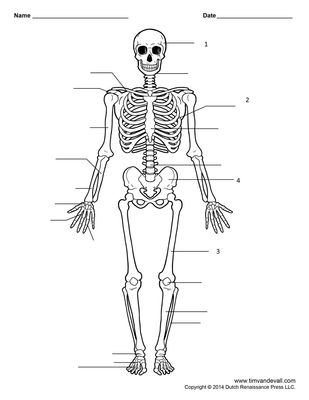
- Aspine
- Bcranium
- Cfemur
- Dpelvis
2Bone 2 is
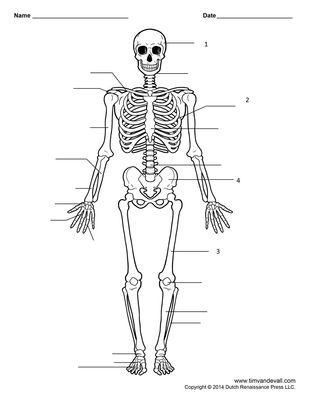
- Atibia
- Brib
- Cfemur
- Dpelvis
3Bone 3 is
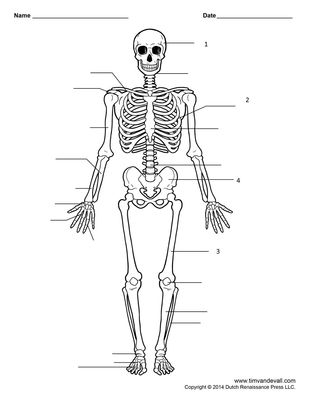
- Atibia
- Bfibula
- Cpatella
- Dfemur
4Bone 4 is
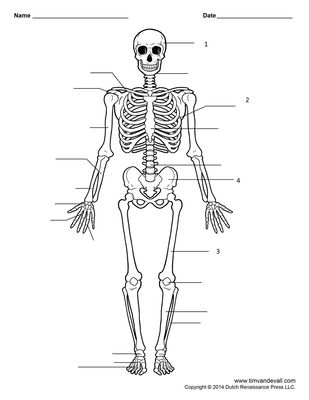
- Ascapula
- Bpelvis
- Csternum
- Dribcage
5This is a drag and drop exercise - but it is a bit fussy. You must drag answers in from the right and wait for the orange blank boxes to turn brown before it will let you drop!
Joints are formed wherever two bones meet to allow [blank_start]movement[blank_end]. The end of each bone is covered in [blank_start]cartilage[blank_end] and the joint is lubricated with [blank_start]synovial[blank_end] fluid. Hips and shoulders have [blank_start]ball and socket[blank_end] joints while fingers and knees have [blank_start]hinge[blank_end] joints. If a joint becomes swollen and painful it may indicate that the patient has [blank_start]arthritis[blank_end].- Amovement
- Bcartilage
- Csynovial
- Dball and socket
- Ehinge
- Farthritis
6Don't forget to drag answers in from the right in this drag and drop exercise and wait for the blank orange boxes to turn brown before dropping.
Bone is made of two types of tissue. The living part is called bone [blank_start]marrow[blank_end] and is where the body makes [blank_start]blood[blank_end] cells. The hard part of the bone is rich in [blank_start]calcium[blank_end]. Long bones such as those found in arms and legs are made of [blank_start]compact[blank_end] bone whilst smaller lighter bones such as those in ankles and wrists are [blank_start]spongy[blank_end] - contain needle like pieces of bone with large spaces between. Long bones such as femurs have growth [blank_start]plates[blank_end] at either end. In children and young people growth occurs where [blank_start]cartilage[blank_end] cells divide but eventually the cartilage [blank_start]ossifies[blank_end] - turns to bone - and the person stops growing.- Amarrow
- Bblood
- Ccalcium
- Dcompact
- Espongy
- Fplates
- Gcartilage
- Hossifies
7When you bend your elbow to lift your forearm, which muscles contract?
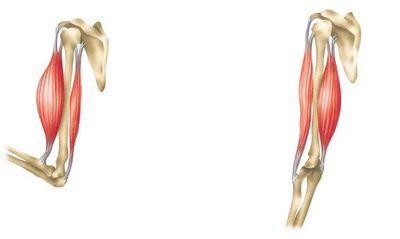
- Abiceps
- Btriceps
8Muscles such as the biceps and triceps are known as
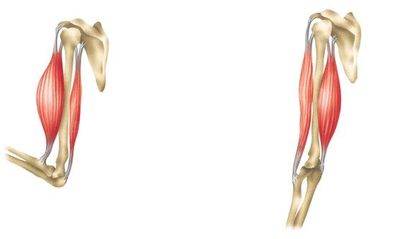
- Aantagonistic muscles
- Bargumentative mucles
- Copposite muscles
9The picture shows the breathing system. In this question we will be thinking about the structures labelled on the left of the diagram.
The [blank_start]rib-age[blank_end] (1) surrounds the [blank_start]lungs[blank_end] (2- outlined in blue) protecting these delicate organs and enabling breathing to take place. The [blank_start]ribs[blank_end] (3) can be moved in and out through contraction and relaxation of the [blank_start]intercostal[blank_end] muscles (4) and the action of the [blank_start]diaphragm[blank_end] (5).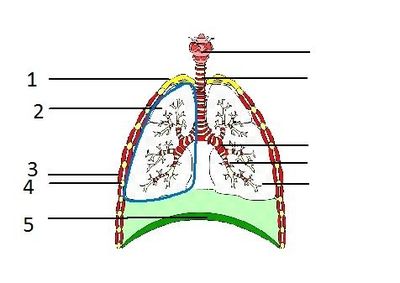
- Arib-cage
- Blungs
- Cribs
- Ddiaphragm
- Eintercostal
10This question concentrates on the passage of air from outside the body into the lungs.
Air can enter the body through the mouth or nose and passes through the [blank_start]larynx[blank_end] (1) or voice box along the main airway called the [blank_start]trachea[blank_end] (2). This divides into branches each called a [blank_start]bronchus[blank_end](3) and then into smaller airways called the [blank_start]bronchioles[blank_end](4) ending up in tiny structures (5) [blank_start]alveoli[blank_end],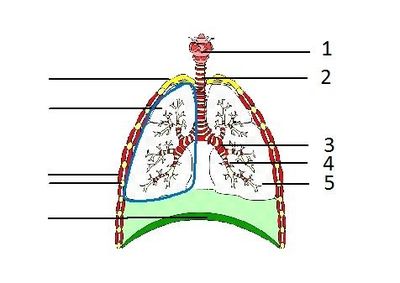
- Alarynx
- Btrachea
- Cbronchus
- Dbronchioles
- Ealveoli
11When breathing in, the diaphragm [blank_start]contracts[blank_end] and flattens and the rib muscles [blank_start]contract[blank_end] so the rib cage moves [blank_start]up[blank_end] and outwards. The volume of the lungs [blank_start]increases[blank_end] so the air pressure inside is [blank_start]lower[blank_end] than in the atmosphere. Air moves into the lungs.
- Acontracts
- Bexpands
- Ccontract
- Drelax
- Eup
- Fdown
- Gincreases
- Hdecreases
- Ilower
- Jhigher
Informationen
- Beschreibung
- Test suitable for students at KS3 and KS4 studying skeleton, muscles and bones. Includes multiple choice and text fill elements.
- Autor
- pam.howie
- Sprache
- English
- Aufrufe
- 2.807
- Schlagwörter
- Bewertung
- Noch keine Bewertungen Bewerte dieses Quiz