
Quiz
Cantajuegos
Erstelle ein kostenloses Konto, um dieses Quiz zu beenden
Speichere deinen Fortschritt und sieh dir dein Endergebnis an.
oder mit deiner E-Mail registrieren
Schon ein Konto? Anmelden
Fragen in diesem Quiz (80)
11 de 80
Basic Data Transformation
From the account table you want to know how many accounts you have per account type, hence you output the ACCOUNT_TYPE, which is used in the GROUP BY tab as well, and an additional COUNTER column
Which mapping would you use for the COUNTER column? (1)- ACount(*)
- BCount_Distinct(ACCOUNT_TYPE)
- CTotal_rows()
- DGen_Row_Num_By_Group(ACCOUNT_TYPE)
27 de 80
Basic Data Transformation
Which join types are supported in the Query Editor? (3)- ARight outer join
- BCross-product join
- CFull outer join
- DLeft outer join
- EInner join
313 de 80 ok
Basic Data Transformation
You executed a job in a development environment and it raised primary key violation errors.
Which option do you use to find which primary key values caused the errors? (1)- AAuto correct load
- BDelete data before loading
- COverflow file
- DDrop and re-create
414 de 80 ok
Basic Data Transformation
Which of the following can be performed in the Query Transform? (3)- ASeparate data into distinct output sets
- BJoin data from multiple sources
- CAssign a value to a global variable
- DChange column datatypes
- EChange the primary key flag of columns
520 de 80 (D)
Basic Data Transformation
Which objects can you use to define an output schema in a Query transform? (3)- AFile formats
- BColumns
- CXML schemas
- DNested schemas
- ELookup_ext as new function calls
635 de 80
Basic Data Transformation
What is the expected result of the expression quarter(to_date(‘Feb 22, 2013’,’mon dd, yyyy’))? (1)- ANull
- BQ1
- C1
- DAn error
739 de 80
Basic Data Transformation
In the source-target mapping document, a Target column is specified to contain a concatenation of a First Name column with a Last Name column from the source table.
Where in the Query Editor can you accomplish this task? (1)- ASELECT
- BGROUP BY
- CORDER BY
- DMAPPING
848 de 80
Basic Data Transformation
You have just added a new template table to a data flow. You validate and save the data flow and its parent job.
What happens during the save? (1)- AThe metadata for the template table is added to the local repository
- BThe job server verifies the existence of the template table
- CThe job server attempts to (re)create the table
- DThe designer attempts to (re)create the table
954 de 80 (D)
Basic Data Transformation
You are part of a development team on a data integration project and have been instructed to use the error_number() function to identify errors while running the job.
Where do you place the error_number() function? (1)- AValidation transform
- BScript at job level
- CQuery transform
- DScript inside a catch
1059 de 80
Basic Data Transformation
Which options are available when using the Include in Transaction target table option? (2)- ATransaction order
- BAuto correct load
- CRows per commit
- DUse overflow file
1161 de 80
Basic Data Transformation
In which cases do you recommend using embedded data flows? (2)- ATo optimize the performance of the data flow
- BTo make the layout more readable by grouping sections of the data flow
- CTo reuse the extraction logic of the existing data flow in another data flow
- DTo run data flows in parallel inside the parent data flow
1276 de 80
Basic Data Transformation
You have multiple output schemas in a Query transform. All columns in the schema you want to edit are greyed-out.
Which action do you perform in order to change the mapping of a column inside this schema? (3)- ADouble-click the column in the output schema area
- BSelect the schema from the Output list
- CRight-click the parent schema and select the Nest with Sub-Schemas option
- DRight-click the schema, column or function and select Make Current
- ERight-click the parent schema and select the Unnest with Sub-Schemas option
1379 de 80
Basic Data Transformation
Which function will deliver the same results as nested IFTHENELSE functions? (1)- ALiteral
- BMatch_pattern
- CWord_ext
- DDecode
146 de 80
Advanced Data Transformation
Your source table has a revenue column and a quantity column for each month (so 12 columns for revenue and 12 columns for quantity). You want to pivot the data to get 12 rows with 2 columns.
What is the best way to achieve this? (1)- AUse a Query transform with multiple IFTHENELSE() functions
- BUse the Pivot transform with two pivot sets
- CUse 12 Query transforms to create the desired output, which you the merge
- DUse the Pivot transform with one pivot set
1512 de 80
Advanced Data Transformation
Which transforms can be used as a source in a dataflow? (2)- AEffective Date
- BSQL
- CRow Generation
- DHierarchy Flattening
1629 de 80
Advanced Data Transformation
What benefits does the Validation transform give you? (3)- AYou can see all violated rules at once
- BYou can call a recovery dataflow
- CYou can have multiple rules on a single column
- DYou can produce statistics
- EYou can interrupt the dataflow once a certain number of violations occur
1731 de 80
Advanced Data Transformation
You have a Map Operation transform immediately before the target in a data flow.
What happens if all operation codes are mapped to Discard in the transform? (1)- AThey are flagged for later deletion
- BThey are deleted from the target
- CThey are added to the overflow file
- DThey are filtered by the transform
1838 de 80
Advanced Data Transformation
In a Slowly Changing Dimension Type 2 dataflow, all INSERT and UPDATE rows are passed through the Key_Generation transform.
What does the Key_Generation transform do with UPDATE rows? (1)- AIt retains the current data
- BIt only creates a new key value when the input value is NULL
- CIt increases the key value by 1
- DIt always creates a new key value
1943 de 80
Advanced Data Transformation
You have used the Table Comparison transform to establish the differences between two tables. In the subsequent History Preserving transform, all columns are listed as compare columns (neither the Valid from/to nor Current flag is used).
What will the History Preserving transform do with new rows or if any of the columns have been changed? (2)- AIt will keep an INSERT as an INSERT
- BIt will change an UPDATE to an INSERT
- CIt will output an UPDATE as two rows with INSERT and UPDATE
- DIt will keep an UPDATE as an UPDATE
2052 de 80
Advanced Data Transformation
What are the source schema requirements when using the Hierarchy Flattening transform? (1)- AEach row contains columns that function as the keys in a parent-child relationship
- BRows with NULL values in the child column have been removed or updated
- CRows with NULL values in the parent column have been removed or updated
- DEach row has an operation code of either UPDATE or INSERT
2160 de 80
Advanced Data Transformation
In which cases do you use the Text_Data_Processing transform? (3)- ATo cleanse material master descriptions
- BTo analyze relationships in a sentence
- CTo spellcheck free-form text
- DTo extract keywords from a free-form text
- ETo evaluate the sentiment (for example, strong positive or weak negative) of a free-form text
2267 de 80
Advanced Data Transformation
Your source vendor data needs to be loaded to one of three target tables, depending on the country code.
Which transform do you use to achieve this? (1)- AValidation transform
- BMap_Operation transform
- CMerge transform
- DCase transform
2370 de 80
Advanced Data Transformation
You have a Validation transform with two rules.
Rule #1: Action on Failure is “Send to Pass”
Rule #2: Action on Failure is “Send to Fail”
Where are the records that fail both Rule #1 and Rule #2 sent? (1)- ATo both the Pass and Fail output
- BOnly to the Fail output
- COnly to the Pass output
- DOnly to the Rule Violation output
2473 de 80
Advanced Data Transformation
Why would you use a validation function instead of the Column Validation option in the Validation transform? (2)- ATo write custom messages to DI_ERRORCOLUMMS in the fail output schema
- BTo capture validation statistics for later reporting purposes
- CTo use a function that was created in SAP Information Steward
- DTo allow the validation rule to be used in multiple data flows
2575 de 80
Advanced Data Transformation
Why would you use the Map_CDC_Operation transform? (1)- ATo identify changed rows in a relational database
- BTo split insert, update and delete flagged rows into three output streams
- CTo consume a source that contains the information if a record was inserted, updated or deleted
- DTo further process rows that have been identified as changes by the Table_Comparison transform
2678 de 80
Advanced Data Transformation
When would you check the Produce default output option in the Case transform? (1)- A-To output all incoming rows by this default path but the flag Row can be true for one case only has to be turned off
- B-To output all incoming rows by this default path
- C-To output rows that do not match one condition
- D-To output all rows that do not match any case expression by this default path
272 de 80
Data Integration Concepts
In which situation do you use the Data Services interactive debugger? (1)- AYou need to debug a script object
- BYou need to view the data output from the dataflow
- CYou need to establish why a small group of records is wrong
- DYou need to resolve syntax validation errors in a dataflow
283 de 80
Data Integration Concepts
Why would you use additional effort to build a job that can be restarted automatically? (2)- AIt shows time consuming jobs to be restarted mid process
- BIt reduces the daily manual work for the operator when errors occur
- CIt enables debugging
- DIt improves the job’s performance
2915 de 80
Data Integration Concepts
What can you control with Data Services system configurations? (2)- ASubstitution parameters
- BGlobal variables
- CJob server used
- DDatastore configurations
3017 de 80
Data Integration Concepts
What benefits does the central repository bring to a development environment? (2)- AIt removes the need for developers to have their own repository
- BIt supports multiple versions of Data Services
- CIt can control which objects developers are allowed to edit
- DIt retains a history of objects checked in
3130 de 80
Data Integration Concepts
A job you are designing requires you to extract source data that contains sales revenue facts for different regions, and separate the records for the regions into distinct output tables.
Which transform will allow you to accomplish this task? (1)- ACountry_ID
- BPivot
- CCase
- DMap_Operation
3233 de 80
Data Integration Concepts
You are part of a development team that is extracting data from external systems using flat files. You must combine all incoming address data sets and produce a single output data set using the Merge transform.
Which conditions must be met to successfully run the Merge transform? (3)- AAll nested schemas from the input sets must be consistent
- BAll sources have the same column names
- CAll sources must have the same column data types
- DAll hierarchical data must have matching names and data types at the highest level only
- EAll duplicates have been removed from source files
3337 de 80
Data Integration Concepts
When using Data Services scripting language, which syntax must be followed when creating an expression? (2)- AEach statement ends in a semicolon (;)
- BVariable names start with a dollar sign ($)
- CValues of an expression are qualified by parentheses ()
- DFunctions call parameters within square brackets [ ]
3446 de 80
Data Integration Concepts
When analyzing your customer’s data, you discover a data entry error in the source system. The contact title “Director” has been entered as “Vice President”.
Which function should be used to correct these entries? (1)- AWord_ext
- BLtrim
- CSearch_Replace
- DMatch_pattern
3557 de 80
Data Integration Concepts
In which of the following objects can built-in functions be used? (3)- AQuery transform
- BMerge transform
- CMap CDC transform
- DConditionals
- EScripts
3663 de 80
Data Integration Concepts
What are the advantages of using the lookup_ext() function as a new function call compared to using it in a mapping? (2)- AYou can have multiple input conditions
- BYou can get better performance
- CYou can have multiple return columns
- DYou can specify a cache setting
3764 de 80
Data Integration Concepts
You are reading sales order data from a file. The file contains order numbers, but each one can have multiple rows (see screenshot below).
How can you populate an additional column with the order line number identifying each line item per order? (1)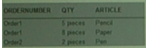
- AUse a gen_row_num_per_group(ORDERNUMBER) function on unsorted data
- BUse the count_distinct(ORDERNUMBER) function on the data sorted by ORDERNUMBER
- CUse a gen_row_num_per_group(ORDERNUMBER) function on the data sorted by ORDERNUMBER
- DUse the count(*) function on unsorted data
3866 de 80
Data Integration Concepts
Which objects can you use to read data from SAP Netweaver Business Warehouse? (2)- AXML file
- BOpen hub
- CFile format
- DTables
3971 de 80
Data Integration Concepts
Which of the following use cases are common for scripts? (2)- AConditional routing
- BJob initialization
- CStatus table checks and updates
- DSet the system/datastore configurations
404 de 80
Complex Design Methodology
A new team member wants to browse the content of an existing local repository
How do you allow them to view the repository without making changes? (2)- A-Copy the repository and instruct the team member to view the copy in the repository manager
- B-Export the repository’s metadata to an XML file and instruct the team member to open it in SAP Information Steward
- C-Assign the team member “View” access level to the repository in the Central Management Console and instruct them to view it from the Designer
- D-Demonstrate to the team member how to view the repository using the Auto Documentation feature in the Management Console
4124 de 80
Complex Design Methodology
What file formats are available when exporting Data Services objects? (2)- AAn XML file
- BA CSV file
- CAn XSD file
- DAn ATL file
4227 de 80 (D)
Complex Design Methodology
You have two workflows. The second workflow should only run if the first one was successful.
How can you achieve this? (1)- AYou embed the first workflow in a try-catch
- BYou connect the two workflows with a line
- CYou add a script between the workflows using the error_number() function
- DYou use a conditional for the second workflow
4332 de 80
Complex Design Methodology
Which of the following are correct sequences of embedding objects within objects? (3)- AJob -> Dataflow -> Table Reader Object -> Dataflow
- BProject -> Job -> Workflow -> Dataflow -> Table Reader Object
- CProject -> Job -> Workflow -> Workflow -> Dataflow -> Dataflow
- DProject -> Job -> Script -> Table Reader Object
- EProject -> Job -> Dataflow -> Table Reader Object
4434 de 80
Complex Design Methodology
You have the requirement to build a process that handles both an initial load and a delta load. For most targets, the initial load and the delta load can use the same dataflow logic.
How does SAP recommend that you design the job(s)? (1)- A-One job is used for the initial load, and another job is used for delta load. The delta dataflows are copied from the initial load dataflows where necessary
- B-One job is used for the initial load, and another job is used for delta load. Both call the same objects where required
- C-One job is used for both initial and delta load. A conditional object is used to start the initial or delta dataflow where necessary
- D-One job is used for initial load and delta load. You control the dependencies by using scripting
4536 de 80
Complex Design Methodology
You want to display an object’s description in the Designer workspace
What tasks must be performed to accomplish this? (3)- AClick the View Enabled Descriptions button on the toolbar
- BEnter a description in the properties of the object
- CDisable Hide Non-Executable Elements in the difference viewer
- DRight-click the object, then choose Enable Description
- ERight-click the object in the local object library, then choose View Where Used
4641 de 80
Complex Design Methodology
You have three workflows:
• Customer
• Salesoffice
• Geography
The Salesoffice and Customer workflows have a dependency that the Geography workflow is loaded first.
How does SAP recommend dealing with the dependency? (1)- A-Connect the Geography workflow to the Customer workflow and the Salesoffice workflow
- B-Connect the Geography workflow to the Customer workflow, which in turn is connected to the Salesoffice workflow
- C-Have the Geography workflow as first object in the Customer workflow and Salesoffice workflow, and set them all to Execute only once
- D-Have two jobs: The first one calls the Geography and the second one calls the other workflows
4745 de 80
Complex Design Methodology
The design of a complex job requires that a dataflow occur in multiple workflows. This dataflow should run –at most- one time in a single execution of the job.
What would you do to prevent the dataflow from running multiple times? (1)- ASet the Number of Loaders on the target in the data flow to 1
- BEnable the Execute Only Once option in the dataflow properties
- CSet the Degree of Parallelism on the data flow to 1
- DEnable the Execute Only Once option in the properties of each of the workflows
4853 de 80
Complex Design Methodology
Your business user has given you the following source-to-target mapping document.
What issues do you need to clarify with the business user? (1)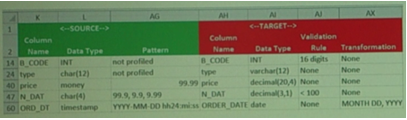
- AThe data type in the price column in the target should be changed to decimal(4,2)
- BThe to_date function will be used for the transformation of the ORDER_DATE column
- CThe transformation of the B_CODE column will be performed using regular expressions
- DThe N_DAT column will have some values truncated in the target table
4956 de 80
Complex Design Methodology
How does a workflow differ from a job? (1)- AA workflow can only call embedded dataflows
- BIn recovery mode, only workflows with “recover as a unit” enabled will be executed
- CA workflow has its own global variables
- DA workflow must be called by a job in order to execute
5074 de 80
Complex Design Methodology
Which of the following components are required to run batch jobs in Data Services? (2)- ALocal repository
- BJob server
- CDesigner
- DCentral repository
515 de 80
Performance Optimized Design
You need to initial load a target table with data from an extremely large source table in another database. The only mappings are columns being renamed. The source has been set up to allow for maximum throughput, for example, the source table is partitioned.
Which option should you check before the first execution of the dataflow? (3)- A-Check if the Degree Of Parallelism property of the dataflow object is set to the same number of CPU cores as the DataServices server
- B-Check the Degree Of Parallelism property of the dataflow object and set it to the same number as the number of partitions in the source table
- C-Check that the target table options Enable Partitions, Number of Loaders and Enable Bulkloader are aligned to the database you are using
- D-In the source table options, check if the Enable Partitions flag is available and turned on
- E-Check if the bulkloader is turned on, although the number of Loaders and Enable Partitions options are greyed out
5210 de 80 (D)
Performance Optimized Design
A dataflow contains a Pivot transform, which is followed by a Query transform that performs an aggregation.
How do you push down the aggregation query to the database? (1)- A-The Data_Transfer transform must be used twice, ahead of the Pivot transform and after the Query transform
- B-The Data_Transfer transform must go ahead of the Query transform
- C-The Data_Transfer transform must follow the Query transform
- D-The Data_Transfer transform must go ahead of the Pivot transform
5316 de 80 (D)
Performance Optimized Design
Your dataflow reads a subset of data (where ORDER_TYPE=’A’) from a relational source database and loads another target database. The only mappings you are using are columns being renamed and the functions trim_blanks() and substring().
To isolate the performance bottleneck, what test would you perform first? (1)- A-Add a Map_Operation discarding all rows between the query and the target table
- B-Add a Map_Operation discarding all rows between the source table and the query transform with the where clause and the functions
- C-Remove the functions trim_blanks() and substring() from the query mappings
- D-Use the Display Optimized SQL menu item and copy the shown SQL statement into a database query tool
5418 de 80
Performance Optimized Design
You have a source table and lookup table in the same database.
Which is the fastest method to retrieve a lookup value from a table based on a primary key? (1)- AUse the sql() function in the query mapping
- BPush down the lookup as a join into the source database
- CIn the database, write a stored procedure to return the row
- DUse the lookup_ext function with pre_load_cache
5521 de 80
Performance Optimized Design
Your customer is using the lookup function and needs to improve performance.
Under what conditions should they use the Demand Load Cache option? (3)- AAll rows of the lookup table will eventually be needed
- BLookup rows are used more than once
- CColumns referenced in the lookup condition are indexed
- DOptimization statistics have been collected for the job
- EThe lookup table is too large to fit in cache
5623 de 80
Performance Optimized Design
After modifying an existing job, you notice that the run time is longer than expected.
Where in the Management Console can you observe the progress of row counts to determine the location of a bottleneck? (1)- AUse the Administrator web page to access the Trace log
- BUse the Impact and Lineage Analysis option to access the Trace log
- CUse the Administrator web page to access the Monitor log
- DUse the Impact and Lineage Analysis option to access the Monitor log
5744 de 80
Performance Optimized Design
To improve load balancing, you decide to distribute the execution of a job across multiple job servers within a server group.
What objects can be distributed across the server group? (3)- AEmbedded dataflow
- BSub-dataflow
- CJob
- DWorkflow
- EDataflow
5855 de 80
Performance Optimized Design
You are working on a dataflow where performance is critical. You use the Display Optimized SQL menu item and expected to see an insert…select statement, but the dataflow is not optimized as full pushdown.
What could have caused this? (3)- AThe dataflow produces a warning saying “varchar(20) converted to varchar(5)”
- BThe dataflow has two query transforms, although they are simple
- CThe dataflow has two target tables
- DThe dataflow has the Bulkloader option enabled
- EThe dataflow is using a join clause containing a greater than condition
5962 de 80 (D)
Performance Optimized Design
After a batch job executes, you view the Monitor log for execution statistics. For one of the tasks, you observe that the Elapsed Time column is 0.0000 (zero), while Actual Time for the task is greater than zero.
What might explain this outcome? (1)- AThe task was performed on the access server
- BThe task was pushed down to the database server
- CAn exception was raised in the job prior to the task
- DThe task was performed using data cached in job server memory
6065 de 80
Performance Optimized Design
Which transforms execute SQL statements themselves? (2)- AMap CDC Operation transform
- BKey Generation transform
- CHistory Preserving transform
- DTable Comparison transform
6180 de 80
Performance Optimized Design
Which factor do you need to consider when setting the degree of parallelism? (1)- AThe number of access servers available
- BThe number of CPUs available on the server
- CThe number of source tables used in the dataflow
- DThe amount of disk space available on the server
6219 de 80 (D)
Recovery and Troubleshooting
You have built a job using many workflows and dataflows.
What is the SAP-recommended way to execute a single workflow for testing? (1)- ACopy and paste each of the objects within the workflow into a test job
- BExecute the job in debug mode and skip the other objects
- CUse conditionals for each workflow and a complex control logic
- DDrag the workflow object from the object library into a test job
6325 de 80
Recovery and Troubleshooting
You created a job containing a number of workflows. You want to implement a solution that allows you to restart loading the job from a point of failure.
What do you need to do before starting the job? (1)- A-Turn on the Enable Recovery flag in the execution properties
- B-Turn on the Recover as a Unit flag in the workflow properties
- C-Turn on the Recover from Last Failed Execution flag in the execution properties
- D-Turn on the Enable Recovery flag and the Recover from Last Failed Execution flag in the execution properties
6442 de 80 (D)
Recovery and Troubleshooting
You execute a job with Enable Recovery activated and one of the data flows in the job raises an exception, interrupting execution. You run the job again with Recover from Last Failed Execution enabled.
What happens to the data flow that raised the exception during the first execution? (1)- AIt is rerun only if the dataflow is part of a recovery unit
- BIt is rerun from the beginning and the design of the data flow must deal with partially loaded data
- CIt is rerun from the beginning and the partially loaded data is always handled automatically
- DIt is rerun starting with the first failed row
6550 de 80
Recovery and Troubleshooting
Where can you set up breakpoints for the interactive debugger? (1)- AIn a workflow
- BIn a script
- CIn a job
- DIn a dataflow
6651 de 80
Recovery and Troubleshooting
A job is failing with a primary key constraint violation error during testing.
How can you run the job successfully and also capture the rows that are failing? (1)- APut the data flow in a try-catch block and use the error_message function
- BSet the Auto Correct Load option to Yes in the target table editor
- CEnable the Distinct Rows option in the Query transform
- DSet the Use Overflow File option to Yes in the target table editor
6768 de 80
Recovery and Troubleshooting
Your job design includes an initialization script that truncates rows in the target prior to loading. The job will make use of automatic recovery.
Which of the following behaviours can you expect when you run the job in recovery mode? (2)- A-The job will rerun all workflows and scripts. Only data flows that ran successfully in the previous execution in skipped when using automatic recovery
- B-The job will start with the flow that caused the error. If this is after the initialization script, the initialization script will be skipped
- C-The job will execute the script if it is part of a workflow marked as a recovery unit, but only if an error was raised within that workflow
- D-The job will execute the script if it is part of a workflow marked as a recovery unit, no matter where in the job’s flow the error occurred
6872 de 80 (D)
Recovery and Troubleshooting
What is the consequence of using the loader option Include in Transaction? (1)- AIt requires a single database connection and might slow down performance
- BIt requires all data to be staged in a temporary database table
- CIt requires the dataflow to have a single target database
- DIt requires a script object after the dataflow to commit the data
6977 de 80
Recovery and Troubleshooting
Which of the following cause conversion warnings? (2)- Avarchar(10) converted to varchar(5)
- Bint to decimal(20,3)
- Cvarchar(5) converted to varchar(10)
- Dto_date(sysdate(),’YYYY.MM.DD’))
709 de 80
Implement Change Data Capture
You have a delta dataflow that is loading a large target table containing historical data. The table contains many indexed columns. The dataflow uses the Key_Generation transform to populate a surrogate key column in the target table. A typical delta run will update 80% of the target table.
How can you improve the performance of the delta load? (1)- A-Truncate the target table before loading
- B-Set the target table option Include in Transaction to Yes
- C-Replace the Key_Generation transform with a Query transform using the gen_row_num function
- D-Before loading, drop the indexes except the primary key on the target and recreate the indexes after loading
7111 de 80
Implement Change Data Capture
What are all the available options you have to identify changed rows in the source database with Data Services? (1)- A-Timestamps
- B-Read all and compare with the current target
- C-CDC datastores
- D-Additional log tables in the source containing changes
7226 de 80 (D)
Implement Change Data Capture
You want to load a target database that is queried day and night by users worldwide.
How do you design your job to have the least impact on users who are currently querying the database? (1)- AUse the option to truncate the target table and bulkload all data quickly
- BUse the Table Comparison transform in all dataflows
- CUse the sql() function to lock all tables at the beginning of the job
- DUse the Include in Transaction option in all dataflows and commit once at the end of the job
7328 de 80
Implement Change Data Capture
Your target database has a dimension table with 100 columns and 50,000,000 rows. More than half of the records change each day. You are designing a job to capture changes to this table without preserving history.
Which method is the fastest? (1)- AUse the Delete Data from Table Before Loading option
- BUse Table Comparison transform
- CUse Bulk Load with truncate option
- DUse the Auto-Correct Load option
7440 de 80
Implement Change Data Capture
How can you implement a target-based delta that deals with inserts, updates and deletes in the source? (1)- AUse Auto correct load
- BUse a Map_Operation transform
- CUse a Map_CDC_Operation transform
- DUse a Table Comparison transform
7547 de 80
Implement Change Data Capture
Which transforms are typically used to implement a Slowly Changing Dimension Type 2? (3)- AData_Transfer
- BHistory_Preserving
- CMap_CDC_Operation
- DKey_Generation
- ETable_Comparison
7658 de 80
Implement Change Data Capture
Which transforms can be connected directly to the Table Comparison transform’s output? (1)- AHistory_Preserving
- BKey_Generation
- CMap_Operation
- DQuery
7769 de 80
Implement Change Data Capture
In which situation is it appropriate to use an update timestamp column to capture changes in source data? (1)- AYou need to capture intermediate changes
- BYou need to capture physical deletes from source
- CAlmost all of the rows have changes
- DThere is an index on the timestamp column
788 de 80
Data Management
You have previously created and saved a database datastore.
Which properties can you change in the Edit Datastore dialog box? (3)- ADatabase name
- BUser name and password
- CDatabase server name
- DDatastore name
- EDatabase version
7922 de 80
Data Management
As part of the project team for a data migration engagement, you have been assigned to help create the source-to-target mapping document.
What is the main information that needs to be captured during the process? (2)
Data flow mapping- AData flow mapping
- BBusiness rules
- CUser rules
- DData Security
8049 de 80
Data Management
What is the relationship between datastore configurations and system configurations? (1)- A-A datastore configuration can only reference one system configuration
- B-System configurations and datastore configurations are exported together as one file
- C-Substitution parameters link system configurations to datastore configurations
- D-A system configuration consists of exactly one datastore configuration for each datastore in the repository
Informationen
- Beschreibung
- Cantajuegos
- Sprache
- Español
- Aufrufe
- 40
- Schlagwörter
- Bewertung
- Noch keine Bewertungen Bewerte dieses Quiz