
Quiz
Theme 1
Erstelle ein kostenloses Konto, um dieses Quiz zu beenden
Speichere deinen Fortschritt und sieh dir dein Endergebnis an.
oder mit deiner E-Mail registrieren
Schon ein Konto? Anmelden
Fragen in diesem Quiz (50)
1Rank the following interactions in order of increasing strength
- Aionic interactions, hydrogen bonds, London dispersion forces, covalent bonds
- BLondon dispersion forces, hydrogen bonds, ionic interactions, covalent bonds
- CLondon dispersion forces, ionic interactions, hydrogen bonds, covalent bonds
- Dcovalent bonds, London dispersion forces, ionic interactions, hydrogen bonds
2The strongest non-covalent interactions are
- Aionic interactions
- Bhydrogen bonds
- Cdipole-dipole interactions
- DLondon dispersion forces
3Hydrogen bonds within liquid water
- Aare attractions between protons and oxygen nuclei
- Bare attractions between two hydrogen atoms
- Care dipole-dipole attractions
- Dare attractions between protons and hydroxide ions
4Urea is a water-soluble product of nitrogen metabolism. How many hydrogen bonds can one urea molecule donate to surrounding water molecules?
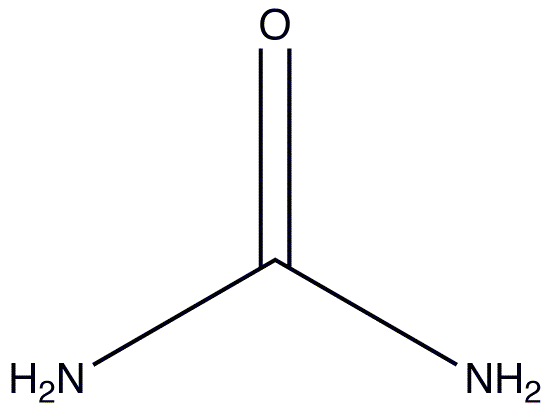
- A2
- B3
- C4
- D5
5Methanol can act both as a H-bond donor and as a H-bond acceptor. What is the maximal number of H-bonds a single molecule of methanol can form with surrounding water molecules.
- A1
- B2
- C3
- D4
6In a hydrogen bond between a water molecule and another biomolecule
- Aa hydrogen ion on the water molecule forms an ionic bond with a hydride ion on the other molecule
- Bthe partial charge on a hydrogen of the water molecule interacts with the partial charge on a hydrogen of the other molecule
- Cthe hydrogen bond will typically form between a hydrogen atom of the water molecule and either a nitrogen, sulfur, or oxygen atom of the other molecule
- Dthe hydrogen atom is located between an oxygen atom of the water and a carbon atom of the other molecule
7Which of the following statements about water is not true?
- AIt has a high dielectric constant
- BIt dissolves salts and polar substances
- CIt can form two hydrogen bonds per water molecule
- DIn the liquid state it is only 15% less hydrogen bonded than in the solid state at 0°C
8Which of the following statements about water is not true?
- AThe electron-rich oxygen atom of one water molecule can interact with the electron-poor proton on another water molecule to form a hydrogen bond
- BLiquid water is only 15% less hydrogen bonded than ice
- CWater can form highly ordered, cage-like, structures around nonpolar molecules
- DWater is a nonpolar molecule that with a bent molecular geometry
9Which of the following statements about water is incorrect?
- AWater is an excellent solvent for polar molecules
- BCations are solvated by shells of water molecules oriented with their hydrogen atoms pointed toward the ions
- CAmphiphilic detergents often form micelles with the polar groups on the outside exposed to water (solvent) and the nonpolar groups sequestered in the interior
- DPure water has a concentration of approximately 55.5 M
10Which of the following statements about water is incorrect?
- AIt is a small, polar molecule with a low dielectric constant
- BAcid-base reactions are very fast due to the mobility of hydronium ions in water which is a consequence of the ability of individual protons to “jump” from one water molecule to another
- CIt has a bent geometry with each O─H bond approximately 0.958 Å long and with an O─H bond energy of approximately 460 kJ/mol
- DIt has a marked dipole moment
11Ice
- Ais a crystal of water molecules packed in an open structure stabilized by hydrogen bonds
- Bis less dense than liquid water
- Ccontains 17% more hydrogen bonds then water
- DAll of the statements above are true
12Covalent C─C and C─H bonds have bond strengths that are approximately ____ times higher than those of H-bonds
- A2
- B5
- C20
- D100
13The boiling point of water is 264°C higher than the boiling point of methane because
- Athe molecular mass of methane is much lower than that of water
- Bmethane molecules tend to avoid contact with each other
- Cwater molecules are connected to each other by H-bonds
- Dall of the above
14_____ is exceptionally soluble in water due to the formation of hydrogen bonds
- ANaCl
- BBenzene
- CSodium palmitate
- DEthanol
15Molecules such as methanol and ethanol are very soluble in water because
- Athey tend to avoid contact with each other
- Bthey contain C─H groups that donate H-bonds to water
- Cthey contain C─H groups that accept H-bonds from water
- Dthey contain O─H groups that can form multiple H-bonds with water
16Hydrophobic interactions between nonpolar molecules
- Aresult from the tendency of water to maximize contact with nonpolar molecules
- Bare the result of strong attractions between nonpolar molecules
- Crequire the presence of surrounding water molecules
- Dare the result of strong repulsion between water and nonpolar molecules
17Fatty acids such as palmitate and oleate are usually characterized as
- Aamphiphilic
- Bpolar
- Chydrophilic
- Dhydrophobic
18Amphiphilic molecules
- Ahave both oxidizing and reducing groups
- Bhave both hydrophilic and hydrophobic groups
- Chave chromophores in two different wavelength regions
- Dare micelles
19Which of the following statements about hydrophobic interactions is not true?
- AThey are caused by hydrophobic molecules interacting strongly with each other
- BThey are entropy driven
- CThey are the main driving force for protein folding into three dimensional structures
- DThey are the driving force for micelle formation
20Which of the following is the best explanation for the hydrophobic effect?
- AIt is caused by an affinity of hydrophobic groups for each other
- BIt is caused by the affinity of water for hydrophobic groups
- CIt is an entropic effect caused by the desire of hydrophobic groups to increase their entropy by associating with other hydrophobic groups
- DIt is an entropic effect, caused by the desire of water molecules to increase their entropy by excluding hydrophobic groups, which they must otherwise surround with highly ordered structures
21Globules of up to several thousand amphiphilic molecules arranged with the hydrophilic groups on the surface and the hydrophobic groups buried in the center that form in water are called
- Amicelles
- Bliposomes
- Cbilayer membranes
- Dvacuoles
22Sheets composed of two layers of amphipathic molecules arranged with the hydrophilic groups on the surface and the hydrophobic groups buried in the center that form in water are called
- Abilayer membranes
- Bvacuoles
- Cliposomes
- Dmicelles
23Physical properties that depend on the amounts of various species, rather than the identities of those species, are called
- Aosmotic properties
- Bhydrophobic properties
- CLondon dispersion forces
- Dcolligative properties
24Osmotic pressure is a function of
- Avan der Waals forces
- Bsolute concentration
- Csolute vapor pressure
- Dhumidity
25Kw, the ionization constant of water, is _____ at _____.
- A10-7; 25°C
- B10 14; 25°C
- C10–14; 25°C
- D10–14; 0°C
26Weak acids
- Aare only partially ionized in an aqueous solution
- Bgive solutions with a high pH
- Care of no value in a buffering system
- Ddo not provide hydronium ions
27A solution is made by mixing 0.05 mL of 1.0 M HCl with 999.95 mL of pure water. Calculate the pH of the resulting solution (assume the total volume is 1.0 L).
- A2.7
- B4.3
- C9.7
- D5.0
28The pH of coffee is 5.6. The pH of grapefruit juice is 2.6. This means that the proton concentration in coffee is
- Athousand times higher than in grapefruit juice.
- B3000 times lower than in grapefruit juice
- Ca thousand times lower than in grapefruit juice
- D3 times the proton concentration of grapefruit juice
29A solution is made by mixing 1.0 mL of 1.0 M acetic acid (pK = 4.76, Ka = 1.74 x 10⁻⁵ ) with one 999 mL of pure water. Calculate the pH of the resulting solution (assume the total volume is 1.0 L).
- A10.1
- B3.9
- C1.0
- D1.32
30The pH of a 0.1 M solution of sodium acetate would be
- Abasic, because of the acetate ion reacts with water to form acetic acid and OH–
- Bacidic, because the acetate ion is acidic
- Cneutral, because salts are neither acidic nor basic
- Dacidic, because the acetate ion forms acetic acid
31Phosphoric acid is a polyprotic acid, with pK values of 2.14, 6.86, and 12.38. Which ionic form predominates at pH 9.3?
- AH3PO4
- BHPO42−
- CPO43−
- Dnone of the above
32To make a phosphate buffer at pH 6.82 starting with one liter of 10 mM phosphoric acid (pKs are 2.15, 6.82, and 12.38), you could add
- A5 millimoles of HCl
- B25 millimoles of HCl
- CYou can't make a buffer by adding HCl or KOH
- D15 millimoles of KOH
33The pK1 of citric acid is 3.09. What is the citric acid : monosodium citrate ratio in a 1.0 M citric acid solution with a pH of 2.09?
- A10:1
- B1:1
- C10:11
- D1:11
34What is the approximate pKa of a weak acid HA if a solution 0.1 M HA and 0.3 M A– has a pH of 6.5?
- A5.8
- B6.0
- C6.4
- D6.6
35The pH at the midpoint in the titration of an acid with a base is
- Aequal to the pK of the corresponding acid
- Bequal to the pK of the corresponding base
- Cequal to 14 minus the pK of the corresponding acid
- Dnone of the above
36The capacity of a buffer to resist changes in pH upon addition of protons or hydroxide ions depends on
- Athe pKa of the weak acid in the buffer
- Bthe pH of the buffer
- Cthe total concentration of the weak acid and its conjugate base in the buffer
- Dall of the above
37The pH of blood is affected by
- Athe reaction of CO2 with H2O to form carbonic acid
- Bthe decrease of the blood pH due to the production of hydronium ions
- Cthe excretion of bicarbonate and ammonium ions from the kidneys
- Dall of the above
38The 104.5° bond angle in the water molecule is the result of the ______ of electron orbitals around oxygen
- Atetrahedral arrangement
- Bdisordered
- Chydrogen bond
- Dhigher electronegativity
39The polarity of the O–H bond is caused by the ______ of oxygen relative to that of hydrogen.
- Apositive entropy
- Bhydrogen bond
- Cnegative entropy
- Dhigher electronegativity
40Octane molecules dispersed in water tend to aggregate because that allows water molecules to be more ______.
- Arotational
- Bdisordered
- Cacid
- Dbasic
41Which of these statements about hydrogen bonds is not true?
- AHydrogen bonds account for the anomalously high boiling point of water
- BIn liquid water, the average water molecule forms hydrogen bonds with three to four other water molecules
- CIndividual hydrogen bonds are much weaker than covalent bonds.
- DIndividual hydrogen bonds in liquid water exist for many seconds and sometimes for minutes
42A true statement about hydrophobic interactions is that they:
- Aare the driving force in the formation of micelles of amphipathic compounds in water
- Bdo not contribute to the structure of water-soluble proteins
- Chave bonding energies of approximately 20–40 Kjoule per mole
- Dinvolve the ability of water to denature proteins
43Hydrophobic interactions make important energetic contributions to
- Abinding of a hormone to its receptor protein
- Benzyme-substrate interactions
- Cthree-dimensional folding of a polypeptide chain
- Dall of the above are true
44Dissolved solutes alter some physical (colligative) properties of the solvent water because they change the:
- Aconcentration of the water
- Bhydrogen bonding of the water
- Cionic bonding of the water
- DpH of the water
45Osmosis is movement of a
- Acharged solute molecule (ion) across a membrane
- Bgas molecule across a membrane
- Cnonpolar solute molecule across a membrane
- Dwater molecule across a membrane
46A hydronium ion:
- Ahas the structure H3O+
- Bis a hydrated hydrogen ion
- Cis a hydrated proton
- Dall of the above are true
47The pH of a solution of 1 M HCl is:
- A0
- B0.1
- C1
- D10
48The Henderson-Hasselbalch equation:
- Aallows the graphic determination of the molecular weight of a weak acid from its pH alone
- Brelates the pH of a solution to the pKa and the concentrations of acid and conjugate base
- Cemploys the same value for pKa for all weak acids
- Dis equally useful with solutions of acetic acid and of hydrochloric acid
49Consider an acetate buffer, initially at the same pH as its pKa (4.76). When sodium hydroxide (NaOH) is mixed with this buffer, the:
- ApH remains constant
- BpH rises more than if an equal amount of NaOH is added to an acetate buffer initially at pH 6.76
- CpH rises more than if an equal amount of NaOH is added to unbuffered water at pH 4.76
- Dratio of acetic acid to sodium acetate in the buffer falls
50Which of the following properties of water does not contribute to the fitness of the aqueous environment for living organisms?
- ACohesion of liquid water due to hydrogen bonding
- BThe very low molecular weight of water
- CHigh heat of vapori
- DHigh specific heat
Informationen
- Beschreibung
- Quiz am Theme 1, erstellt von Silvana Medina am 27/08/2017.
- Autor
- Silvana Medina
- Sprache
- Español
- Aufrufe
- 8
- Bewertung
- Noch keine Bewertungen Bewerte dieses Quiz