
10021448
Beschreibung

Quiz von Alyssa Williamson, aktualisiert more than 1 year ago

|
Erstellt von Alyssa Williamson
vor etwa 9 Jahre
|
|
Frage 1
Frage
Mr. Smith presents to your clinic with complaints of low back pain for 3 months. During his subjective history, he shares that he is 65 years old, history of prostate cancer, with weakness to the knee extension/flexion, and urinary incontinence. He maybe recalls injuring his back lifting a box off the floor a few months ago. What should your differential diagnoses include?
Antworten
-
Muscle Strain, Cancer
-
Cancer
-
Muscle Strain, Cancer, Cauda Equina Syndrome
-
Muscle Strain.
Frage 2
Frage
What is the definition of spondylolysis?
Antworten
-
defect in pars interarticularis
-
anterior slippage of the vertebral segment in relation to the vertebral segment immediately above it
-
anterior slippage of the vertebral segment in relation to the vertebral segment immediately below it
-
degenerative changes within the spine
Frage 3
Frage
Mr. Brown presents to the outpatient clinic with complaints of low back pain. During the examination, you determine the diagnosis to be spondylosis. Click the options below that could be the cause.
Antworten
-
Bulging Disc
-
Loss of IVD height
-
Lifting a 50# box a week ago
-
Slipping on the ice while working
Frage 4
Frage
Based on this image, what x-ray image are you looking at? How can you tell?
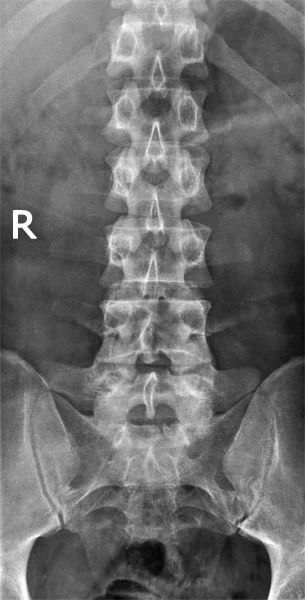
Antworten
-
Lateral -- We are able to look at the vertebral body heights
-
AP -- The spinous processes are visible
-
Oblique -- Scotty Dog is visible
-
PA -- I do not see the spinous processes indicating this view.
Frage 5
Frage
What myotome level correlates with hip extension?
Antworten
-
L1-L4
-
L2-S1
-
L5-S1
-
L5-S2
Frage 6
Frage
What muscle and level is this reflex testing?
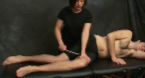
Antworten
-
Adductor Magus, L3/4
-
Adductor Magus, L2/3
-
Adductor Brevis, L3/4
-
Abductor, L2/3
Frage 7
Frage
If your patient had a (-) SLR test, with the following information, what would you know regarding the statistical information of this test.
Sn = 0.91
Sp = 0.26
- LR = 0.35
+ LR = 1.2
Antworten
-
The SN is high, so I would say this patient has sciatic pain!
-
The SN is high, so I would say this patient does not have sciatic pain!
-
The SP is low, so I would say this patient has sciatic pain!
-
The SP is low, so I would say this patient does not have sciatic pain!
Frage 8
Frage
a patient presents with a non-neutral lumbar spine dysfunction. Patient is restricted in extension, R rotation, and _____ SB.
Antworten
-
R SB
-
L SB
Frage 9
Frage
What is Fryette's 2nd Law of Biomechanics?
Antworten
-
if the lumbar spine is non-neutral, LF and Rotation occur in the same direction
-
in a neutral lumbar spine, LF and Rotation occur in opposite directions
-
Motion introduced in one plane reduces motion available in other planes.
-
in a neutral lumbar spine, LF and Rotation occur in the same direction
-
if the lumbar spine is non-neutral, LF and Rotation occur in the opposite direction
Möchten Sie mit GoConqr kostenlos Ihre eigenen Quiz erstellen? eigenen Mehr erfahren.