
Quiz
Consumer Behaviour MidTerm
Erstelle ein kostenloses Konto, um dieses Quiz zu beenden
Speichere deinen Fortschritt und sieh dir dein Endergebnis an.
oder mit deiner E-Mail registrieren
Schon ein Konto? Anmelden
Fragen in diesem Quiz (53)
1What is the basic consumption process?
- A1. Need 2. Want 3.Exchange 4.Costs & Benefits 5.Reaction 6.Value
- B1. Exchange 2. Want 3.Need 4.Costs & Benefits 5.Value 6.Reaction
2What are the characteristics of successful innovations?
- A1. Relative advantage - makes things better than before
2. Simplicity - all things equal, a simpler innovation is better than a complex innovation
3. Observability - Things that are observable tend to get adopted faster
4. Trialability - things that can be tried with little or no risk get adopted first
5. Consistency - consumers are more likely to adopt things that are congruent with existing values and knowledge - B1. Relative disadvantage - makes things better than before
2. Complexity- all things equal, a simpler innovation is better than a complex innovation
3. Unavoidance- Things that are observable tend to get adopted faster
4. User interface- things that can be tried with little or no risk get adopted first
5. Consistency - consumers are more likely to adopt things that are congruent with existing values and knowledge
- A1. Relative advantage - makes things better than before
3What does the consumer value framework represent?
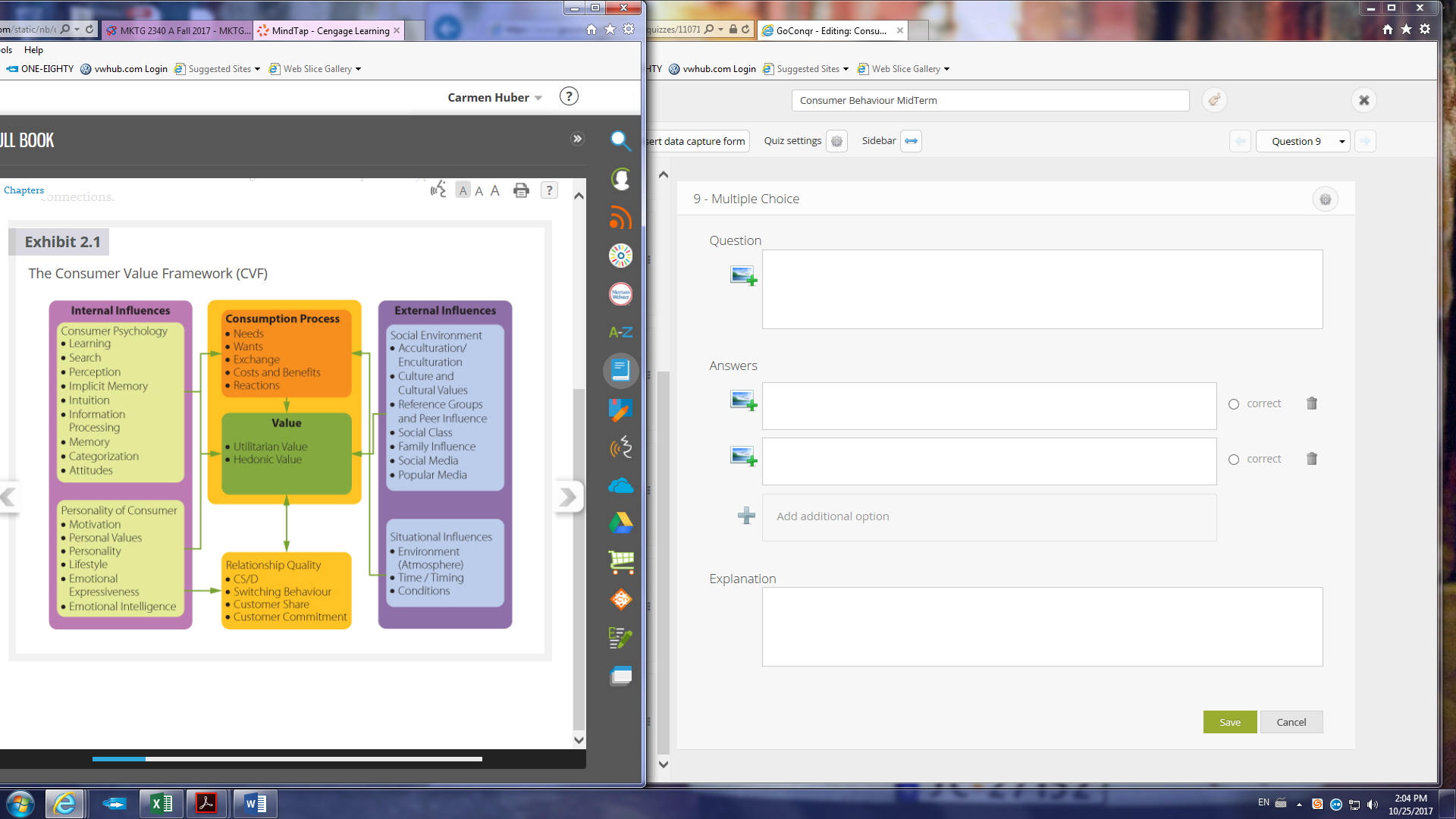
- ARepresents consumer behaviour theory illustrating factors that shape consumption related behaviours and ultimately determine the value associated with consumption.
- BRepresents the consumer's journey In discovering how they find value in products.
4What are internal influences for the Consumer value framework?
- AConsumer Psychology: learning, search, perception, intuition, memory, attitudes
Personality of Consumer: motivation, personal values, personality, lifestyle, emotional expressiveness, emotional intelligence - BSocial Environment: acculturation/enculturation, culture and cultural values, reference and peer groups, social class, family influence, social media, popular media
Situational Influences: Environment, time, conditions
- AConsumer Psychology: learning, search, perception, intuition, memory, attitudes
5What are the external influences in the consumer value framework?
- ASocial Environment: acculturation/enculturation, culture and cultural values, reference and peer groups, social class, family influence, social media, popular media
Situational Influences: Environment, time, conditions - BConsumer Psychology: learning, search, perception, intuition, memory, attitudes
Personality of Consumer: motivation, personal values, personality, lifestyle, emotional expressiveness, emotional intelligence
- ASocial Environment: acculturation/enculturation, culture and cultural values, reference and peer groups, social class, family influence, social media, popular media
6What are the factors involved in the consumption process in the consumer value framework?
- Aneeds, wants, exchange, costs, benefits
- BCS/D, Switching behaviour, customer share, customer commitment
7what are the types of value in the consumer value framework?
- Autilitarian and hedonic
- Bneeds, wants, exchange, costs and benefits, reactions
8what is the relationship quality in the consumer value framework?
- ACS/D, switching behaviour, customer share, customer commitment
- Butilitarian, hedonic
9What is utilitarian value?
- Ais derived from a product that helps the consumer solve problems and accomplish tasks. Consumers usually offer a rational explanation of why something is purchased when utilitarian value is the prime motivation. Ex Clorox bleach its a means to an end. Value happens because the object or activity allows something else to happen.
- Bthe immediate gratification that comes from experiencing an activity. The value is provided entirely by the actual experience and emotions associated with consumption. Emotional and subjective in matter.
10what is hedonic value?
- Athe immediate gratification that comes from experiencing an activity. The value is provided entirely by the actual experience and emotions associated with consumption. Emotional and subjective in matter.
- Bis derived from a product that helps the consumer solve problems and accomplish tasks. Consumers usually offer a rational explanation of why something is purchased when utilitarian value is the prime motivation. Ex Clorox bleach its a means to an end. Value happens because the object or activity allows something else to happen.
11What is the consumer perception process?
- ASensing, organizing, reacting, back to sensing
- BSmelling, organizing, reacting, back to smelling
12what is sensing in the consumer perception process?
- Aan immediate response to stimuli that have come into contact with one of the consumer's five sense, sight, smell, touch, taste or hearing.
- Bthe process by which the human bran assembles the sensory evidence into something recognizable. When an object is first handles, the sorter hasn't a clue what slot the object belongs in, however information allows the sorter to place the object into progressively more specific categories.
13what is organizing in the consumer perception process?
- Athe process by which the human bran assembles the sensory evidence into something recognizable. When an object is first handles, the sorter hasn't a clue what slot the object belongs in, however information allows the sorter to place the object into progressively more specific categories.
- Ban immediate response to stimuli that have come into contact with one of the consumer's five sense, sight, smell, touch, taste or hearing.
14what is reacting in the consumer perception process?
- Athe process ends with a reaction. If an object is successfully recognized, chances are some nearly automatic reaction takes place. For example, when a driver notices that the car in front of him or her has its brake lights on, the learned response is to apply brakes as well. Here, the reaction occurs as a response or behaviour. Note that reactions can include both physical and mental responses to the stimuli encountered.
- Bthe process by which the human bran assembles the sensory evidence into something recognizable. When an object is first handles, the sorter hasn't a clue what slot the object belongs in, however information allows the sorter to place the object into progressively more specific categories.
15What are the physical characteristics of a message?
- Arefer to the elements of a message that one senses directly. These parts come together to execute a communication of some type. While these elements affect comprehension, you may note that some of these characteristics also affect the likelihood that consumers pay attention. Here are just a few physical characteristics that can contribute to effective communication.
- BAre they way that a consumer will feel through an experience of a product. These are carefully planned by marketers.
16What are the 5 physical characteristics on the message?
- AIntensity, Colour, Font, Numbers, Spacing
- BNumbers, Feel, Scent, Colour, Time
17Intensity means?
- AGenerally speaking, the greater the movement, the larger the picture, or the louder the sound, the more likely a consumer is to attend and comprehend something from a message. Large numbers convey better deal than smaller numbers. All capitals conveys shouting.
- BColour affects the likelihood of gaining a consumer’s attention, but it can also have an impact on comprehension. Gold signals quality. Similarly, blue is associated with higher quality and higher price expectations. Warm colours like red and orange get attention but also may lower quality perceptions relative to cool colours.
18Colour means?
- AColour affects the likelihood of gaining a consumer’s attention, but it can also have an impact on comprehension. Gold signals quality. Similarly, blue is associated with higher quality and higher price expectations. Warm colours like red and orange get attention but also may lower quality perceptions relative to cool colours.
- BConsumers derive meaning from both the actual text of a message and the visual presentation of the message. Font styles send meaningful signals. The same brand or store name presented in a block font such as Courier may take on a different meaning if presented in a script font.
19Font means?
- AConsumers derive meaning from both the actual text of a message and the visual presentation of the message. Font styles send meaningful signals. The same brand or store name presented in a block font such as Courier may take on a different meaning if presented in a script font.
- BMany brand managers rely on alphanumeric names, combining letters and numbers, for new products. Automobiles provide an interesting illustrative example of this practice. For example, makes and models include Lexus RC-F, Mercedes CLS-550, and Mazda CX-8.
20Numbers mean?
- AMany brand managers rely on alphanumeric names, combining letters and numbers, for new products. Automobiles provide an interesting illustrative example of this practice. For example, makes and models include Lexus RC-F, Mercedes CLS-550, and Mazda CX-8. Compare these names with something like Volkswagen Rabbit or Dodge Ram. A consumer expects a car named after a rabbit to possess rabbit-like qualities, which can be both good and bad. In contrast, combinations of numbers and letters have little specific meaning. This gives marketers a better opportunity to shape the intended meaning of a brand. Names with letters and numbers used in combination do tend to signal a “technologically advanced” meaning.
- BAll types of communicators, from salespeople to advertisers to teachers, repeat messages as a way of increasing comprehension. If a communicator is going to repeat a message multiple times, is it better to repeat it in sequence or to break up the repetition? Actually, consumers display greater recall of an intended message when information is presented in intervals rather than in sequence. For instance, in media advertising, three 30-second ads spread over three hours achieve better consumer recall of information than a single 90-second advertisement.
21Spacing means?
- AAll types of communicators, from salespeople to advertisers to teachers, repeat messages as a way of increasing comprehension. If a communicator is going to repeat a message multiple times, is it better to repeat it in sequence or to break up the repetition? Actually, consumers display greater recall of an intended message when information is presented in intervals rather than in sequence. For instance, in media advertising, three 30-second ads spread over three hours achieve better consumer recall of information than a single 90-second advertisement.
- BMany brand managers rely on alphanumeric names, combining letters and numbers, for new products. Automobiles provide an interesting illustrative example of this practice. For example, makes and models include Lexus RC-F, Mercedes CLS-550, and Mazda CX-8. Compare these names with something like Volkswagen Rabbit or Dodge Ram. A consumer expects a car named after a rabbit to possess rabbit-like qualities, which can be both good and bad. In contrast, combinations of numbers and letters have little specific meaning.
22What is an associative network?
- Aa network of mental pathways linking knowledge within memory (and sometimes referred to as a semantic network). These networks are similar to family trees, as they represent known linkages between objects.
- Ba bunch of cognitive reactions that refer to a specific sense in time. They can influence consumers decisions as they can activate deep parts of their cognitive memory.
23This is an example of an associative network graphic?
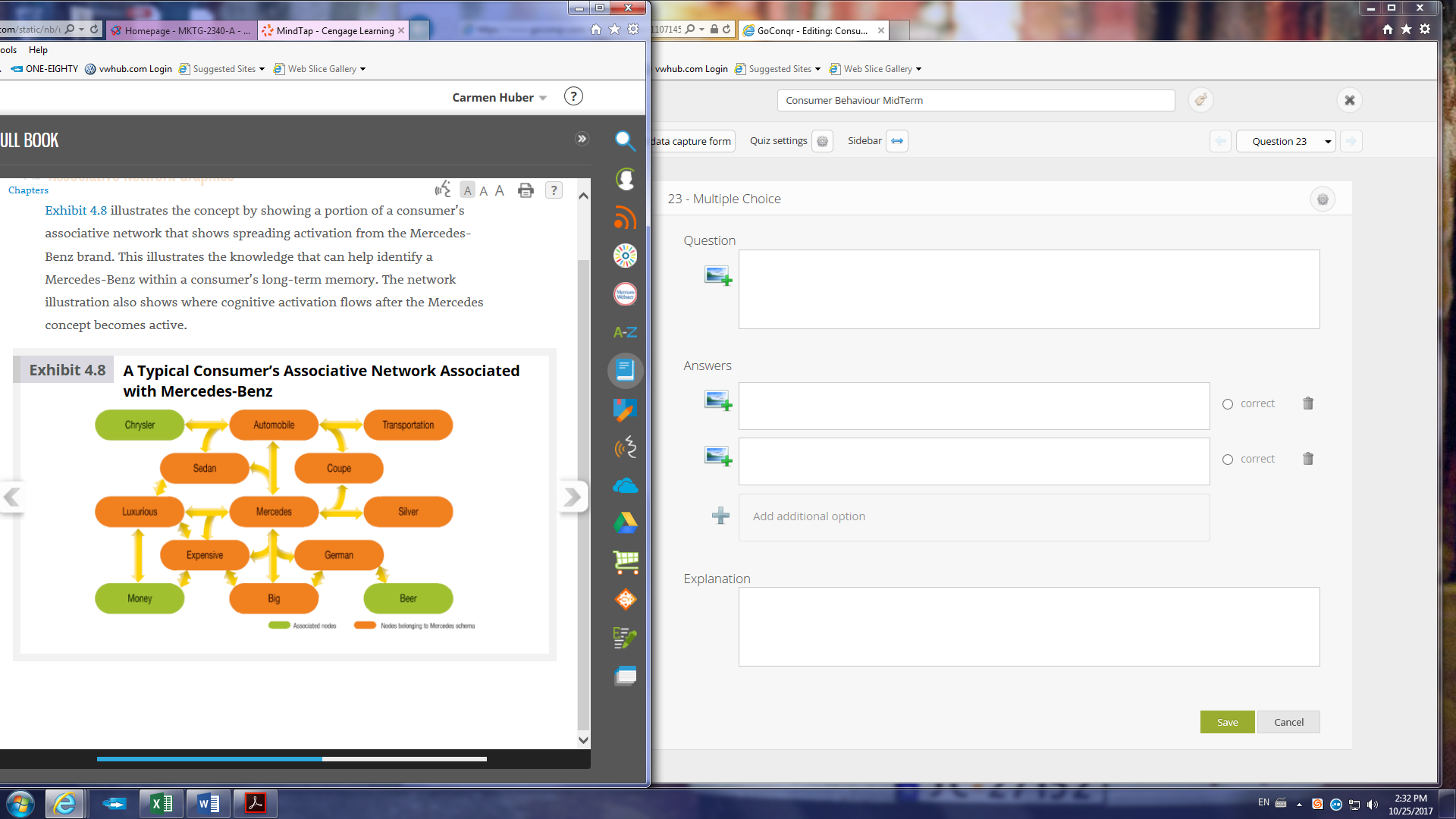
- Aillustrates the concept by showing a portion of a consumer’s associative network that shows spreading activation from the Mercedes-Benz brand. This illustrates the knowledge that can help identify a Mercedes-Benz within a consumer’s long-term memory. The network illustration also shows where cognitive activation flows after the Mercedes concept becomes active.
- Billustrates the concept by showing a portion of a consumer’s associative network that shows spreading activation from the Mercedes-Benz brand. This illustrates the knowledge that can help identify a Mercedes-Benz within a consumer’s long-term memory.
24What is maslow's hierarchy of needs?
- Aa theory of human motivation that describes consumers as addressing a finite set of prioritized needs
- Ba theory that humans do not need anything besides basic needs like water, food, shelter and oxygen
25what is the 5 factors in maslow's hierarchy of needs?
- APhysiological. Basic survival (food, drink, shelter, etc.)
Safety and security. The need to be secure and protected
Belongingness and love. The need to feel like a member of a family or community
Esteem. The need to be recognized as a person of worth
Self-actualization. The need for personal fulfillment - BTouch
Taste
Smell
Belief
Scent
- APhysiological. Basic survival (food, drink, shelter, etc.)
26what is utilitarian motivation?
- Adrive to acquire products that can be used to accomplish something
Example: Using air freshener to cover up a strange smell in the apartment - Bdrive to experience something emotionally gratifying
Example: Using air freshener because one really enjoys the smell
- Adrive to acquire products that can be used to accomplish something
27what is hedonic motivation?
- Adrive to acquire products that can be used to accomplish something
Example: Using air freshener to cover up a strange smell in the apartment - Bdrive to experience something emotionally gratifying
Example: Using air freshener because one really enjoys the smell
- Adrive to acquire products that can be used to accomplish something
28what is consumer involvement?
- Adegree of personal relevance a consumer finds in pursuing value from a particular category of consumption
- Bthe amt the consumer is willing to participate in the research of a product
29What are examples of high product involvement?
- ADresses, televisions, champagne, bras
- Bdetergents, facial soap, toothpaste, yogurt
30what are examples of low product involvement?
- Adetergents, facial soap, toothpaste, yogurt
- Bdresses, televisions, champagne, bras
31What is the five factor model approach?
- Amultiple-trait perspective that proposes that the human personality consists of five traits: agreeableness, extroversion, openness to experience (or creativity), conscientiousness, and neuroticism (or stability)
- BIt uses the approach to maslows hierarchy basing the model approach upon what a consumers basic needs are
32What is correct below in terms of the 5-factor model?
- AExtroversion - talkative, outgoing
Agreeableness - kind-hearted, sympathetic
Openness to experience - creative, open to new ideas
Stability - even-keeled, avoids mood swings
Conscientiousness - Precise, efficient, organized - BTouch
Taste
Smell
Hearing
Sight
- AExtroversion - talkative, outgoing
33What does lifestyle refer to ?
- Adistinctive modes of living, including how people spend their time and money. In other words, they are very useful in identifying viable market segments. Appealing to a consumer’s lifestyle is so important that it’s not uncommon to see advertisements focusing as much on lifestyle as on the actual product itself.
- Bquantitative investigation of consumer lifestyles
34What does psychographics refer to?
- Aquantitative investigation of consumer lifestyles. analysis involves surveying consumers using AIO statements hich are used to gain an understanding of consumers’ activities, interests, and opinions. These measurements can be narrowly defined (as relating to a specific product or product category) or broadly defined (as pertaining to general activities that the consumer enjoys).
- Brefers to observable, statistical aspects of populations, including such factors as age, gender, or income. Lifestyles, although also observable, refer to how consumers live.
35what does demographics refer to?
- Aquantitative investigation of consumer lifestyles. analysis involves surveying consumers using AIO statements hich are used to gain an understanding of consumers’ activities, interests, and opinions. These measurements can be narrowly defined (as relating to a specific product or product category) or broadly defined (as pertaining to general activities that the consumer enjoys).
- Brefers to observable, statistical aspects of populations, including such factors as age, gender, or income. Lifestyles, although also observable, refer to how consumers live.
36What are source effects?
- Aimportant issue in the study of persuasion is how the source of a message (a spokesperson or model, for example) influences consumers’ attitudes. Source effects include issues such as credibility, attractiveness, likeability, and meaningfulness.
- BThe different categories that can effect the opinion of a consumer
37what is source credibility?
- Ageneral, credible sources tend to be more persuasive than less credible sources. This effect tends to be highest when consumers lack the ability or motivation to expend effort attending to the details of an ad (low involvement). Credibility consists of 2 elements: expertise and trustworthiness. Expertise refers to the amount of knowledge that a spokesperson is perceived to have about the product or issue in question. Trustworthiness refers to a perception of the extent to which a spokesperson is presenting a message that he or she truly believes, with no reason to present false information.
- Bis another quality that has received a great deal of attention. Attractive models are often thought to possess desirable qualities and personalities. They also tend to be more persuasive than unattractive spokespeople.
38what is source attractiveness?
- AAttractive models are often thought to possess desirable qualities and personalities. They also tend to be more persuasive than unattractive spokespeople. However, the type of product plays an important role in the process. Much like the research regarding the use of sex appeals, research into attractiveness reveals that attractive models are more effective when promoting products that have an intimate appeal, whereas unattractive models are more effective when promoting products that have no intimate appeal.
- BSource likeability also affects a spokesperson’s effectiveness. Likeable sources tend to be persuasive. Of course, individuals differ in terms of which celebrities they like and dislike, and marketers are very interested in finding the best possible spokesperson for a given market segment. The advertising industry relies heavily on a Q-score rating provided by Marketing Evaluations, Inc., as an indication of the overall appeal of celebrities
39what is source meaningfulness?
- ASource likeability also affects a spokesperson’s effectiveness. Likeable sources tend to be persuasive. Of course, individuals differ in terms of which celebrities they like and dislike, and marketers are very interested in finding the best possible spokesperson for a given market segment. The advertising industry relies heavily on a Q-score rating provided by Marketing Evaluations, Inc., as an indication of the overall appeal of celebrities
- BThat is, the dominant characteristics of a source should match the characteristics of the product. This is a key concept that is found in the matchup hypothesis
, which states that a source feature is most effective when it is matched with relevant products. As such, we should expect LeBron James to be an effective spokesperson for footwear and less effective when promoting a product that has no athletic qualities at all.
40What is message appeals?
- AThere are several ways to conceptualize how a message may affect the persuasiveness of an advertisement. number of appeals are used by advertisers, including sex appeals, humour appeals, fear appeals, and violence appeals.
- BHow a message comes across
41What are the dimensions of cultural value?
- AIndividualism, masculinity, power distance, uncertainty avoidance
- Btouch, taste, smell, hearing, visual
42what is individualism?
- Aextent to which people are expected to take care of themselves and their immediate families
- Brole distinction within a group that values assertiveness and control; core societal value opposite of femininity
43what is masculinity?
- Arole distinction within a group that values assertiveness and control; core societal value opposite of femininity
- Bextent to which authority and privileges are divided among different groups within society and the extent to which these facts of life are accepted by the people within the society
44what is power distance?
- Aextent to which authority and privileges are divided among different groups within society and the extent to which these facts of life are accepted by the people within the society
- Bextent to which a culture is uncomfortable with things that are ambiguous or unknown
45what is uncertainty avoidance?
- Aextent to which a culture is uncomfortable with things that are ambiguous or unknown
- Bvalues consistent with Confucian philosophy and a prioritization of future rewards over short-term benefits
46what are the quartet of institutions?
- Afour groups responsible for communicating the CSV through both formal and informal processes from one generation to another: family, school, church, and media
- BDifferences in CSVs may have public policy implications as well. A study of teen consumers in countries such as Italy, Austria, Slovenia, Uzbekistan, Russia, and the United States, among others, found that anti-smoking ads were not equally effective.
47what is social power?
- Aability of an individual or a group to alter the actions of others
- Bresult of group influence in which an individual yields to the attitudes and behaviours of others
48what are the 5 types of social power?
- Areferent power - a consumer admires the qualities of a group and emulates their behaviour as a way to identify with the group. Ex) A new resident deires to join the rotary club
Legitimate Power - Specific agreements are made regarding group membership and the punishment for nonconformity is understood. Ex) bosses have legitimate authority over their employees.
Expert Power - Groups possess knowledge that members or aspirant members desire to gain. Ex)Consumers seek out groups that have health related information such as the dental association
Reward Power- A group has the power to reward members for various behaviours Ex) sports teams give MVP honours to a team member
Coercive Power - a group has the power to sanction members for failing to follow expectations or rules Ex) a university football player is kicked off the team for using drugs - Breverent power - a player In the nba signs a 10 year contract
- Areferent power - a consumer admires the qualities of a group and emulates their behaviour as a way to identify with the group. Ex) A new resident deires to join the rotary club
49what is reference group influence?
- Ainfluence generally falls into one of three categories: informational influence, utilitarian influence, and value-expressive influence
- Bmanipulate by many different factors such as religion, culture and subculture
50what is informational influence?
- Aways in which a consumer uses the behaviours and attitudes of reference groups as information for making personal decisionsReference groups often provide members with product- or issue-related information, and consumers often consider group-related information when purchasing products or services. Consumers desire to make informed decisions, and reference groups are often perceived as being effective sources of information. Groups can be very influential in this way. Informational influence can be a result of explicit searching behaviour. For example, when a consumer is seeking a doctor, friends may influence the choice by saying, “This doctor is very good.”
- Boccurs when consumers conform to group expectations to receive a reward or avoid punishment (this is sometimes referred to as “normative” influence). Compliance with group expectations often leads to valued rewards.
51what is utilitarian influence?
- AReference groups often provide members with product- or issue-related information, and consumers often consider group-related information when purchasing products or services. Consumers desire to make informed decisions, and reference groups are often perceived as being effective sources of information. Groups can be very influential in this way. Informational influence can be a result of explicit searching behaviour. For example, when a consumer is seeking a doctor, friends may influence the choice by saying, “This doctor is very good.”
- Boccurs when consumers conform to group expectations to receive a reward or avoid punishment. Utilitarian influence of groups is not limited to any age group or demographic profile. Adult consumers often perceive a great deal of utilitarian influence from reference groups. Driving the right car, living in the right neighbourhood, and belonging to the right clubs can make adults feel accepted. Here, we can see that utilitarian influence is related to reward power.
52what is value-expressive influence?
- Aof groups refers to the ways in which consumers internalize a group’s values or the extent to which consumers join groups to express their own closely held values and beliefs. This influence is related to referent power.
Consumers may also use group membership as a way to project their own self-image. Importantly, the self-image of the individual is influenced by the group, and group membership helps the individual project her desired image. For example, a consumer may choose to join Mothers Against Drunk Driving because she feels strongly about the drunk driving issue. Once she has joined, she can project the values of the group as well. - BAs discussed earlier, young consumers often think they need to buy a specific brand of shoes or clothing to fit in. By wearing apparel approved by the reference group, a child feels accepted (the reward). If the wrong clothing is selected, the child may feel shunned by the group (a punishment). When the group is perceived as being able to give rewards and punishment based on compliance, then this influence is quite strong. Importantly, rewards can be either social (the feeling of fitting in) or economic (the attainment of direct monetary value).
- Aof groups refers to the ways in which consumers internalize a group’s values or the extent to which consumers join groups to express their own closely held values and beliefs. This influence is related to referent power.
53what are the qualities of an environment?
- Afunctional and affective quality
functional quality: In a shopping environment, this includes convenience in all forms: the price levels, the number and helpfulness of employees, and the breadth and depth of merchandise, along with other characteristics that facilitate the shopping task. In a service environment, the amount and expertise of service employees, the convenience of the environment, and the capability of the support staff, among other things, all contribute to the functional quality of the service environment.
Affective quality: represents the emotional meaning of an environment, which results from the sum effect of all ambient attributes that affect the way one feels in that place. A friendly service employee can make the environment more pleasant, cool colours can be relaxing, upbeat music can be exciting, and a crowded environment that restricts movement can be distressing.
all ties into atmosphere - Bfun and disappointment quality
- Afunctional and affective quality
Informationen
- Beschreibung
- Quiz am Consumer Behaviour MidTerm, erstellt von Carmen Huber am 25/10/2017.
- Autor
- Carmen Huber
- Sprache
- English
- Aufrufe
- 0
- Bewertung
- Noch keine Bewertungen Bewerte dieses Quiz