
Quiz
Bones Basics :)
Dieses Quiz enthält Fragetypen, die sich im gewohnten Player öffnen.
Fragen in diesem Quiz (59)
1There are different types of bone shape. Bone shape is primarily dependent upon bone [blank_start]function[blank_end]. There are 5 main types.
1. The patella is an example of a [blank_start]sesamoid[blank_end] bone (as are most of the knobbly bits in the body.)
2. The pelvic bones are examples of [blank_start]irregular[blank_end] bones.
3. The femur and humerus are both [blank_start]long[blank_end] bones.
4. Bones in the skull are [blank_start]flat[blank_end] bones.
5. The carpals are examples of [blank_start]short[blank_end] bones.- Afunction
- Bshort
- Cflat
- Dlong
- Esesamoid
- Firregular
2Which of these influence bone shape?
- Arange of movement
- Bprotective role in comparison to the viscera
- Csites for muscle attachment
- Dthe shape of the joint
- Esites of increased cartilagious activity
3Which is NOT true regarding the axial skeleton?
- Abones of the trunk: ex) skull bones
- Bfrom sclerotomes of the somites
- Csome of the bones of the axial skeleton formed via intramembranous ossification
- DAll bones of the axial skeleton formed via intramembranous ossifucation
4Differentiation of the sclerotome begins with the activation of [blank_start]HOX[blank_end] [blank_start]genes[blank_end]. These genes also played a role, of course, in fetal development.
- AHOX
- Bgenes
5The embryological origin of the [blank_start]appendicular[blank_end] skeleton (for example, the bones of the arms and legs) is the [blank_start]lateral[blank_end] [blank_start]plate[blank_end] of the [blank_start]mesoderm[blank_end].
- Aappendicular
- Blateral
- Cplate
- Dmesoderm
6In embryological development, the [blank_start]trilaminar[blank_end] [blank_start]disk[blank_end] has three layers: ectoderm (outer), endoderm (inner), and mesoderm (middle).
The ectoderm gives rise to the forces interacting with the exterior, such as the skin, nail, hair and [blank_start]autonomic[blank_end] [blank_start]nervous[blank_end] system.
The endoderm gives rise to the GI tract, [blank_start]epithelial[blank_end] [blank_start]lining[blank_end], liver, and pancreas.
The mesoderm gets more special. There are 4 main types:
-[blank_start]chordamesoderm[blank_end] (which leads to the formation of the notochord)
-the [blank_start]paraxial[blank_end] mesoderm (AKA the somite.)
-[blank_start]lateral[blank_end] [blank_start]plate[blank_end] mesoderm (most posterior part--> appendicular skeleton)
-the [blank_start]intermediate[blank_end] mesoderm (urogenital system)- Atrilaminar
- Bdisk
- Cautonomic
- Dnervous
- Eepithelial
- Flining
- Gchordamesoderm
- Hparaxial
- Ilateral
- Jplate
- Kintermediate
7Cartilage is actually part of the myotome, not the sclerotome.
- ARichtig
- BFalsch
8What else does the lateral plate mesoderm give rise to?
- AHeart
- BBlood vessels
- CGeneral body cavity lining
- DBlood cells
- ELung tissue
- FBrainstem
- GExterior of GI tract
- HGonads
9Somite's 3 parts: (alphabetical order)
1. [blank_start]Dermatome[blank_end]
2. [blank_start]Myotome[blank_end]
3. [blank_start]Sclerotome[blank_end]- ADermatome
- BMyotome
- CSclerotome
10Embryologically speaking, [blank_start]neural[blank_end] [blank_start]crest[blank_end] cells become [blank_start]schwann[blank_end] cells, which produce myelin sheath and are the surrounding coat on nerves.
- Aneural
- Bcrest
- Cschwann
11Ossification is a embryological process.
- ARichtig
- BFalsch
12Intramembranous ossification involves hyaline cartilage.
- ARichtig
- BFalsch
13Which of these are characteristics of cartilage?
- Asmooth
- Bsemi-rigid
- Cprevents bone-bone friction
- Dprevents muscle-bone friction
- Ehigh friction
14The primary purpose of the hyaline cartilage is to provide stability for the osteoblasts as the bone develops further.
- ARichtig
- BFalsch
15There are two primary components of the periosteal bud: the [blank_start]periosteal[blank_end] [blank_start]capillaries[blank_end] (which are important for nutrients/waste exchange) and [blank_start]osteoblasts[blank_end].
- Aperiosteal
- Bcapillaries
- Costeoblasts
16What leads to the breakdown of the hyaline cartilage skeleton?
- Aincreased osteoclast activity
- Bcalcification and vascularization of bone leads to lateral expansion which leads to...
- Cinhibition of osteoblastic activity
- Dbody produces specific antibodies to induce apoptosis of chondroblasts
17Noncalcified bone matrix is referred to as the [blank_start]osteoid[blank_end].
Osteocytes specifically can be found in the bone [blank_start]lacunae[blank_end].- Alacunae
- Bosteoid
18Where can you find red bone marrow?
- AEpiphysial growth plates of the major long bones
- BMedullary cavity of the diaphysis
- CPerichondrium
- DOsteon
- EPeriosteum
19How does the medullary cavity come about?
- AApoptosis of some of the trabecular bone
- BNecrosis of some of the trabecular bone
- CIncreased osteoclast activity
- DRANK and RANK-L interactions
20What is true regarding trabecular bone?
- AAKA spongy bone
- BAKA periosteum
- Cis the initial deposition by osteoblasts
- Dis the later deposition following osteocyte's control
- Econtains osteocytes and vasculature
- Fcontains osteoblasts, osteoclasts, and vasculature
21The most functional unit of bone is called a(n) [blank_start]osteon[blank_end].
- Aosteon
22A bundle of tightly packed osteocytes is known as an osteon.
- ARichtig
- BFalsch
23Compact bone borderlines the rim of [blank_start]trabecular[blank_end] bone. It is created through bone [blank_start]remodelling[blank_end].
- Atrabecular
- Bremodelling
24Bone remodeling eliminates spongy bone only partially.
- ARichtig
- BFalsch
25Yellow Marrow is within [blank_start]long[blank_end] bones and is rich of [blank_start]lipids[blank_end].
- Alipids
- Blong
26What is true regarding red bone marrow?
- Aproduces leukocytes
- Bproduces erythrocytes
- Cproduces platelets
- Dmainly in flat bones
- Emore prominent in children's bones
- Fproduces chondroblasts
- Gmainly in long bones
- Hmore prominent in different time periods of adult life (dependent on when bone remodelling occurs)
27The defining characteristic of flat bones is their appearance:
[blank_start]compact[blank_end] bone--[blank_start]spongy[blank_end] bone--[blank_start]compact[blank_end] bone- Acompact
- Bspongy
- Ccompact
28What is true regarding periosteum?
- Aoutermost superficial layer of bone
- Blayer of bone between compact and spongy
- Chas the ability to lay down more bone matrix if needed
- Dhas the ability to send over osteoclasts if needed
29What is longitudinal growth in bones referred to as?
- Aapositional
- Binterstitial
- Cdiaphysistic
- Dlengthening
30Bones grow in terms of length, width, and thickness.
- ARichtig
- BFalsch
31What feature of the periosteum enables it to produce more bone matrix if needed.
- Athe innermost layer of it is mesenchymal fibros tissue
- Bdue its to close relation to the perichondrium
- Cdue to its multitude of osteons
- Ddue to its higher contact time with vasculature
32Like the periosteum, the perichondrium can lay down more cartilage if needed.
- ARichtig
- BFalsch
33What is the blood supply for the joint?
- Aepiphysial artery
- Bmetaphysial artery
- Cperiosteal artery
- Dnutrient artery
- Enutrient vein
34The [blank_start]periosteal[blank_end] artery, [blank_start]nutrient[blank_end] artery, and [blank_start]nutrient[blank_end] vein all go through the nutrient foramina of bones.
- Aperiosteal
- Bnutrient
- Cnutrient
35The [blank_start]periosteal[blank_end] nerve is the general nerve supply of bones. It contains sensory nerve fibers, and is especially useful to carry [blank_start]pain[blank_end] messages up to the brain.
- Aperiosteal
- Bpain
36Non-remodelled bone is brittle and easy to break
- ARichtig
- BFalsch
37What can lead to resorption? (best answer)
- Adisuse of bones
- Boverexertion of bones
- Cdecreased osteoclast activity
- Dold age
38Blood clots form in the surrounding cleft of the fracture to avoid total blockage of blood, considering vasculaturre is necessary for healing.
- ARichtig
- BFalsch
39What is of clinical relevance regarding greenstick fractures?
- Amore common in children
- Bmore common in elderly and adults
- Cpartial/incomplete fracture
- Dmultiple segments of bone
- Eprotrudes out of skin
40A [blank_start]comminuted[blank_end] fracture is when the bone shatters into more than 2 pieces.
- Acomminuted
41An open fracture (also called a [blank_start]compound[blank_end] fracture) is when bone is poking out of skin or soft tissue. It is very common in [blank_start]wrist[blank_end] injuries, such as falling on an outstretched hand.
- Acompound
- Bwrist
42What is of clinical relevance regarding compression fractures?
- AAKA spinal fracture
- BAKA vertebral fracture
- CAKA wedge fracture
- DAKA osteoporotic fracture
- Efrom external extensive force application
- Fcharacteristic slight decrease in height
- Gdue to increased internal pressure on bones from inflammation viscera
- Hbulging in lower extremities
- IAKA pressure induced fracture
43What types are these hmmm? (all lower case questions)
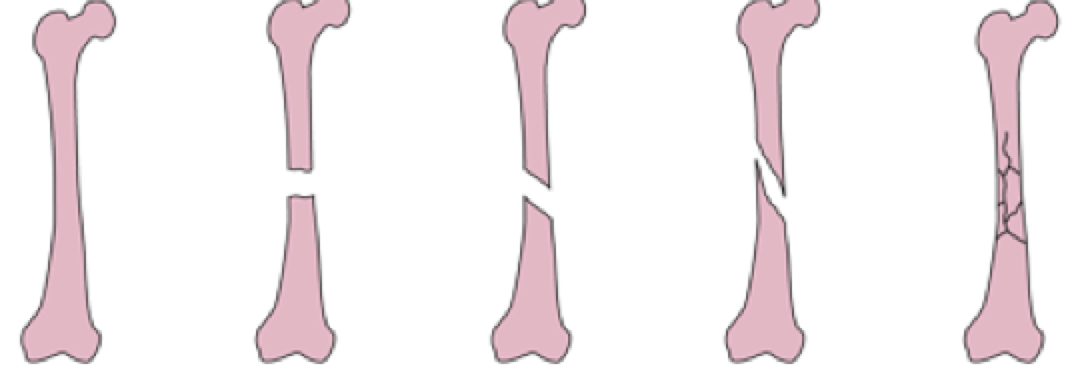
- Atransverse
- Boblique
- Cspiral
- Dcomminuted
44What types are these??? (all lower case; first one is a bonus!)
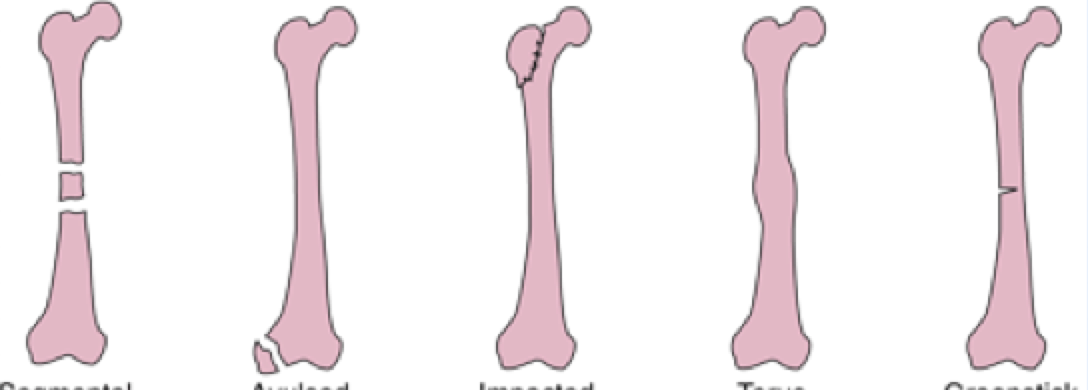
- Asegmental
- Bavulsed
- Cimpacted
- Dtorus
- Egreenstick
45What type of fracture is particularly common in sports injuries
- Atorque
- Bcomminuted
- Ccompression
- Dgreenstick
46An [blank_start]impacted[blank_end] fracture is when the bone kind of bends inwards, bucking and snapping upon itself.
- Aimpacted
47What is of clinical relevance regarding epiphyseal plate fractures?
- Acan affect growth in children still growing
- Bcan be from trauma
- Ccan be from repeated stress upon bones
- Dquite common in older people
- Equite common in children
48Which of these are typical symptoms of fractures?
- Apain
- Bloss of function
- Cbruising
- Ddeformity
- Eswelling
- Fparesthesia
- Gscarring of skin (even if the fracture may be within the skin)
49What is a possible complication of fractures due the break in bone's circulation?
- Anecrosis of bone tissue
- Bloss of sensation in skin overlying/around fracture
- Cavascularization
- Danti-angiogenesis antibodies developed
50Standard for treating open fractures:
1. [blank_start]Analgesia[blank_end] (pain relief)
2. [blank_start]Immobilization[blank_end]
3. [blank_start]Antibiotics[blank_end] (usually Flucloxacillin because mainly gram [blank_start]positive[blank_end] bacteria reside on skin)
4. [blank_start]Tetanus[blank_end] [blank_start]Prophalaxis[blank_end] (vaccination)
5. Clean wound (with sterile [blank_start]saline[blank_end] [blank_start]isotonic[blank_end] solution at low [blank_start]pressure[blank_end])- AAnalgesia
- BImmobilization
- CAntibiotics
- Dpositive
- ETetanus
- FProphalaxis
- Gsaline
- Hisotonic
- Ipressure
51We give the tetanus prophalaxis vaccination as a precaution aginst [blank_start]tetanus[blank_end] because tetanus is a [blank_start]bacterial[blank_end] infection and can happen if the open fracture comes in contact with [blank_start]rust[blank_end], dirt, saliva, or [blank_start]manure[blank_end].
- Abacterial
- Btetanus
- Crust
- Dmanure
52Why is tetanus referred to as "Lockjaw?"
- Amuscle spasms/rigidness begin at the jaw and spread down eventually to other parts of the body
- Bmuscle spasms/rigidness spread up to the jaw at last from the lower extremities
- Cparalysis of the jaw is most emphasized
- DInability to control/use tongue as it is "locked in the jaw"
53Splints are favored over casts by patients due to easy usage.
- ARichtig
- BFalsch
54How does a cast work?
- Acircumferential pressure by bandage and fiber glass
- Bcircumferential pressure by bandage and sponge cushioning
- Ccircumferential pressure by bandage and fluid/gel-like cushioning
- Dcircumferential pressure by bandage causes temporary suppression of sensory nerves (hence why patient feels no pain)
55casts have a higher chance of complications than splints do
- ARichtig
- BFalsch
56One potential complication of a cast is [blank_start]compartment[blank_end] [blank_start]syndrome[blank_end]. This is when fluid accumulates in the [blank_start]muscle[blank_end] compartments, causing increased pressure. This may lead to the tissue to starve for [blank_start]oxygen[blank_end] and [blank_start]nutrients[blank_end].
Presentation:
Due to the change in pressure, it is very [blank_start]painful[blank_end]. The compartment is also very [blank_start]tense[blank_end] at touch. It will seem to have [blank_start]less[blank_end] color than usual, be [blank_start]pulseless[blank_end], and have a tingly feeling ([blank_start]paresthesia[blank_end].)- Acompartment
- Bsyndrome
- Cmuscle
- Doxygen
- Enutrients
- Fpainful
- Gtense
- Hless
- Ipulseless
- Jparesthesia
57What are possible complications of wearing a cast?
- Askin rash
- Bskin infection
- Cpressure sores
- Djoint stiffness
- Efriction burn
58 What is FALSE about buddy taping?
- Auseful for toe fractures
- Bone way to avoid complications of casts
- Cone way to avoid complications of splints
- Duseful for finger fractures
59Clinical relevance of K-wires?
- Aused for small and short bones
- Bused for longer bones
- Ctemporary fixation
- Dlong term fixation
- Ea bit left out of the skin so that they can be pulled out later
- Fmust be surgically removed
- Gnormally removed after about 4-6 weeks of insertion
- Hnormally removed after child stops growing as bones have stabilized
- Ik-wires covered with plasters and padding so that patient doesn't see them
- Jk-wires covered with plasters and padding to prevent infection
Informationen
- Beschreibung
- Der Nutzer hat seine Fachbereichs-Information gelöscht. Quiz am Bones Basics :) , erstellt von Gelöschter Nutzer am 18/01/2018.
- Autor
- Gelöschter Nutzer
- Sprache
- English
- Aufrufe
- 11
- Verlauf
- Erstellt am 18 Jan 2018 · aktualisiert am 23 Jan 2018
- Schlagwörter