
Quiz
BSCI 103 Test 1
Dieses Quiz enthält Fragetypen, die sich im gewohnten Player öffnen.
Fragen in diesem Quiz (80)
1What things do all living things have in common?
- AAsexual reproduction
- BGrowth and Development
- CBiosphere
- DReproduction
- ERegulation
- FEvolutionary Change
- GOrder
- HEnergy Processing
- IRespond to Enviornment
2Lifes Hierarchy From Least to Greatest?
[blank_start]1.[blank_end]
[blank_start]2.[blank_end]
[blank_start]3.[blank_end]
[blank_start]4.[blank_end]
[blank_start]5.[blank_end]
[blank_start]6.[blank_end]
[blank_start]7.[blank_end]
[blank_start]8.[blank_end]
[blank_start]9.[blank_end]
[blank_start]10.[blank_end]
[blank_start]11.[blank_end]- AAtom
- BMolecule
- CAtom
- DOrgans and Organ System
- EBiosphere
- FOrganelle
- GCells
- HOrganism
- ITissue
- JOrganelle
- KAtom
- LOrganelle
- MCells
- NTissue
- OOrgans and Organ System
- POrganism
- QPopulation
- RCommunity
- SEcosystem
- TBiosphere
- UOrganelles
- VCells
- WTissue
- XMolecule
- YCommunity
- ZOrganism
- AAPopulation
- ABEcosystem
- ACBiosphere
- ADEcosystem
- AEMolecule
- AFCells
- AGCommunity
- AHTissue
- AIOrgans and Organ System
- AJOrganism
- AKPopulation
- ALAtom
- AMAtom
- ANOrganelle
- AOTissue
- APBiosphere
- AQEcosystem
- ARCommunity
- ASPopulation
- ATOrgans and Organ System
- AUMolecule
- AVBiosphere
- AWEcosystem
- AXCommunity
- AYPopulation
- AZOrganism
- BAOrgans and Organism
- BBCells
- BCmolecule
- BDAtom
- BEMolecule
- BFOrganelles
- BGCells
- BHTissues
- BIOrganism
- BJPopulation
- BKOrgans and Organ Sytem
- BLCommunity
- BMEcosystem
- BNBiosphere
- BOCommunity
- BPBiosphere
- BQPopulation
- BREcosystem
- BSTissue
- BTAtom
- BUMolecule
- BVOrganism
- BWOrgans and Organ System
- BXCells
- BYOrganelle
- BZMolecule
- CABiosphere
- CBOrganelle
- CCEcosystem
- CDCells
- CECommunity
- CFTissue
- CGPopulation
- CHOrgans and Organ Systems
- CIOrganism
- CJMolecule
- CKAtom
- CLTissue
- CMOrganelles
- CNBiosphere
- COEcosystem
- CPPopulation
- CQOrganism
- CROrgans and Organ System
- CSCells
- CTCommunity
- CUOrganelles
- CVTissue
- CWOrgans and Organ System
- CXOrganism
- CYPopulation
- CZCells
- DAMolecule
- DBAtom
- DCBiosphere
- DDEcosystem
- DECommunity
- DFOrganism
- DGCells
- DHBiosphere
- DIEcosystem
- DJCommunity
- DKOrganelle
- DLPopulation
- DMOrgans and Organ System
- DNTissue
- DOAtom
- DPMolecule
33 Domains of life ?
- AEukarya
- BAnamalia
- CArchea
- DBacteria
- EPlantae
4Are the Plantae, Fungi and Animalia Within the Protist Kingdom?
- ARichtig
- BFalsch
5Observations which led Darwin to Evolutionary Theory?
- AGalapagos Islands
- BFish
- CIndividual Variation
- DOver Production and Competition
6The Scientific Method Requires one to (In order)?:
1) Question
2) Observe
3) Hypothesis
4) Prediction
5) Explain Results
6) Accept or Reject Hypothesis- ARichtig
- BFalsch
74 Most common elements
- ACarbon
- BCalcium
- CChlorine
- DPotassium
- EOxygen
- FNitrogen
- GHydrogen
8Atomic Number is?
- AAn element with same number of protons and nuetrons
- BThe number of protons
- CNumber of protons and nuetrons
9Atomic Mass is ?
- ANumber of protons and nuetrons
- Bnumber of proton
- CAn element with same atomic number but different mass
10What is an Isotope
- ANumber of protons
- BNumber of Neutrons and Protons
- CElements with same atomic number but different mass numbers
11A weak bond; polar, can bind with other polar molecules is a ionic bond?
- ARichtig
- BFalsch
12An Ionic bond is where some atoms gain ot lose electrons in order to gain ion attraction between ions of opposite charges .
- ARichtig
- BFalsch
13A covalent bond is a bond where atoms share electrons; 2+ atoms held by covalent bonds make a molecule
- ARichtig
- BFalsch
14Functional groups are part of a molecule that participate in chemical reactions, examples of these groups are... hydroxyl and carboxyl
- ARichtig
- BFalsch
15Lipids...
- AAre non-polar Hydrocarbons composed of fat molecules
- Bare important components of cell membranes, phospholipids
- Cregulate cell function and protect other cells
- Dall the above
16Dehydration Synthesis [blank_start]Joins[blank_end] and Hydrolysis [blank_start]Breaksdown[blank_end] chemical bonds.
- AJoins
- BBreaksdown
- CBreaksdown
- DJoins
17Primary Structure:
- Asequence of amino acids
- Bcoils to form alpha helix or pleated sheet
- C3-D shape, described as fibrous or gobular
- Dmany peptide chains or subunits, how it fits
18Secondary Structure:
- AA sequence of amino acids
- Bcoils to form alpha helix or pleated sheet
- C3-D shape, described as fibrous or gobular
- Dmany peptide chains or subunits, how it fits
19Tertiary Structure:
- ASequence of Amino Acids
- Bcoils to form alpha helix or pleated sheet
- C3-D shape, described as fibrous or globular
- Dmany peptide chains or subunits, how it fits
20Quartenary Structure:
- Asequence of amino acids
- Bcoils to form alpha helix or pleated sheet
- C3-D shape, described a fibrous or globular
- Dmany peptide chains or subunits, how it fits
21[blank_start]Prokaryotes[blank_end] lack a Membrane enclosed [blank_start]Nucleus[blank_end].
- AProkaryotes
- BNucleus
22[blank_start]Eukaryotes[blank_end] have a membrane that surrounds [blank_start]nuclear[blank_end] material.
- AEukaryotes
- BProkaryotes
- CNuclear
- DCytoplasm
23Phospholipids: Tails are [blank_start]Hyrdrophobic[blank_end], and heads are [blank_start]Hydrophilic[blank_end].
- AHyrdrophobic
- BHydrophilic
24Ribosomes make?
- AProtien
- BDNA
- CRNA
25The [blank_start]Endomembrane[blank_end] system has interconnected membranes throughout cell for synthesis, storage and transportation.
- AEndomembrane
- BMembrane
- COrgan
26The structure which receives packages, such as transport vesicles, and modifies products, then repackages products in transport vesicles for other sites is called:
- ARough Endoplasmic Reticulum
- BSmooth Endoplasmic Reticulum
- CGolgi Apparatus
27The Endoplasmic Reticulum:
- AHas two forms: Rough and Smooth
- BSmooth has Ribosomes
- CWalls contain enzymes that make phospholipids, steroids, and fatty acids
- DDetoxifies Poisons
- EPackages Products in Transport vesicles that bud off
- Fstores minerals for muscle contraction
28[blank_start]Lysosomes[blank_end] merge with food [blank_start]vacuoles[blank_end] to digest food or destroy invading organisms.
- ALysosomes
- BVacuoles
- Cvacuoles
- Dlysosomes
29What are the energy converting organelles?
- ACholorplast
- BMitochondria
- CVaculoes
- DNucleus
30Larger, Membraneous sacs which help in digestion, storage or water removal are called [blank_start]vacuoles[blank_end]
- Avacuoles
- Blysosomes
31mitochondria are only found in plants
- ARichtig
- BFalsch
32[blank_start]Cilia[blank_end] are short and numerous and control movement, and [blank_start]Flagella[blank_end] are long and few and control movement.
- ACilia
- BFlagella
33The location of a gene on a chromosome is called a [blank_start]locus[blank_end]
- Alocus
34Homozygous alleles are [blank_start]identical[blank_end] and Heterozygous alleles are [blank_start]different[blank_end]
- Aidentical
- Bdifferent
- Cdifferent
- Didentical
35Complete the Punnett Square
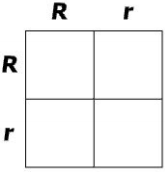
- ARR
- BR
- CRr
- DrR
- Err
- Fr
36[blank_start]Phenotypes[blank_end] are observable traits. [blank_start]Genotypes[blank_end] are particular genes or alleles an individual carries.
- APhenotypes
- BGenotypes
37The law of [blank_start]segregation[blank_end] states that pairs of genes separate during formation of gametes. The law of [blank_start]Independent Assortment[blank_end] states that seperation occurs individually and that the way one gene is seperated does not affect how the other is seperated.
- Asegregation
- BIndependent assortment
- CIndependent Assortment
- DSegregation
38Choose all recessive disorders:
- AExtra toes or fingers
- Bhuntingtons disease
- CSickle cell
- DTay-sachs
- ECystic Fibrosis
- FAlbinism
- GDwarfism
39[blank_start]Incomplete dominace[blank_end] occurs when one allele is not filly dominant and phenotype of heterozygote is between two
example: red and white flower = pink flower- AIncomplete dominace
40[blank_start]Codominance[blank_end] is when both alleles are expressed at the same time
Example: Blood type- ACodominance
- BIncomplete Dominance
41When a single gene affects many traits it is called polygenic inheritance
- ARichtig
- BFalsch
42Polygenic inheritance occurs when many genes affect single traits such as height, skin color and hair color
- ARichtig
- BFalsch
43Epistasis is the interaction between gene pairs, where sometimes the product of one pair of genes may alter the product of another pair of genes
- ARichtig
- BFalsch
44genes that travel together are called [blank_start]linked[blank_end] genes
- Alinked
45Place the genes in the correct order on the chromosome based upon their probability of recombination:
AB= 20% chance
AC= 10% chance
AD= 40% chance
( just choose the capital letter sometimes this is dumb)
- AA
- Bd
- CC
- Dd
- EB
- Fc
- GD
- Ha
46A sex-linked gene is found on the [blank_start]X[blank_end]-chromosomes
examples: Red-green colorblindness, hemophilia- AX
- BY
47Label the cells as hypertonic, hypotonic or normal
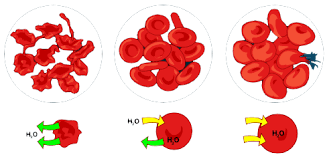
- AHypertonic
- BNormal
- CHypotonic
48Facilitated diffusion is when transport protiens help move molecules across a membrane
- ARichtig
- BFalsch
49[blank_start]Exocytosis[blank_end] moves bulky molecules out of cells and [blank_start]endocytosis[blank_end] moves bulky molecules into cells.
- AExocytosis
- Bendocytosis
50[blank_start]Pinocytosis[blank_end] takes in small drinks of fluid in tiny vesicles and [blank_start]Phagocytosis[blank_end] engulfs large pieces of food or bacteria in a vacuole
- APinocytosis
- BPhagocytosis
- CPhagocytosis
- DPinocytosis
51[blank_start]Endergonic[blank_end] reactions require a net input of energy. An [blank_start]exergonic[blank_end] reaction releases energy.
- AEndergonic
- BExergonic
- Cexergonic
- Dendergonic
52The photosynthesis equation is [blank_start]6CO2[blank_end] + [blank_start]6H2O[blank_end] ----> [blank_start]C6H12O6[blank_end]+[blank_start]6O2[blank_end]
Do not include any parentheses- A6CO2
- B6H2O
- CC6H12O6
- D6O2
53Cellular respiration equation is:
[blank_start]C6H12O6[blank_end]+[blank_start]6O2[blank_end]---->[blank_start]6CO2[blank_end]+[blank_start]6H2O[blank_end]- AC6H12O6
- B6CO2
- C6O2
- D6H2O
- E6CO2
- FC6H12O6
- G6H2O
- H6O2
54In [blank_start]oxidation[blank_end], a molecule loses electrons. In [blank_start]reduction[blank_end] electrons a molecule gains electrons.
- Aoxidation
- Breduction
- Creduction
- Doxidation
55A redox reaction is a coupled oxidation and reduction reaction
Photosynthesis is an example of a redox reaction- ARichtig
- BFalsch
56ATP is generated in what ways?
- Aelectron transport train
- Bchemiosmosis
- CGlycolysis
- DCitric acid cyle
57[blank_start]2[blank_end] ATP's are made in Glycolysis, [blank_start]2[blank_end] ATP's are made in the Citric Acid Cycle and [blank_start]34[blank_end] are made in Oxidative Phosphorylation. There are [blank_start]38[blank_end] in total.
- A2
- B2
- C34
- D38
58[blank_start]Restriction enzymes[blank_end] cut out specific genes of interest.
- ARestriction enzymes
59factors which regulate gene expression?
- ADNA Packing/ Histones
- BMethylation
- CDNA Scilencers
- DDNA Enhancers
- ERNA Splicing
- FMetastasis
60The two major phases of the cell cycle are M phase and Interphase
- ARichtig
- BFalsch
61[blank_start]Introns[blank_end] are non coding segments, whereas [blank_start]Exons[blank_end] are coding segments.
- AIntrons
- BExons
- CExons
- DIntrons
62Genes that may cause cancer are called
- AOncogenes
- BCancer genes
- CCarcinoma genes
63A proto-oncogene is a normal gene that had the potential to become [blank_start]cancerous[blank_end]
- Acancerous
64Cancer which moves from its original site is called [blank_start]metastasis[blank_end]
- Ametastasis
65When building a new strand of DNA the enzyme DNA [blank_start]Polymerase[blank_end] attaches free nucleotides to the growing new strand of DNA and the enzyme DNA [blank_start]ligase[blank_end] seals the short strands of growing DNA together/
- APolymerase
- BLigase
- Cligase
- Dpolymerase
66There are three classes of RNA. Transcription of most genes produce [blank_start]m[blank_end]RNA, this type of RNA carry protein building instructions. [blank_start]r[blank_end]RNA is composed of ribosomes, here polypeptide chains of protiens are assembled. Lastly there is [blank_start]t[blank_end]RNA, which delivers free amino acids to the ribosome where they assemble using the mRNA template.
- Am
- Br
- Ct
67Ribosomes consist of three subunits, small, medium and large
- ARichtig
- BFalsch
68During translation subunits combine
- ARichtig
- BFalsch
69Common gene mutations are
- AFrame shifts
- BBase pair Substitutions
- CInsertions or deletion
- DMetylation
- EHistones
70In the [blank_start]lysogenic[blank_end] cycle, the cell changes from a regular cell to a virus cell, in the [blank_start]lytic[blank_end] cycle, immediate action occurs, the virus copies itself and the cell breaks
- Alysogenic
- Blytic
- Clytic
- Dlysogenic
71What is an example of a retrovirus?
- AHIV/AIDS
- BSickle Cells
- CHuntington's Disease
- DTay-Sach's
72Bacteria transfer DNA in three ways. [blank_start]Transduction[blank_end] is the process where a bacteriophage injects a piece of bacterial DNA into a bacteria with its own DNA. [blank_start]Transformation[blank_end] uptakes DNA from an outside source and is placed in a host cell. When two cells mate the donor cell transfer DNA to a recipient through sex pili or mating bridge, this is called [blank_start]conjugation[blank_end]
- ATransduction
- BTransformation
- CConjugation
- DTransformation
- ETransduction
- Fconjugation
- Gconjugation
- Htransformation
- Itransduction
73Interphase has 3 parts and is the longer phase of the two. It begins with the [blank_start]G1[blank_end] phase, cell growth occurs in this stage. In the [blank_start]S[blank_end] phase the DNA replicates and sister chromatids form. In the [blank_start]G2[blank_end] phase the cell phase prepares for division.
- AG1
- BG2
- CS
- DS
- EG1
- FG2
- GG2
- HG1
- Is
74When the cytoplasm pinches into two it is called?
- Acleavage furrow
- BPlate
- Ca and b
- Ddivison
75Types of Cancer therapies
- ARadition
- Bcounseling
- Cimmunotherapies
- Done-on-one
- ETarget therapies
- Fchemotherapy
761. In [blank_start]prophase[blank_end] chromosomes condense, microtubules form and the chromosomes move to opposite poles of cell
2. In [blank_start]Metaphase[blank_end] chromosomes line up at the equator
3. In [blank_start]anaphase[blank_end], chromatids break apart and move to opposite poles
4. In [blank_start]Telophase[blank_end] chromosomes de-condense, a new nuclear envolope forms and cell divides- Aprophase
- Banaphase
- Cmetophase
- Dtelophase
- EMetaphase
- FProphase
- GAnaphase
- HTelophase
- Ianaphase
- Jprophase
- Kmetaphase
- Ltelophase
- MTelophase
- Nprophase
- Ometaphase
- Panaphase
77Give these sex-linked disorders their correct chromosome labeling:
Klinefelter [blank_start]XXY[blank_end] = Male
Turners Syndrome [blank_start]XO[blank_end] = Female
Metafemale [blank_start]XXX[blank_end] = Female- AXXY
- BXO
- CXXX
78Meiosis One
1. [blank_start]Interphase[blank_end] - DNA replicates & sister chromatids form
2. [blank_start]Prophase 1[blank_end]- genetic information is exchanged, nuclear envelope breaks
3. [blank_start]Metaphase 1[blank_end]- chromosomes line up at equator
4. [blank_start]Anaphase 1[blank_end]- chromosomes separate and move to opposite sides
5. [blank_start]Telophase 1[blank_end] - cytoplasm divides and 2 new haploid cells form- AInterphase
- BAnaphase
- CProphase
- DTelophase
- EMetaphase
- FProphase
- GAnaphase
- HTelophase
- IMetaphase
- JInterphase
- KMetaphase
- LAnaphase
- MTelophase
- NInterphase
- OProhase
- PAnaphase
- QMetaphase
- RProphase
- SInterphase
- TTelophase
- UTelophase
- VInterphase
- WProphase
- XAnaphase
- YMetaphase
79Meiosis 2
1. [blank_start]Prophase[blank_end] - New microtubules form and attach to centromeres
2. [blank_start]Metaphase[blank_end] - Chromosomes line at equator
3. [blank_start]Anaphase[blank_end] - sister chromatids break apart and travel to opposite poles
4. [blank_start]Telophase[blank_end] - 4 new haploid cells for- AProphase
- BMetaphase
- CAnaphase
- DTelophase
80RFLP's ( Restriction Fragment Length Polymorphisms) can be used to identify people with harmful genes
- ARichtig
- BFalsch
Informationen
- Beschreibung
- Mariam Ajibola
- Autor
- Mariam Ajibola
- Sprache
- English
- Aufrufe
- 194
- Schlagwörter
- Bewertung
- Noch keine Bewertungen Bewerte dieses Quiz