
Quiz
Compendium 4
Dieses Quiz enthält Fragetypen, die sich im gewohnten Player öffnen.
Fragen in diesem Quiz (52)
1Functions of the respiratory system:
Respiration -
• [blank_start]Ventilation[blank_end] – Movement of air in and out of lungs
• [blank_start]External respiration[blank_end] - Gas exchange between lungs blood
• [blank_start]Transport[blank_end] - of respiratory gases
• [blank_start]Internal respiration[blank_end] – Gas exchange between blood tissues- AVentilation
- BExternal respiration
- CTransport
- DInternal respiration
2Respiration:
• Internal respiration – Movement of air in and out of lungs- ARichtig
- BFalsch
3Regulation of blood pH is a function of the respiratory system
- ARichtig
- BFalsch
4Select the Five main functions of the respiratory system:
- ARegulation of blood pH
- BHomeostasis
- CVoice production
- DRespiration
- EWaste elimination
- FSmell (olfaction)
- GProtection
5Divisions of the respiratory system include the upper respiratory tract and the lower respiratory tract
- ARichtig
- BFalsch
6Select the four anatomical associations with the upper respiratory tract:
- AExternal nose
- BLarynx
- CPharynx
- DNasal cavity
- ETrachea
- FBronchi
7The Trachea is associated with the upper respiratory tract.
- ARichtig
- BFalsch
8Select the Three anatomical associations with the lower respiratory tract
- ALarynx
- BTrachea
- CBronchi
- DLungs
- EPharynx
9Respiratory diagram:
1. [blank_start]External nose[blank_end]
2. [blank_start]Nasal Cavity[blank_end]
3. [blank_start]Pharynx (throat)[blank_end]
4. [blank_start]Upper Respiratory[blank_end]
5. [blank_start]Larynx[blank_end]
6. [blank_start]Trachea[blank_end]
7. [blank_start]Lower Respiratory[blank_end]
8. [blank_start]Bronchi[blank_end]
9. [blank_start]Lungs[blank_end]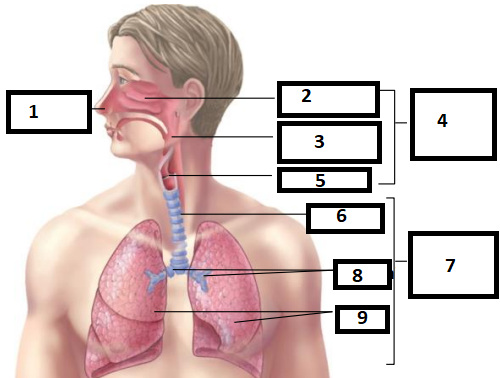
- AExternal nose
- BNasal Cavity
- CPharynx (throat)
- DUpper Respiratory
- ELarynx
- FTrachea
- GLower Respiratory
- HBronchi
- ILungs
10Nasal cavity:
• From [blank_start]nostrils[blank_end] (nares) to [blank_start]choana[blank_end]
• [blank_start]Vestibule[blank_end] - entry to nasal cavity
Stratified squamous epithelium, sweat and sebaceous glands and hair follicles
• [blank_start]Hard palate[blank_end] – floor of nasal cavity
• [blank_start]Septum[blank_end] – separates nasal cavity into left and right parts, cartilage and bone
• [blank_start]Concha[blank_end] – bony “ridges” in nasal cavity- Anostrils
- Bchoana
- CVestibule
- DHard palate
- ESeptum
- FConcha
11What are the ridges of the nasal cavity called?
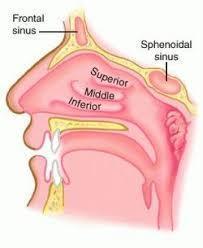
- AConcha
- BChoana
12The Concha are the bony ridges in the Nasal cavity.
- ARichtig
- BFalsch
13The Concha are surrounded with Superior, Inferior and middle 'meatus' to increase surface space
- ARichtig
- BFalsch
14Epithelium of concha (and most of nasal cavity) is:
- Apseudostratified ciliated columnar epithelium
- Bstratifed squamous epithelium
15Select Seven functions of the nasal cavity
- A• Sound of your voice
- B• Olfaction (or smell)
- C• via moisture from mucous epithelium and excess tears which drain into nasal
cavity - D• Passageway for air
- E• Cleans the air
- F• Humidifies and warms the air
- G• via warm blood flowing through nasal cavity
- H• assist with taste
16Select the Three areas of the Pharynx:
- ANasopharynx
- BOropharynx
- CLaryngopharynx
- DTrachea
17Tonsil diagram:
1. [blank_start]Pharyngeal tonsil[blank_end]
2. [blank_start]Palatine tonsil[blank_end]
3. [blank_start]Lingual tonsil[blank_end]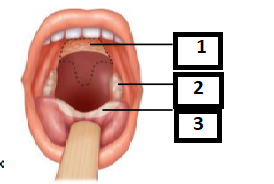
- APharyngeal tonsil
- BPalatine tonsil
- CLingual tonsil
18Oropharnyx and Laryngopharnyx both have stratified squamous epithelium
- ARichtig
- BFalsch
19What are the 6 pairs of cartilage in the larynx
- A• Arytenoid
• Corniculate
• Cuneiform - B• Thyroid (Adam’s apple)
• Cricoid
• Epiglottis
- A• Arytenoid
20The Three unpaired cartilage in the Larynx are the Thyroid (Adam’s apple), Cricoid, Epiglottis
- ARichtig
- BFalsch
21Select Four functions of the larynx:
- A• Trap debris from entering lungs
- B• Sound production via vocal folds
- C• Directs food into the oesophagus away from respiratory tract
- D• Maintains an open passageway for air movement
- E• Provides assistance to Peristalsis of food
22The Larynx directs food into the oesophagus away from respiratory tract
- ARichtig
- BFalsch
23The Trachea has 10-25 ‘C-shaped’ hyaline cartilage rings for support
- ARichtig
- BFalsch
24The Trachea has 15-20 ‘C-shaped’ hyaline cartilage rings for support
- ARichtig
- BFalsch
25The Trachea descends from the pharynx and sits anterior to oesophagus
- ARichtig
- BFalsch
26What is the arrow pointing towards?
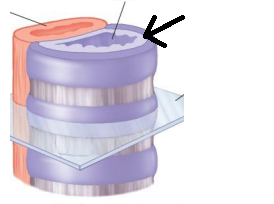
- ATrachea
- BLarynx
27The right lung has 3 lobes
- ARichtig
- BFalsch
28Lung diagram:
1. [blank_start]Larynx[blank_end]
2. [blank_start]Trachea[blank_end]
3. [blank_start]Carina[blank_end]
4. [blank_start]Visceral Pleura[blank_end]
5. [blank_start]Parietal Pleura[blank_end]
6. [blank_start]Pleural Cavity[blank_end]
7. [blank_start]Main (primary) bonchus[blank_end]
8. [blank_start]Lobar (secondary) bronchus[blank_end]
9. [blank_start]Segmental (tertiary) bronchus[blank_end]
10. [blank_start]Bronchiole[blank_end]
11. [blank_start]To terminal Bronchiole[blank_end]
12. [blank_start]Diaphragm[blank_end]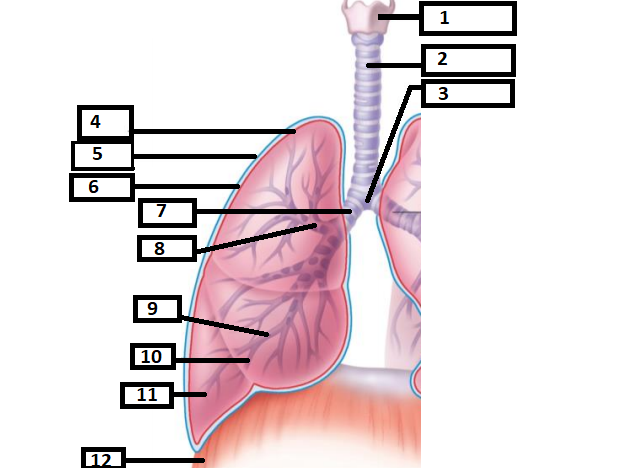
- ALarynx
- BTrachea
- CCarina
- DVisceral Pleura
- EParietal Pleura
- FPleural Cavity
- GMain (primary) bonchus
- HLobar (secondary) bronchus
- ISegmental (tertiary) bronchus
- JBronchiole
- KTo terminal Bronchiole
- LDiaphragm
29Alveoli diagram:
1. [blank_start]Alveoli[blank_end]
2. [blank_start]Alveolar duct (2)[blank_end]
3. [blank_start]Respiratory bronchioles[blank_end]
4. [blank_start]Alveolar duct (3)[blank_end]
5. [blank_start]Terminal bronchiole[blank_end]
6. [blank_start]Alveolar sac[blank_end]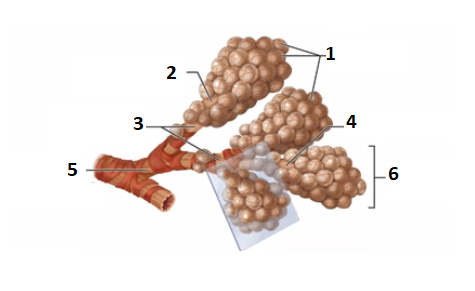
- AAlveoli
- BAlveolar duct (2)
- CRespiratory bronchioles
- DAlveolar duct (4)
- ETerminal bronchiole
- FAlveolar sac
30Classify the structures below into whether fall within the ‘conducting zone’ or ‘respiratory zone’?
[blank_start]Conducting zone[blank_end]: nasal cavity, pharynx, larynx, trachea, primary bronchus, secondary bronchus, tertiary
bronchus, bronchiole, terminal bronchiole,
[blank_start]Respiratory zone[blank_end]: respiratory bronchiole, alveolar duct, alveolar sac, alveoli- AConducting zone
- BRespiratory zone
31Select the structures below which fall into the ‘respiratory zone’?
- Abronchiole, alveoli
- Btertiary bronchus
- Calveolar duct and sac
- Dterminal bronchiole
- Eprimary and secondary bronchus
- Frespiratory bronchiole
- Glarynx
- Htrachea
- Inasal cavity
- Jpharynx
32Gas transport mechanism:
[blank_start]Oxygen (O2)[blank_end]
• Transported via:
• Red blood cells (haemoglobin) (98.5%)
• Dissolved in blood plasma (1.5%)
[blank_start]Carbon dioxide (CO2)[blank_end]
• Transported as:
• HCO3
- dissolved in plasma (70%)
• CO2 dissolved in plasma (7%)
• Bound to haemoglobin (23%)- AOxygen (O2)
- BCarbon dioxide (CO2)
33Respiratory Membrane diagram:
1. [blank_start]Alveolar fluid (with surfactant)[blank_end]
2. [blank_start]Alveolar epithelium[blank_end]
3. [blank_start]Basement membrane of alveolar epithelium[blank_end]
4. [blank_start]Interstitial space[blank_end]
5. Basement [blank_start]membrane of capillary endothelium[blank_end]
6. [blank_start]Pulmonary capillary endothelium[blank_end]
7. [blank_start]Diffusion of O2[blank_end]
8. [blank_start]Diffusion of CO2[blank_end]
9. [blank_start]Red blood cell[blank_end]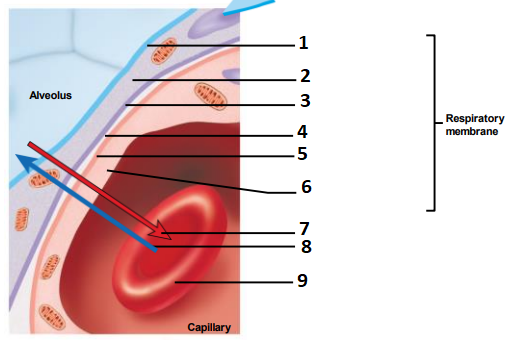
- AAlveolar fluid (with surfactant)
- BAlveolar epithelium
- CBasement membrane of alveolar epithelium
- DInterstitial space
- Emembrane of capillary endothelium
- FPulmonary capillary endothelium
- GDiffusion of O2
- HDiffusion of CO2
- IRed blood cell
34Pulmonary ventilation:
[blank_start]Inspiration:[blank_end]
• LUNGS: [blank_start]volume increases as it fill with air[blank_end]
• DIAPHRAGM: [blank_start]moves inferiorly and flattens[blank_end]
• RIB CAGE: elevated
• STERNUM: elevated
• INTERCOSTAL MUSCLES: [blank_start]contract[blank_end]
Expiration:
• LUNGS: [blank_start]volume decreases as air leaves[blank_end]
• DIAPHRAGM: [blank_start]moves superiorly[blank_end] as it relaxes into its dome-shape
• RIB CAGE: depresses
• STERNUM: depresses
• INTERCOSTAL MUSCLES: [blank_start]relax[blank_end]- AInspiration:
- Bvolume increases as it fill with air
- Cmoves inferiorly and flattens
- Dcontract
- Evolume decreases as air leaves
- Fmoves superiorly
- Grelax
35Airflow in and out of alveoli:
• [blank_start]Barometric air pressure (PB)[blank_end] – atmospheric air pressure outside the body
• [blank_start]Intra-alveolar pressure (Palv)[blank_end] – pressure inside the alveoli- ABarometric air pressure (PB)
- BIntra-alveolar pressure (Palv)
36• Intrapleural pressure = pressure in the pleural cavity
- ARichtig
- BFalsch
37Select Two Forces which promote alveoli recoil:
- A• Surfactant (Fluid which coats alveoli)
- B• Muscle contraction
- C• Fine elastic fibers
38Pulmonary volumes:
• [blank_start]Tidal volume[blank_end] – the amount of air inspired or expired with each breath
• [blank_start]Inspiratory reserve volume[blank_end] – the amount of air that can be inspired forcefully after inspiration of the tidal volume
• [blank_start]Expiratory reserve volume[blank_end] – the amount of air that can be forcefully expired after expiration of the tidal volume
• [blank_start]Residual volume[blank_end] – the volume of air still remaining in the respiratory passages and lungs after the most forceful expiration- ATidal volume
- BInspiratory reserve volume
- CExpiratory reserve volume
- DResidual volume
39Pulmonary capacities:
• [blank_start]Inspiratory capacity[blank_end] – the amount of air a person can inspire maximally after normal expiration (tidal volume + inspiratory reserve volume)
• [blank_start]Functional residual capacity[blank_end] – the amount of air remaining in the lungs at the end of a normal expiration (expiratory reserve volume + residual volume)
• [blank_start]Vital capacity[blank_end] – the maximum volume of air that can be expelled from the respiratory tract after a maximum inspiration (inspiratory reserve volume + tidal volume + expiratory reserve volume)
• [blank_start]Total lung capacity[blank_end] – inspiratory reserve volume + expiratory reserve volume + tidal volume +residual volume- AInspiratory capacity
- BFunctional residual capacity
- CVital capacity
- DTotal lung capacity
40• [blank_start]Respiratory rate[blank_end] – number of breaths taken per minute
• [blank_start]Minute ventilation[blank_end] – total amount of air moved into and out of the respiratory system each minute (tidal volume X respiratory rate) (E.g. 500 ml X 12 breaths per minute = 6000 ml per minute)
• [blank_start]Anatomic dead space[blank_end] – space formed by nasal cavity, pharynx, larynx, trachea, bronchi, bronchioles and terminal bronchioles.
• [blank_start]Alveolar ventilation[blank_end] - volume of air available for gas exchange per minute- ARespiratory rate
- BMinute ventilation
- CAnatomic dead space
- DAlveolar ventilation
41Parameters measured of dynamic lung function test:
• [blank_start]Forced vital capacity (FVC)[blank_end] – maximal volume of air that can be forcefully expired as fast as possible after a deep breath in
• Forced [blank_start]expiratory volume in 1 second (FEV1 sec)[blank_end] – the volume of air expired in the first second of the test
• Forced [blank_start]expiratory volume 1% (FEV1%)[blank_end] – FEV1sec expressed as a percentage of the FVC- AForced vital capacity (FVC)
- Bexpiratory volume in 1 second (FEV1 sec)
- Cexpiratory volume 1% (FEV1%)
42The Nasal cavity, Nasopharynx and Trachea all have [blank_start]pseudostratified ciliated columnar[blank_end] epithelium
- Apseudostratified ciliated columnar
- Bsimple squamous epithelium
43The Vestible is situated [blank_start]anteriorly[blank_end] of the nose in the middle.
- Aanteriorly
- Bsuperiorly
44The Vestibule, Oropharynx and Laryngopharynx all have [blank_start]stratified squamous epithelium[blank_end]
- Astratified squamous epithelium
- Bpseudostratified columnar epithelium
45The Alveoli has simple squamous epithelium
- ARichtig
- BFalsch
46The [blank_start]Oropharynx[blank_end] is the middle part of the throat that includes the base of the tongue, the tonsils, the soft palate, and the walls of the pharynx.
- AOropharynx
- BLaryngopharynx
47The [blank_start]Laryngopharynx[blank_end] is where both food and air pass. It can be found between the hyoid bone and the larynx and esophagus, which helps guide food and air where to go. It is a part of the pharynx.
- ALaryngopharynx
- BOropharynx
48[blank_start]Choana[blank_end]: An opening at the back of the nasal passage (there is a left and a right side) that empties into the space behind the nose called the [blank_start]nasopharynx[blank_end], where the adenoids and eustachian tube are. The passage way continues down into the back of the mouth and into the throat.
- AChoana
- BChoncha
- Cnasopharynx
- Doropharynx
49Alveolar fluid (surfactant) reduces the surface tension of fluid in the lungs and helps make the small air sacs in the lungs (alveoli) more stable.
- ARichtig
- BFalsch
50[blank_start]Pharynx[blank_end]: the membrane-lined cavity behind the nose and mouth, connecting them to the oesophagus
[blank_start]Larynx[blank_end]: the hollow muscular organ forming an air passage to the lungs and holding the vocal cords in humans and other mammals; the voice box.- APharynx
- BLarynx
- CLarynx
- DPharynx
51The [blank_start]Bronchiole[blank_end] descends into the [blank_start]Terminal Bronchiole[blank_end] which then leads onto the [blank_start]Respiratory Bronchiole[blank_end]. From here, oxygen descends through the [blank_start]Alveolar Duct[blank_end], into the [blank_start]Alveolar Sac[blank_end] and eventually into the individual [blank_start]Alveoli[blank_end]
- ABronchiole
- BTerminal Bronchiole
- CTerminal Bronchiole
- DRespiratory Bronchiole
- ERespiratory Bronchiole
- FTerminal Bronchiole
- GAlveolar Duct
- HAlveolar Sac
- IAlveolar Sac
- JAlveolar Duct
- KAlveoli
- LAlveolar Sac
52When you breathe in, air enters your body through your nose or mouth. From there, it travels down your throat through the [blank_start]larynx[blank_end] (or voicebox) and into the [blank_start]trachea (or windpipe)[blank_end] before entering your lungs.
- Alarynx
- Bpharynx
- Ctrachea (or windpipe)
- Doesophagus
Informationen
- Beschreibung
- Why do we breathe? HUMB1000
- Autor
- Jessica Bulley
- Sprache
- English
- Aufrufe
- 389
- Schlagwörter
- Bewertung
- Noch keine Bewertungen Bewerte dieses Quiz