
Quiz
W1 Questions
Erstelle ein kostenloses Konto, um dieses Quiz zu beenden
Speichere deinen Fortschritt und sieh dir dein Endergebnis an.
oder mit deiner E-Mail registrieren
Schon ein Konto? Anmelden
Fragen in diesem Quiz (34)
1(Inheritance W1) You have received chromosome results back on the products of conception from your patient who has had a miscarriage. The karyotype is designated 92,XXXY. Which term below describes the karyotype?
- AHaploid
- BAneuploid
- CTriploid
- DTetraploid
2(Inheritance W1) Polycystic kidney disease is a significant cause of renal failure that presents from early infancy to adulthood. Early-onset cases tend to affect one family member or siblings, whereas adult-onset cases often show a vertical pattern in the pedigree with affected family members in each generation. Which of the following provides the BEST explanation of these observations?
- APleitropy
- BVariable expressivity
- CLocus heterogeneity
- DAllelic heterogeneity
3(Cytogenetics W1) A standard chromosome analysis is ordered for a child with heart defects, developmental delay, and an unusual facial appearance. The results are normal. A clinical geneticist colleague with whom you consult suspects Williams syndrome and recommends that fluorescent in situ hybridization (FISH) be performed on the patient's chromosomes using a probe for chromosome 7. Only one
signal is seen for the chromosome 7 probe in each chromosome spread examined. Which of the following statements best summarizes the analyses?- AA microdeletion is present on one of the patient's chromosomes 7.
- BThis is a normal result.
- CThe initial karyotype results are inconsistent with the FISH results.
- DFISH is only helpful when the initial karyotype results are abnormal.
4(Cytogeneics W1)
Which of the following features distinguishes meiosis from mitosis?- ASeparation of sister chromatids.
- BDNA replication in preceding interphase
- CMissegregation of chromosomes, which may lead to aneuploidy.
- DSynapsis of homologs during prophase I.
5(DNA Replication W1) A one-year old child was treated in the emergency department for severe sunburn. According to the parents, the child had minimal
sun exposure. No other abnormalities were noted in the physical exam except for freckling. You suspect:- APossible defect in nucleotide excision repair
- BParental neglect
- CPossible defect in DNA mismatch repair
- DA defect in the process that controls the initiation of DNA replication
6(DNA Replication W1) A patient with Xeroderma pigmentosum has a defect in the XPA gene leading to a defect in nucleotide excision repair (NER). Cell extracts are prepared from this patient's cells and tested for the ability to perform nucleotide excision repair on DNA damage
resulting from exposure to UV light. What outcome would you predict?- AExtracts remove lesions too fast but there is no lasting defect
- BCell extracts perform NER within normal limits
- CCell extracts cannot repair UV damaged DNA
- DExposure to UV light does not result in the specific DNA damage that is repaired by NER
7(DNA Replicatoin W1) The replication of genomic DNA is a tightly-controlled fundamental process. The beginning or initiation of chromosomal replication is initiated where?
- ANo proteins are involved in initiation, only DNA is required.
- BFrom the centromere of each chromosome
- CAt an origin
- DAt the telomeres
8(DNA Replication) Many drugs target the DNA replication process by altering the DNA template, inhibiting crucial enzyme activity, or blocking
replication elongation. Drugs that inhibit bacterial Type II Topoisomerases (quinolone related) are very effective in antibacterial chemotherapy. What function of topoisomerase during replication are quinolones targeting?- AUnwinding of the Okazaki fragment by the replicative helicase
- BResolution of supercoiling created by DNA strand separation by the moving replication fork
- CPrimer loading at the origin of replication by the sliding clamp protein
- DLoading of the Okazaki fragments in the leading strand
9(CSL) In systole, which valves are open and which valves are closed?
- AOpen: mitral, tricuspid; Closed: aortic, pulmonic
- BOpen: pulmonic, tricuspid; Closed: aortic, mitral
- COpen: aortic, pulmonic; Closed: mitral, tricuspid
- DOpen: aortic, mitral; Closed: pulmonic, tricuspid
10(Anatomy) Which type of imaging uses no radiation?
- APET scan
- BCT scan
- CMRI
- DPlain X-ray
11(Anatomy) Which one of the following types of anatomical planes would divide the body into a left half and a right half?
- ASagittal
- BHorizontal
- CFrontal
- DTransverse
12(Anatomy) A 15-year-old girl is suspected of having meningitis. To obtain a sample of cerebrospinal fluid by lumbar puncture, the tip of the needle must be placed in which of the following locations?
- ABetween arachnoid mater and dura mater
- BBetween pia mater and arachnoid mater
- CDeep to pia mater
- DSuperficial to dura mater
13(Anatomy) The ventral (anterior) roots of the spinal nerves contain axons of somatic___________?
- Aafferent and somatic efferent neurons
- Bafferent and visceral afferent neurons
- Cafferent neurons
- Defferent neurons
14(Cell Bio) Small unrestrained particles such as proteins in an aqueous solution are in constant riotous motion due to thermal energy. Which of the following is a defining property of thermally-driven Brownian motion in the cell?
- AThe thermally-driven Brownian motion of a protein or protein complex is independent of its mass.
- BThe thermally-driven Brownian motion of a protein or protein complex in the cell results from collisions of the particle with water molecules.
- CThe path of a single protein molecule exhibiting thermally-driven Brownian motion in the cell would fill the cell's volume uniformly in an instant.
- DThe combined paths of millions of protein molecules exhibiting thermally-driven Brownian motion in the cell would eventually fill the cell's volume
more or less uniformly.
15(Metabolism) During an enzymatically catalyzed reaction, what do the enzymes stabilize?
- AProduct
- BSubstrate
- CTransition state
- DReverse reaction
16(Early Embryology) The amniotic cavity first forms by cavitation within which layer of cells?
- AExtraembryonic mesoderm
- BEpiblast
- CHypoblast
- DSyncytiotrophoblast
17(Embryology) Certain factors delay the transport of the cleavage stage embryo through the uterine tube (oviduct). This delay may cause which of
the following?- AExtrauterine pregnancy
- BFailure in fertilization
- CFailure in zona reaction
- DFormation of twins
18(Embryology) Which of the following types of cells will specifically form the embryo?
- ATrophoblast
- BCytotrophoblast
- CICM
- DFollicle
19(Genome organization) What functionally separates neighbouring Topologically Associated Domains (TADs) from each other?
- AGenes
- BBoundaries
- CEnhancers
- DSegmental duplications
20(CSL) A heart murmur is caused by:
- ARapid deceleration of blood during early diastole
- BRapid deceleration of blood during late diastole
- CTurbulent blood flow across a valve or septal defect
- DAn inflamed pericardial surfaces rubbing against each other
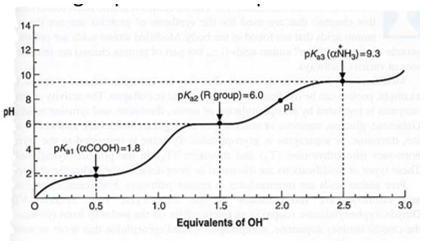
21(Biochem) Please use the attached image to answer the following: Some amino acids have ionizable side chains. Which amino acid would have the titration curve shown in the attached figure?
- AAlanine
- BGlycine
- CHistidine
- DLeucine
22(Biochem) The concentration of H+ ions in a solution at pH 6 compared to pH 7 is:
- ATwice as high
- BTwice as low
- CTen times higher
- Dten times lower
23(Biochem) Although all protein structures are unique, there are common structural building blocks that are referred to as regular secondary structures. Some proteins have a helices, some have B sheets, and still others have a combination of both. Which of the features below is most responsible for enabling proteins to have these common structural elements?
- ASpecific amino acid sequences
- BSide-chain interactions
- CThe hydrophobic-core interactions
- DHydrogen bonds along the protein backbone
24(Genome Organization) The Philadelphia chromosome was a landmark because it was the first consistent chromosome abnormality found in any kind of malignancy. What kind of chromosomal rearrangement creates the Philadelphia chromosome?
- Ainversion
- Btranslocation
- Cdeletion
- Dduplication
25In judging the quality of a physician, which of the following factors is noted as being most important to patients?
- AThe physician's use of advanced medical technology
- BThe physician's amount of time spent on the physical exam of the patient
- CThe physician's ability to build rapport and communicate empathetically
- DThe perceived age and gender of a physician
26A physician's active listening is a key part of communication between physician and patient. Active listening includes accurately summarizing the patient's story and responding empathetically. Another indicator of active listening is:
- ARepeating back the patient's words verbatim to show you have paid careful attention
- BParaphrasing the patient's words to demonstrate understanding
- CTo start taking notes right away to show you don't want to miss a word
- DImmediately opening the patient's EMR to demonstrate you are aware of their history
27(Genetic Variation) In reference to genetic variation, a mutation is best characterized as:
- AA permanent change in the nucleotide sequence or arrangement of DNA, ranging from a single nucleotide to alterations of an entire chromosome
- BAny change in the DNA sequence which results in disease
- CAn alternate genotype in the population of which the rarer allele has a frequency of at least 1%
- DAny common variant in the population that increases susceptibility to disease
28(Genetic Variation) Your 8 y.o. patient and his parents undergo genome sequencing. The report shows that your patient has a variant, c.100delAG in a gene associated with his phenotype. This variant is not found in either of his parents nor in any population database or the literature. What is your best interpretation?
- AThis is a benign missense variant that, without other evidence, does not explain this patient's clinical presentation.
- BThis is a variant of unknown significance since it has never been reported in a patient.
- CThis is a likely pathogenic missense variant but it requires confirmation by a functional assay
- DThis is a de novo, novel likely pathogenic variant that produces a frameshift and results in disease.
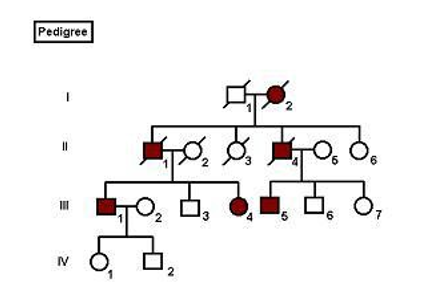
29(Inheritance and pedigree) Use the attached image to answer the following: The attached pedigree shows segregation of a rare genetic disease through a family. Filled in symbols represent family members with the disease phenotype. What is the MOST LIKELY mode of inheritance?
- AAR
- BAD
- CXLD
- DMitochondrial
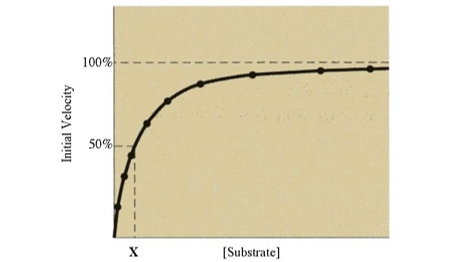
30(Metabolism) Please use the attached image to answer the following: In the attached graph of an enzyme-catalyzed reaction, what is indicated by the letter "X"?
- AThe change in Gibbs Free Energy, ∆G10
- BThe equilibrium constant, K'eq
- CThe Michaelis-Menton constant, Km
- Dthe maximal velocity, Vmax
31(Protein Structure) Of the following amino acids, which one can be phosphorylated on its side chain?
- Aalanine
- Bglutamic acid
- Clysine
- Dtyrosine
32(Proteins) Studies conducted with a lysozyme mutant that contains an Asp->Asn change at position 52 and a Glu->Gln change at position 35 exhibited almost a complete loss in enzymatic activity. What is the most likely explanation for the decrease in enzyme activity in the mutant?
- AIncreased affinity for substrate
- BAbsence of negative charges in the active site
- CChange in the active-site scaffold
- DLarger amino acids in the active site decreases the affinity for substrate
33(Proteins) Polypeptides are synthesized from amino acid building blocks. The condensation reaction between the growing polypeptide chain and the next amino acid to be added involves the combined loss of ________________ from the newly formed peptide.
- Aa water molecule
- Ban amino group
- Ca carbon atom
- Da carboxylic acid group
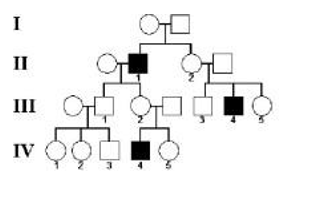
34(Pedigree) Use the attached image to answer the following: Attached is the pedigree of a family in which a genetic disease is segregating. Affected family members are in black. The MOST LIKELY mode of inheritance is:
- AAD
- BAR
- CXLR
- DMitochondrial
Informationen
- Beschreibung
- Quiz am W1 Questions, erstellt von Madi Egan am 02/10/2018.
- Autor
- Madi Egan
- Sprache
- English
- Aufrufe
- 185
- Bewertung
- Noch keine Bewertungen Bewerte dieses Quiz