
Quiz
Sample Final Exam
Erstelle ein kostenloses Konto, um dieses Quiz zu beenden
Speichere deinen Fortschritt und sieh dir dein Endergebnis an.
oder mit deiner E-Mail registrieren
Schon ein Konto? Anmelden
Fragen in diesem Quiz (100)
1What is the strongest argument for why we need more economists today than ever before?
- Aa. We have a need for more wealth given the higher standard of living that individuals demand.
- Bb. Economists are needed to address the allocation of scarce resources as a result of the world’s growing population.
- Cc. Economists are needed to make sure that firms continue to make profits.
- Dd. Economists are needed to make sure that consumers are well informed about their possible purchase options and that they budget their finances appropriately.
- Ee. Economists are needed to make sure that the government doesn’t involve itself too much in the economy.
2Which of the following is NOT a type of incentive?
- Aa. positive
- Bb. negative
- Cc. complementary
- Dd. indirect
- Ee. direct
3A health insurance company may offer its policyholders a discount on their premiums if they prove that they have stopped smoking. What type of incentive is the health insurance company offering?
- Aa. direct
- Bb. indirect
- Cc. neutral
- Dd. complementary
- Ee. unintended
4Opportunity cost is the ________ alternative forfeited when a choice is made.
- Aa. least-valued
- Bb. highest-valued
- Cc. most recently considered
- Dd. most convenient
- Ee. first
5Nicole asked her neighbor to rake the leaves on his lawn because they were blowing into her yard. It takes an hour to rake the yard, regardless of who performs the task. He responded that it wouldn’t be rational for him to do so, but he would be willing to hire someone else to rake. Why would this be the case?
- Aa. Her neighbor lacks the equipment to rake leaves and thinks it would take too long to do the job.
- Bb. Her neighbor is a busy person and doesn’t have time to rake leaves.
- Cc. Her neighbor is getting revenge on her because Nicole didn’t rake the leaves on her lawn last year.
- Dd. Her neighbor is a lawyer who values his time at $200 an hour and knows that he can hire a high school kid to rake leaves for $20 an hour.
- Ee. Her neighbor is a high school teacher and values his time at $15 an hour, and he knows that he can hire one of his students to rake leaves for $20 an hour.
6Economists believe that optimal decisions are made up to the point where
- Aa. marginal benefit is zero.
- Bb. marginal cost is zero.
- Cc. marginal benefits are greater than marginal costs.
- Dd. marginal costs are greater than marginal benefits.
- Ee. marginal benefits are equal to marginal costs.
7An activity’s marginal benefit is ________ at the optimal quantity.
- Aa. zero
- Bb. greater than zero
- Cc. less than zero
- Dd. equal to the marginal cost
- Ee. greater than the marginal cost
8Hassan enjoys lifting weights in his spare time, but his gain in strength has come to a plateau. He is considering giving up weight lifting altogether, unless he experiences significant gains in the near future. Hassan is seeking a ________ incentive.
- Aa. power
- Bb. reasonable
- Cc. negative
- Dd. positive
- Ee. neutral
9________ show(s) how resources and final goods and services flow through the economy.
- Aa. Money
- Bb. Government
- Cc. Allocation
- Dd. Trade-offs
- Ee. Circular flow
10If specialization and outsourcing can harm domestic workers, why do countries still engage in trade?
- Aa. Most workers have little influence on politicians and are ignored.
- Bb. The gains from trade far outweigh the costs, and the economy benefits overall.
- Cc. Domestic workers can move to a country with a greater need for their skills.
- Dd. Welfare programs can support unemployed workers.
- Ee. Shipping companies have a powerful lobby in Congress.
11Bea bakes pasteries, and Lucian raises great herbs. If Lucian trades parsley with Bea in exchange for cupcakes, then
- Aa. both Bea and Lucian are made better off by trade.
- Bb. neither Bea nor Lucian are made better off by trade.
- Cc. only Bea is made better off by trade.
- Dd. only Lucian is made better off by trade.
- Ee. either Bea or Lucian is made better off by trade, but not both.
12Wages are higher in Country X than in Country Y. If the countries decide to trade, then who will benefit?
- Aa. Neither country can benefit unless one knows the product that is traded.
- Bb. Both countries can benefit regardless of the products traded.
- Cc. Only the country that can produce the product more efficiently will benefit.
- Dd. Only the country that can produce the product at a lower opportunity cost will benefit.
- Ee. Both countries will benefit, but only if a trade agreement for specific products is made by their respective governments.
13The important act of holding all other variables constant while examining a particular variable is known as
- Aa. endogeneity.
- Bb. a normative statement.
- Cc. a positive statement.
- Dd. macroeconomics.
- Ee. ceteris paribus.
14A graph that shows the maximum attainable combinations of two goods when society efficiently uses its productive resources is called
- Aa. a production possibilities frontier (PPF).
- Bb. a supply curve.
- Cc. opportunity cost.
- Dd. a consumer demand curve.
- Ee. absolute advantage.
15As we move from one efficient point on the production possibilities frontier (PPF) to another efficient point on the PPF, we experience
- Aa. decreasing relative cost.
- Bb. opportunity cost.
- Cc. macroeconomics.
- Dd. unlimited resources.
- Ee. unattainable combinations.
16Consider the following scenario to answer the following questions: Two friends, Monica and Chandler, enjoy baking bread and making apple pies. Monica takes two hours to bake 1 loaf of bread and one hour to make 1 pie. Chandler takes four hours to bake 1 loaf of bread and four hours to make 1 pie.
If Monica and Chandler decide to specialize in order to maximize their combined output, who should produce what?- Aa. Chandler should specialize in making pies because he has an absolute advantage.
- Bb. Monica should specialize in making pies and Chandler should specialize in making bread.
- Cc. Chandler should specialize in making pies and Monica should specialize in making bread.
- Dd. Monica should specialize in making bread and pies because she has a comparative advantage in both.
- Ee. Monica should not specialize because she is better at producing both.
17When one producer can create more of a good than another producer using the same quantity of resources, the first producer has
- Aa. a zero-sum game.
- Bb. gains from trade.
- Cc. an absolute advantage.
- Dd. a comparative advantage.
- Ee. increasing relative costs.
18Given an eight-hour workday, which statement best describes the absolute advantage evident in the table?
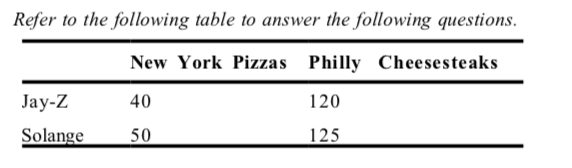
- Aa. Jay-Z has an absolute advantage in making pizzas, and Solange has an absolute advantage in making cheesesteaks.
- Bb. Solange has an absolute advantage in making pizzas, and Jay-Z has an absolute advantage in making cheesesteaks.
- Cc. Jay-Z has an absolute advantage in the production of both foods.
- Dd. Solange has an absolute advantage in the production of both foods.
- Ee. Neither party has an absolute advantage.
19Consumer goods
- Aa. are produced today to be used to produce more goods in the future.
- Bb. are produced today to be consumed at some point in the future.
- Cc. are invested today in order to consume more today.
- Dd. are produced today to be consumed today.
- Ee. generate economic growth.
20The figure depicts a shift in a society’s production possibilities frontier (PPF) for the manufacture of trains and planes: train-manufacturing capacity expands while plane-manufacturing capacity shrinks. Refer to this figure to answer the following questions.
Which point ceases to represent a production possibility?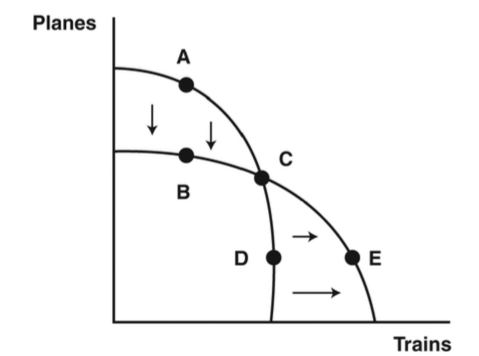
- Aa. point A
- Bb. point B
- Cc. point C
- Dd. point D
- Ee. point E
21Consider the following scenario to answer the following questions: Kukla makes tables, with an opportunity cost of 3 rugs per every 4 tables. Zola makes rugs, with an opportunity cost of 2 tables per every 3 rugs.
Ollie proposes that Kukla give Zola 2 tables in exchange for 2 rugs. What are Kukla's and Zola’s reactions?- Aa. Kukla likes the proposal, but Zola does not.
- Bb. Zola likes the proposal, but Kukla does not.
- Cc. Kukla and Zola both like the proposal.
- Dd. Neither Kukla nor Zola likes the proposal.
- Ee. Ollie’s proposal is not feasible.
22In March 2012, the state of California started requiring that all packaging for food and drink with the additive 4-methylimidazole (4-MI) be clearly labeled with a cancer warning. Because of this, both Pepsi and Coke changed their formula to eliminate 4-MI as an ingredient. If Pepsi and Coke did NOT change their formula, holding all else constant, what would have happened to the demand for these goods, assuming Pepsi and Coke were in a competitive market?
- Aa. The demand curves for both Pepsi and Coke would have shifted to the right, causing the price of both products to decrease and the profits for the companies to fall.
- Bb. The demand curves for Pepsi and Coke would have remained unchanged, but the price of both products would have decreased and the profits for the companies would have fallen.
- Cc. The demand curves for Pepsi and Coke would have decreased, but the prices and profits would not have changed.
- Dd. The demand curve for only one of them would change because Pepsi and Coke are substitutes.
- Ee. The demand curves for Pepsi and Coke would have shifted to the left, causing the price of both products to decrease and the profits for both companies to fall.
23Which of the quantity (Q) and price (P) combinations in the accompanying figure represents the market at competitive equilibrium?
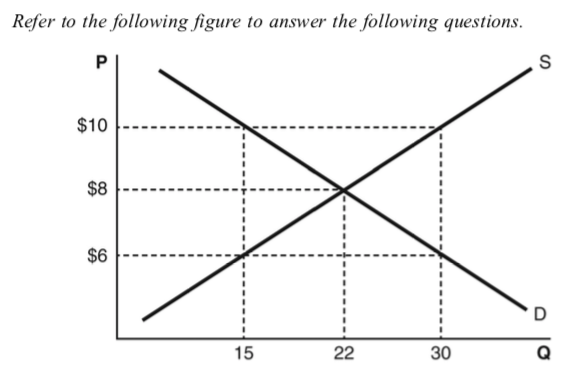
- Aa. (15, $10)
- Bb. (15, $6)
- Cc. (22, $8)
- Dd. (30, $6)
- Ee. (30, $10)
24The government offers numerous educational subsidies through grants and low-cost equipment to schools. They also provide a lot of incentives to go to school. Because of this, we expect that the equilibrium price of education will ________ and the equilibrium quantity of students will ________.
- Aa. be indeterminate; go up
- Bb. go up; go up
- Cc. go down; be indeterminate
- Dd. be indeterminate; go down
- Ee. go up; be indeterminate
25What would we expect to happen to the price of bagels if the price of flour decreased and the price of cream cheese decreased?
- Aa. The equilibrium price of bagels will be indeterminate and the equilibrium quantity will
go up. - Bb. The equilibrium price will go up and the equilibrium quantity will go up.
- Cc. The equilibrium price will go down and the equilibrium quantity will be indeterminate.
- Dd. The equilibrium price will be indeterminate and the equilibrium quantity will go down.
- Ee. The equilibrium price will go up and the equilibrium quantity will be indeterminate.
- Aa. The equilibrium price of bagels will be indeterminate and the equilibrium quantity will
26When supply shifts left and demand shifts right,
- Aa. the equilibrium price always rises.
- Bb. the equilibrium price always falls.
- Cc. the equilibrium quantity always falls.
- Dd. the equilibrium quantity always rises.
- Ee. the equilibrium price is indeterminate.
27Salima is a devoted Coca-Cola consumer, whereas Antonia can drink either Coca-Cola or Pepsi products. Salima’s demand for Coca-Cola will be relatively more ________, while Antonia’s demand will be relatively more ________.
- Aa. elastic; inelastic
- Bb. unrelated to price; elastic
- Cc. perfectly elastic; elastic
- Dd. inelastic; elastic
- Ee. unitary elastic; inelastic
28Use the following scenario to answer the following questions: Dairy Wishes, a local ice cream store, finds that it sells out of ice cream sandwiches at the current price of $1. It raises the price to increase its revenues and finds that no one buys ice cream sandwiches anymore.
The demand for ice cream sandwiches is- Aa. inelastic.
- Bb. elastic.
- Cc. perfectly inelastic.
- Dd. perfectly elastic.
- Ee. unitary elastic.
29If the income elasticity of demand is 1.2, the good will be a(n) ________ good.
- Aa. complement
- Bb. substitute
- Cc. necessity
- Dd. inferior
- Ee. luxury
30When the price of a basketball is $15, the quantity supplied is 5,000. When the price increases to $20, the quantity supplied is 10,000. The price elasticity of supply is
- Aa. 2.33.
- Bb. 0.67.
- Cc. 0.33.
- Dd. 0.43.
- Ee. 0.29.
31When the price of a good increases and all else is held constant
- Aa. both consumer surplus and producer surplus decrease.
- Bb. both consumer surplus and producer surplus increase.
- Cc. consumer surplus decreases.
- Dd. producer surplus decreases.
- Ee. producer surplus increases.
32In the long run, both supply and demand tend to become more elastic. This suggests that, in the long run, the
- Aa. revenue generated from the tax will increase.
- Bb. deadweight loss from a tax will be less than it is in the short run.
- Cc. deadweight loss from a tax will be zero.
- Dd. deadweight loss from a tax will be greater than it is in the short run.
- Ee. government will likely reduce tax rates.
33Taxing goods with very elastic supply generates more deadweight loss than taxing goods with very inelastic supply because
- Aa. the amount of the tax is larger.
- Bb. the change in producer behavior is greater.
- Cc. producers have to pay these taxes out of pocket.
- Dd. the change in producer behavior is smaller.
- Ee. the government does not bother collecting the revenue
34Price controls can be traced back as far as
- Aa. ancient Babylon of 4,000 years ago.
- Bb. ancient Greece of 2,500 years ago
- Cc. ancient Rome of 2,000 years ago.
- Dd. ancient Egypt of 3,000 years ago.
- Ee. recent times, since organized markets under organized government and legal systems are necessary to effectively impose such controls.
35Use the following information to answer the following questions. Market for used cars:
Demand: Qd = 154,000 – 86P Supply: Qs = –100 + 14P
What would be the quantity supplied if a price floor is set at $2,000?- Aa. 9,900
- Bb. 200
- Cc. 27,900
- Dd. 1,541
- Ee. 18,000
36Use the following information to answer the following questions.
Market for a new hardcover book:
Demand: Qd = 325 – 8P
Supply: Qs = –60 + 3P
What would be the quantity demanded if a price ceiling is set at $20?- Aa. 90
- Bb. 45
- Cc. 265
- Dd. 165
- Ee. 305
37If a price ceiling is imposed at $15 per unit when the equilibrium market price is $12, there will be
- Aa. no surplus or shortage.
- Bb. a surplus.
- Cc. a shortage.
- Dd. a downward pressure on prices.
- Ee. an upward pressure on prices.
38Roland is the president of the United States. In an attempt to make prescription drug prices cheaper, he has imposed a binding price ceiling on drugs. What would he expect his critics to say?
- Aa. The binding price ceiling will encourage companies to overproduce drugs and will result in waste.
- Bb. The binding price ceiling will discourage patients from obtaining the drugs they need.
- Cc. The binding price ceiling will increase the likelihood that consumers will obtain needed drugs on the black market.
- Dd. The binding price ceiling will cause firms to spend too many resources on the research and development of new drugs.
- Ee. The binding price ceiling will cause firms to spend too much time making a drug without any flaws.
39Price gouging laws will usually result in ________ the product in the distressed market.
- Aa. more supply of
- Bb. more local business start-ups to supply
- Cc. government setting up an agency to regulate supply of
- Dd. more Craigslist postings for
- Ee. more demand than supply of
40What would be the equilibrium price in the market for corn?
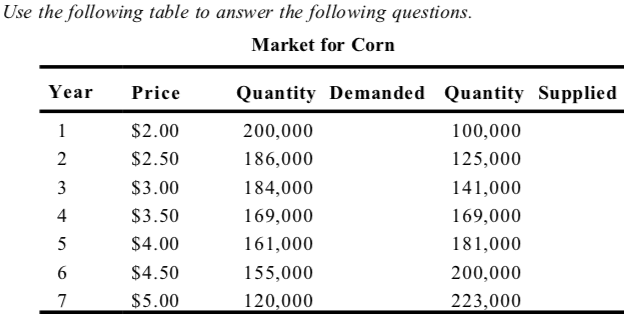
- Aa. $2.00
- Bb. $5.00
- Cc. $4.00
- Dd. $3.50
- Ee. $4.50
41What will happen in a market where a nonbinding price floor is removed?
- Aa. The products sold will become more plentiful.
- Bb. The price or quantity of the product sold on the legal market will not change.
- Cc. There will be upward pressure on the prices.
- Dd. There will be downward pressure on the prices.
- Ee. There will be increased pressure to buy and sell the good on the black market.
42If a good is subject to a binding price floor and someone purchases it on the black market, what would he or she expect to happen to the availability of the good over time?
- Aa. The availability of the good will fall over time as the supply curve becomes more elastic and the demand curve becomes more inelastic. (The surplus of the good will fall.)
- Bb. The availability of the good will fall over time as both the supply and demand curves become more elastic. (The surplus of the good will fall.)
- Cc. The availability of the good will rise over time as both the supply and demand curves become more elastic. (The surplus of the good will rise.)
- Dd. The availability of the good will fall over time as the demand curve becomes more elastic and the supply curve becomes more inelastic. (The surplus of the good will fall.)
- Ee. The availability of the good will not change over time.
43A positive externality exists and the government does not intervene. Which point best identifies the market equilibrium?
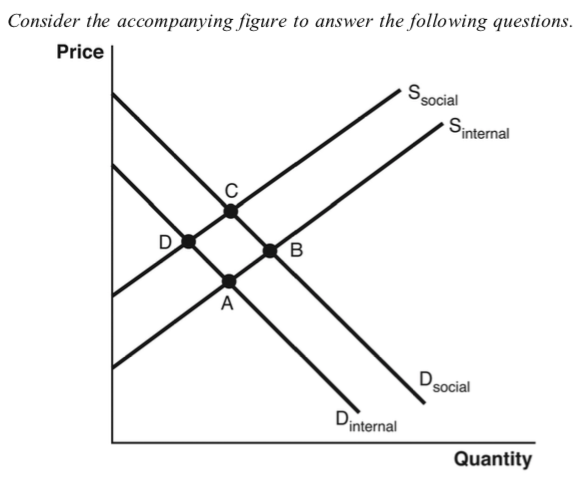
- Aa. A
- Bb. B
- Cc. C
- Dd. D
- Ee. either C or D
44Consider the following scenario when answering the following questions:
Jones owns a factory that is dumping toxic waste into a river where Smith owns a resort. At present, Jones is not filtering the water that he dumps into the river. There is a filter he could install that would remove a significant amount of the toxic elements from the water before it is dumped in the river. Jones and Smith have each assessed the situation and come up with the following data:
If property rights over the river are assigned to Smith, then
- Aa. Smith will force Jones to close the factory.
- Bb. Smith will pay Jones up to $75 per day to install the filter.
- Cc. Smith will pay Jones up to $125 to install the filter.
- Dd. Jones will install a filter and pay Smith at least $75 per day.
- Ee. Jones will install a filter.
45A cattle rancher and a wheat farmer own adjacent properties that may or may not be separated by a fence. The accompanying table identifies the annual profit received by each party per year in the event there is, or there is not, a fence. If there is no fence, one can be installed and maintained at an annual cost of $25,000.
If legal rights are assigned to the wheat farmer so that the cattle rancher is liable for any damage caused by his cattle to the wheat crop, then the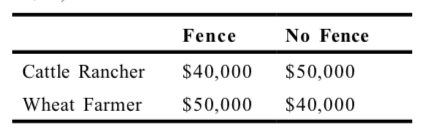
- Aa. rancher will choose to close his ranch.
- Bb. farmer will not allow the rancher to stay in business.
- Cc. rancher will pay to build the fence.
- Dd. rancher will choose to compensate the farmer for damages.
- Ee. rancher will be indifferent toward neither building the fence nor compensating the farmer for damages.
46Which of the following characteristics best defines a public good?
- Aa. rival and excludable
- Bb. rival and nonexcludable
- Cc. nonrival and nonexcludable
- Dd. nonrival and excludable
- Ee. a good that is never produced by the government
47Which of the following is a common-resource good?
- Aa. baseball tickets
- Bb. GPS service
- Cc. pay-per-view television
- Dd. free public parking spaces
- Ee. paramedic emergency medical service
48Common-resource goods are
- Aa. nonrival, like public goods, and excludable, like private goods.
- Bb. nonrival, like private goods, and excludable, like club goods.
- Cc. nonrival, like club goods, and excludable, like public goods.
- Dd. rival, like private goods, and nonexcludable, like public goods.
- Ee. rival, like club goods, and nonexcludable, like private goods.
49The diminishing marginal product is NOT responsible for the shape of ________ cost curve.
- Aa. total fixed
- Bb. total variable
- Cc. total
- Dd. average variable
- Ee. average total
50The average total cost (ATC) and average variable cost (AVC) converge as the level of output produced increases because
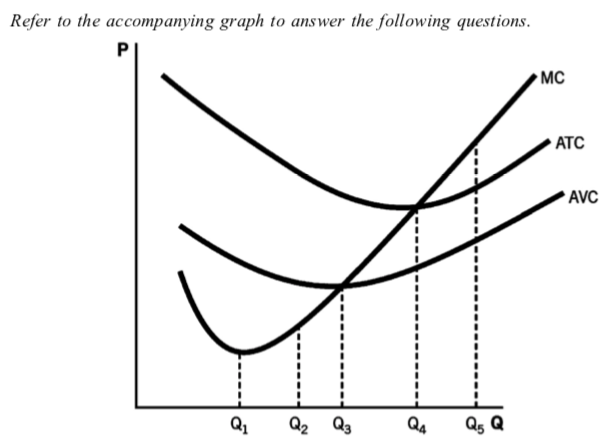
- Aa. the firm is able to purchase more capital and exploit economies of scale.
- Bb. the firm experiences gains in productivity from employee specialization.
- Cc. average total cost decreases as output increases.
- Dd. average fixed cost decreases as output increases.
- Ee. the firm is able to drive its competitors out of business by lowering its price.
51Pablo owns a record store. His total costs are $1.2 million per year, his variable costs are $750,000, and his fixed costs are $450,000 per year. Last year, Pablo sold 1,200 records. If Pablo sells 1,250 records this year (50 more than last year) and his average total cost increases to $1.28 million, we know that the
- Aa. average total cost of selling 1,250 records is $1,000.
- Bb. average variable cost of selling records has decreased.
- Cc. average fixed cost of selling records is unchanged.
- Dd. marginal cost of those 50 records is $80,000.
- Ee. marginal cost of those 50 records is $1.28 million.
52If a firm’s average total costs decrease as it increases its scale of production, the firm is experiencing
- Aa. economies of scale.
- Bb. diseconomies of scale.
- Cc. increasing returns from specialization.
- Dd. diminishing marginal product.
- Ee. constant returns to scale.
53Josephina owns a boxing gym. She recently expanded the size of her gym by adding another boxing ring and moving into a larger building so that she can serve more clients. How would Josephina know if she is experiencing economies of scale from increasing the size of her boxing gym?
- Aa. Her average cost per client increases.
- Bb. Her total cost increases.
- Cc. Her average cost per client remains the same.
- Dd. Her average cost per client decreases.
- Ee. Her total cost remains unchanged.
54A firm expands its scale of production and finds Which of the curves best applies to this firm?
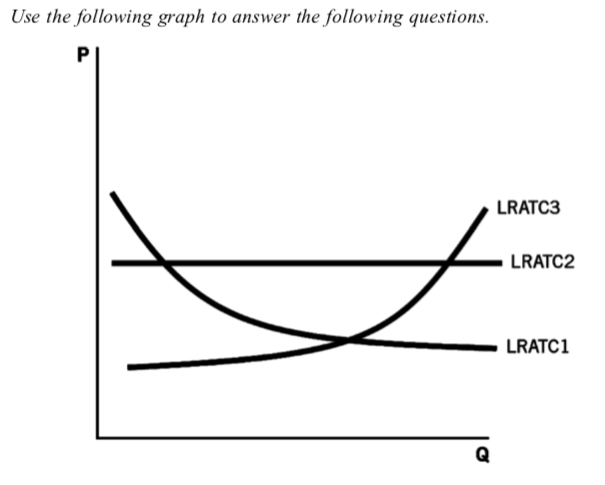
- Aa. LRATC1
- Bb. LRATC2
- Cc. LRATC3
- Dd. LRATC1 and LRATC2
- Ee. LRATC2 and LRATC3
55Each firm in a perfectly competitive industry
- Aa. is a price taker.
- Bb. is a price maker.
- Cc. faces low average total costs.
- Dd. is relatively large.
- Ee. is producing a differentiated product.
56Which of the following is NOT a characteristic of a perfectly competitive industry?
- Aa. The firms produce a homogenous product.
- Bb. Sellers have better information about the product than consumers.
- Cc. There is a large number of buyers and sellers.
- Dd. The firms earn zero profit.
- Ee. Firms can easily enter or exit the industry.
57In competitive markets
- Aa. the products sold are different depending on the firm selling the product.
- Bb. buyers can expect to find consistently low prices and wide availability of the goods that they want.
- Cc. producers can expect to be able to set prices at the level they choose.
- Dd. it is hard for a seller to enter the market due to barriers to entry.
- Ee. firms will leave the market if they are making economic profits.
58Profit per unit is the difference between
- Aa. revenue per unit and average total cost.
- Bb. total revenue and average total cost.
- Cc. marginal revenue and marginal cost.
- Dd. total revenue and total cost.
- Ee. revenue per unit and marginal cost.
59Firms in every market structure
- Aa. make long-run economic profits.
- Bb. are in competition with many other firms.
- Cc. leave the market as soon as they experience loss of profits.
- Dd. will attempt to maximize profits.
- Ee. face a horizontal demand curve.
60All firms, no matter what type of firm structure they are producing in, make their production decisions based on the point where their
- Aa. total revenue equals total cost.
- Bb. marginal revenue equals marginal costs.
- Cc. profits are equal to zero.
- Dd. marginal revenue equals price.
- Ee. average total cost is minimized.
61A firm will shut down in the short run
- Aa. when price is below average variable costs at all levels of output.
- Bb. when price is below average fixed costs at all levels of output.
- Cc. when price is below average total costs at all levels of output.
- Dd. when price is below marginal costs at all levels of output.
- Ee. whenever the firm is losing money.
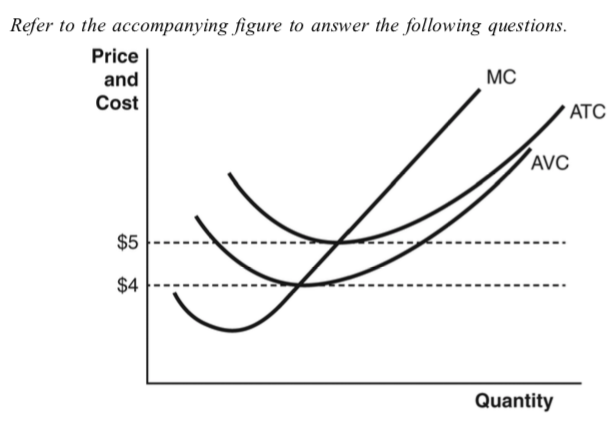
62A firm would be suffering a loss but still be producing if the price is
- Aa. anywhere below $5.
- Bb. below $5 but above $4.
- Cc. anywhere above $4.
- Dd. below $4.
- Ee. above $5.
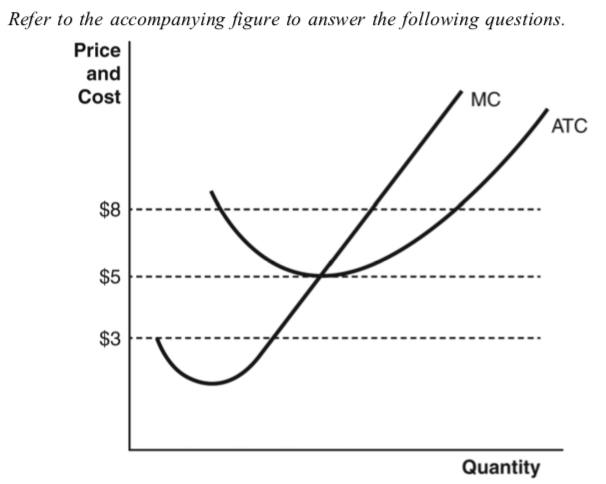
63If the price is $5, the firm is making
- Aa. a loss and will exit the market.
- Bb. a profit and will exit the market.
- Cc. a loss and more firms will enter the market.
- Dd. a profit and more firms will enter the market.
- Ee. zero profits and the market is at long-run equilibrium.
64This firm would shut down in the long run if the price
- Aa. fell below $3.
- Bb. fell below $8.
- Cc. rose above $5.
- Dd. rose above $8.
- Ee. fell below $5.
65If firms in a competitive market are making zero economic profits, the long-run market supply curve
- Aa. is above the point where the short-run market supply curve and the demand curve intersect.
- Bb. is below the point where the short-run market supply curve and the demand curve intersect.
- Cc. and the short-run market supply curve and the demand curve all intersect at the same point.
- Dd. shifts upward.
- Ee. shifts downward.
66Use the following scenario to answer the following questions:
Babak owns a sports practice facility called Boston Batting Cages in Boston, Massachusetts. During the first year of operation, Boston Batting Cages incurred many costs. In that year, Babak spent $5,000 on labor, $2,000 on maintenance, and $1,000 on electricity. Babak took out a loan to open his business, in which he would have earned $1,500, and his previous job, which he could get back at any time, paid him $50,000.
If Boston Batting Cages received $80,000 in revenues, what were the accounting profits?- Aa. $20,500
- Bb. $72,000
- Cc. $51,500
- Dd. $80,000
- Ee. $50,000
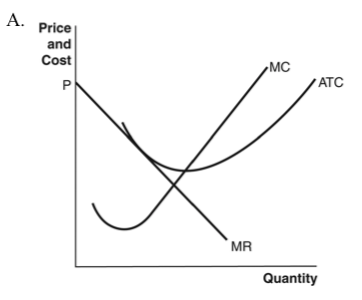
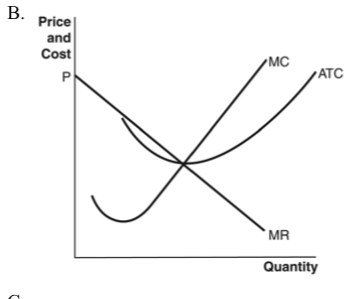
67Which graph would result in no firms entering or exiting the perfectly competitive market?
- A
- B
- C
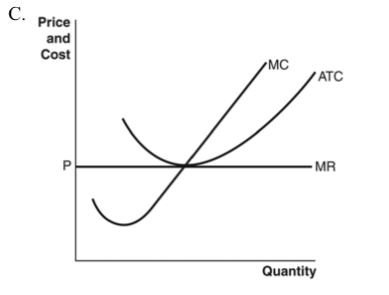
- D
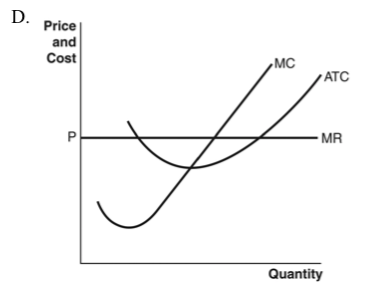
- E
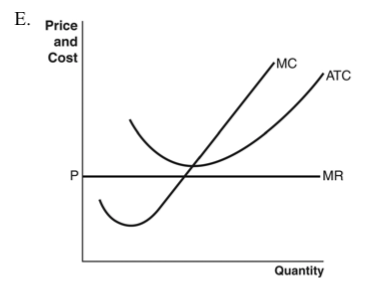
- A
68Two conditions allow a single seller to become a monopolist. Those two conditions are that the firm must
- Aa. have something unique to sell and it must be able to estimate its demand curve.
- Bb. have something unique to sell and it must have a way to prevent potential competitors from entering the market.
- Cc. be able to estimate its demand curve and it must have a way to prevent potential competitors from entering the market.
- Dd. be able to segregate its consumers and it must have a way to prevent potential competitors from entering the market.
- Ee. have something unique to sell and it must be able to segregate its consumers.
69Three natural barriers to entry are
- Aa. control of resources, patents and copyright law, and licensing.
- Bb. economies of scale, problems raising capital, and control of resources.
- Cc. problems raising capital, patents and copyright law, and licensing.
- Dd. control of resources, patents and copyright law, and economies of scale.
- Ee. control of resources, economies of scale, and licensing.
70Which of the following can fall below the x axis when graphing price and cost against quantity?
- Aa. demand curve
- Bb. marginal cost curve
- Cc. total cost curve
- Dd. fixed cost curve
- Ee. marginal revenue curve
71Because the demand curve for a monopolist is downward sloping,
- Aa. there is no limit on the monopolist’s ability to make a profit.
- Bb. the monopolist can sell its product at any price it wants.
- Cc. the monopolist can sell as many units of its product as it wants.
- Dd. the monopolist is a price taker.
- Ee. the monopolist is a price maker.
72At high price levels, demand tends to be ________ and the price effect is ________, relative to the output effect.
- Aa. inelastic; small
- Bb. inelastic; large
- Cc. elastic; small
- Dd. elastic; large
- Ee. inelastic; insignificant
73Clarice’s Campground is the only campground located in Abilene, Texas. Clarice’s Campground’s demand curve is
- Aa. perfectly elastic.
- Bb. perfectly inelastic.
- Cc. horizontal.
- Dd. the market demand curve.
- Ee. upward sloping.
74When a monopolist lowers a price from $80 to $70, the quantity that the firm is able to sell increases from 100 to 150. The change in revenue associated with the price effect is equal to
- Aa. $3,500.
- Bb. −$3,500.
- Cc. $1,000.
- Dd. −$1,000.
- Ee. $4,000.
75When marginal revenue intersects marginal cost on a graph,
- Aa. profits are maximized for a monopolist but not for a competitive firm.
- Bb. profits are maximized for a competitive firm but not for a monopolist.
- Cc. a monopolist prices the good at that point.
- Dd. a monopolist always makes an economic profit.
- Ee. a monopolist must go up to the demand curve to find the price.
76When a town has a single cable provider
- Aa. the cable company usually offers many different cable packages to satisfy customers’ wants.
- Bb. customers must buy some cable channels they don’t want in order to get the channels they do want.
- Cc. the government regulates the cable provider’s offerings.
- Dd. the cable provider is a price taker.
- Ee. the consumers experience no consumer surplus.
77The point of the 1890 Sherman Act was to
- Aa. nationalize industries where economies of scale were especially important.
- Bb. prevent monopoly practices and promote commercial competition.
- Cc. make rent seeking through lobbying of public officials illegal.
- Dd. forbid states from imposing import tariffs on other states.
- Ee. establish patents and copyrights as ways to protect creative activity.
78A firm cannot price discriminate if it
- Aa. operates in a competitive environment.
- Bb. has a downward-sloping demand curve.
- Cc. has a business that is regulated.
- Dd. has perfect information about market demand.
- Ee. can prevent resale of its product.
79If a firm is unable to distinguish which of its buyers has inelastic demand and which has a relatively elastic demand, then the firm will be unable to price discriminate because it will
- Aa. not know how much of the product to offer for sale.
- Bb. not know enough about its customer base to prevent resale.
- Cc. not know which price to charge which customer.
- Dd. not know how many of its customers will buy the product when it is offered for sale.
- Ee. be unable to predict how much of its sales will be retained as profit.
80The main reason firms cannot price discriminate under perfect competition is because
- Aa. firms are price takers and cannot set prices for their goods.
- Bb. firms cannot identify different kinds of consumers perfectly.
- Cc. some goods are being resold in the market.
- Dd. there is a lot of heterogeneity among consumers’ tastes.
- Ee. all firms share the same production technology.
81A firm that is able to differentiate between each of its customers by selling the same good at a unique price to each customer is practicing ________ discrimination.
- Aa. reservation price
- Bb. perfect price
- Cc. inelastic demand
- Dd. idealized price
- Ee. exclusive price
82The following figure depicts the downward-sloping market demand (D) curve for a five-day western Caribbean cruise on Carnival Cruise Lines. The price (P) is per person in U.S. dollars, and the quantity (Q) is the number of passenger tickets sold. This figure also shows the company’s relevant marginal revenue (MR) curve and marginal cost (MC) curve. Use this figure to answer the following questions:
If Carnival Cruise Lines moves from a perfect price-discrimination model to a monopolist model that charges a single price, there would be a ________ in total welfare.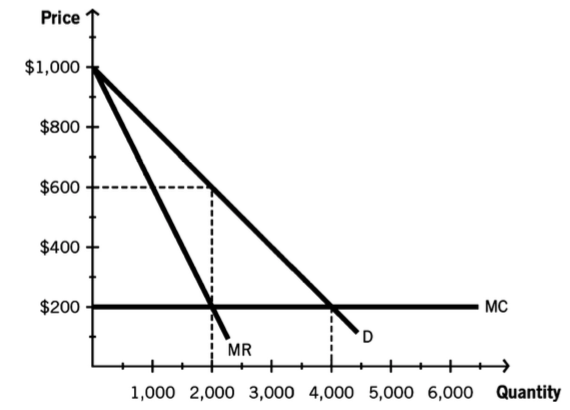
- Aa. gain of $800,000
- Bb. loss of $400,000
- Cc. gain of $400,000
- Dd. loss of $1.2 million
- Ee. gain of $1.2 million
83If this cruise line faces a perfectly competitive market, its consumer surplus would be
- Aa. $400,000.
- Bb. $600,000.
- Cc. $800,000.
- Dd. $1.2 million.
- Ee. $1.6 million.
84Senior citizens typically receive many discounts in movie theaters, among other places, because they
- Aa. have very elastic demands.
- Bb. are poorer than the average population.
- Cc. have very inelastic demands.
- Dd. can be distinguished easily from other types of consumers.
- Ee. are retired and don’t work anymore.
85How does price discrimination help us understand how many markets actually function?
- Aa. All firms will practice price discrimination unless a government prohibits the practice.
- Bb. Monopolistic competition is rare, so economists are able to focus in on the few firms that engage in the practice.
- Cc. Instances of perfectly competitive markets and monopoly are rare.
- Dd. Antidiscrimination laws are widespread, so models explaining price discrimination help us better understand markets that we are unable to witness.
- Ee. Monopolistic competition is the most common market form, but it is the only one that does not engage in price discrimination.
86From an initial examination, price discrimination may not seem like a social good because ________ is transferred from consumer to producer, but the overall benefit for society ________.
- Aa. deadweight loss; decreases
- Bb. deadweight loss; increases
- Cc. market power; multiplies
- Dd. surplus; decreases
- Ee. surplus; increases
87Which of the following is the best description of monopolistic competition?
- Aa. easy entry, low markup
- Bb. barriers to entry, high markup
- Cc. horizontal demand curve for the firm
- Dd. firm has no control over price
- Ee. barriers to entry, low markup
88Which of the following is always associated with monopolistic competition?
- Aa. identical products
- Bb. economic profits in the short run
- Cc. demand curve that lies below the marginal revenue curve
- Dd. demand curves that become more inelastic as new entry occurs
- Ee. product differentiation
89If monopolistically competitive firms are making zero economic profit, then these firms would
- Aa. leave the industry.
- Bb. charge higher prices.
- Cc. make demand more inelastic.
- Dd. remain in the industry.
- Ee. begin to collude illegally.
90Fast-food restaurants are a good illustration of
- Aa. oligopolistic competition.
- Bb. perfect competition
- Cc. monopoly.
- Dd. monopolistic competition.
- Ee. oligopoly
91The marginal revenue of a monopolistically competitive firm will always be
- Aa. less than the price.
- Bb. more than the price.
- Cc. the same as the price.
- Dd. identical to the marginal cost curve.
- Ee. identical to the average total cost curve.
92The demand curve for a monopolistically competitive firm is downward-sloping because of
- Aa. high barriers to entry.
- Bb. product differentiation.
- Cc. the lack of firms in the industry.
- Dd. government regulation.
- Ee. identical cost curves for each firm.
93Both perfectly competitive and monopolistically competitive industries have many firms, in fact so many that, in the long run
- Aa. only one firm can survive in the industry, leading to monopoly.
- Bb. costs must increase due to diseconomies of scale.
- Cc. costs must decrease due to economies of scale.
- Dd. economic profit is “competed away.”
- Ee. economic profit can continue.
94Markup would not exist in
- Aa. a monopoly.
- Bb. a cartel.
- Cc. an oligopoly.
- Dd. monopolistic competition.
- Ee. a competitive market.
95A consumer who adheres to bounded rationality is
- Aa. a fully rational consumer who behaves like an all-knowing supercomputer when making cost-benefit calculations.
- Bb. a completely irrational consumer who is unable to use logic to compare costs and benefits.
- Cc. neither capable of performing the problem-solving that traditional economic theory assumes nor is inclined to do so.
- Dd. rational only in situations that involve market prices.
- Ee. never rational in situations that involve market prices.
96Consider the following scenario when answering the following questions:
Suppose a large electronics retailer has 1,000 salespeople who sell new computers and new computer service plans. The retailer is interested in increasing the percentage of customers who purchase a computer service plan (or warranty) with their new computer. The retailer decides to test two sales pitches by splitting its salespeople into two groups of 500 and giving each group a slightly different sales pitch to recite to customers prior to the consummation of a computer sale.
The first group of salespeople recites the following sales pitch: “Before you pay, I wanted to let you know that all of our new computers come automatically with a warranty that adds $150 to the purchase price. If you wish to opt out and decline the warranty, all you need to do is fill out and sign a form attesting to your refusal.”
The second group of salespeople recites the following sales pitch: “Before you pay, I wanted to let you know that, although none of our new computers come automatically with a warranty, you can purchase one by adding $150 to the purchase price. If you wish to opt in and accept the warranty, all you need to do is fill out and sign a form attesting to your acceptance.”
Suppose that 34 percent of customers hearing the sales pitch from the first group purchased the warranty and that 34 percent of the customers hearing the sales pitch from the second group purchased the warranty. The managers concluded that ________ were not present, so it did not matter how the question about purchasing the warranty was asked.- Aa. rational effects
- Bb. electronic aptitude effects
- Cc. concerns about fairness
- Dd. framing effects
- Ee. fairness effects
97The ________ game is a common game that behavioral economists use in an experimental setting to study how fairness enters into the rational decision-making process.
- Aa. ultimatum
- Bb. prisoner’s dilemma
- Cc. behavioral economics
- Dd. gambler’s dilemma
- Ee. hawk-dove
98Consider the following scenario when answering the following questions:
Derek and Heriberto are playing an ultimatum game where Derek is given $500 and asked to propose a way of splitting it with Heriberto. When Heriberto learns Derek’s proposal, Heriberto chooses whether to accept or reject the split. If Heriberto accepts the split, both players receive the money according to Derek’s split proposal. If Heriberto rejects the split, both players receive nothing. This game will be played only once, so Derek does not have to worry about reciprocity when making his choice.
Suppose that Derek proposes a split such that Derek will receive $489.99 and Heriberto will receive $10.01. Traditional economic theory predicts that Heriberto will- Aa. accept the $10.01 because he values receiving $10.01 more than receiving nothing.
- Bb. accept the $10.01 because he wishes to punish Derek for proposing such an unfair split.
- Cc. reject the $10.01 because he wishes to punish Derek for proposing such an unfair split.
- Dd. reject the $10.01 and also will reject a split such that Derek receives $250 and Heriberto receives $250.
- Ee. sometimes accept the $10.01 and sometimes reject the $10.01, depending on his mood at the time.
99Consider the following scenario when answering the following questions:
Suppose that, in an experimental setting, 100 students are presented with two situations involving risk and return. The students are first asked to choose between Gamble A and Gamble B, where:
Gamble A: The student will receive $1 million with a 100 percent probability.
Gamble B: The student will receive $1 million with an 89 percent probability, $5 million with a
10 percent probability, and $0 million (nothing) with a 1 percent probability. The students are then asked to choose between Gamble C and Gamble D, where:
Gamble C: The student will receive $5 million with a 10 percent probability.
Gamble D: The student will receive $1 million with an 11 percent probability.
According to the standard economic model (expected utility theory), a student who is risk neutral would choose Gambles ________ because they both have higher expected values than ________, respectively.- Aa. A and D; B and C
- Bb. A and C; B and D
- Cc. B and C; A and D
- Dd. B and D; A and C
- Ed. B and C; A and D
100human behavioral economics, a choice to do an activity means
- Aa. choosing not to do the next best activity.
- Bb. choosing not to do a more desirable activity.
- Cc. evaluating that activity versus an alternative group of activities.
- Dd. that activity should be put at the top of a “to-do” list.
- Ee. that activity must have an observable characteristic to be valid in a behavioral sense.
Informationen
- Beschreibung
- Quiz am Sample Final Exam, erstellt von Keaton Claassen am 09/12/2018.
- Autor
- Keaton Claassen
- Sprache
- English
- Aufrufe
- 4
- Bewertung
- Noch keine Bewertungen Bewerte dieses Quiz