
Quiz
Econ Chapter 13 tutorial
Erstelle ein kostenloses Konto, um dieses Quiz zu beenden
Speichere deinen Fortschritt und sieh dir dein Endergebnis an.
oder mit deiner E-Mail registrieren
Schon ein Konto? Anmelden
Fragen in diesem Quiz (15)
1In a natural monopoly, the long-run average cost curve
- Amay be either upward sloping or downward sloping in the relevant range of output levels.
- Bis downward sloping in the relevant range of output levels.
- Cis horizontal in the relevant range of output levels.
- Dis upward sloping in the relevant range of output levels.
- Elies below the marginal cost curve.
2Which of the following is least likely to be a natural monopoly?
- Aelectric utilities
- Btaxicab service
- Csubway services
- Dcable television services
- Ewater and sewer services
3A monopoly arises for two key reasons, which are
- Abarriers to entry and close substitutes.
- Bclose substitutes and no barriers to entry.
- Cfranchises and barriers to entry.
- Dbarriers to entry and no close substitutes
- Enatural and legal
4Refer to Figure 13.2.1. This single-price monopoly produces ________ units per day and charges a price of $________ per unit.
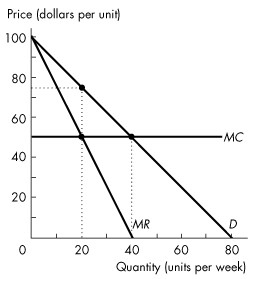
- A20; 50
- Bzero; 0
- C20; 20
- D20; 75
- E40; 50
5Refer to Figure 13.2.2. If the single-price monopoly shown in Figure 13.2.2 is maximizing profit, what is total economic profit?
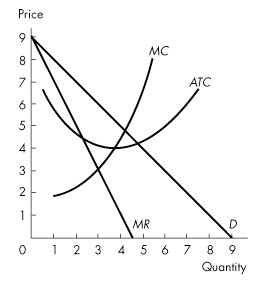
- A$4
- B$7
- C$9
- D$6
- E$3
6The pursuit of wealth by capturing economic rent
- Ais illegal in Canada.
- Bis price discrimination
- Cis rent seeking.
- Dcreates a legal monopoly.
- Ecreates a natural monopoly.
7Consider Figure 13.3.2. Consider a perfectly competitive market. If the light grey area shows the consumer surplus, and the dark grey area shows the producer surplus, which graph correctly represents this market?
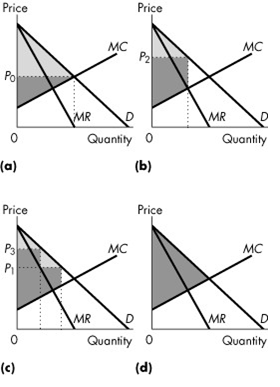
- A(a)
- B(b)
- C(c)
- D(d)
- E(b) and (d)
8Consider the revenue and cost curves in Figure 13.3.3. If this is a single-price monopoly, what is consumer surplus?
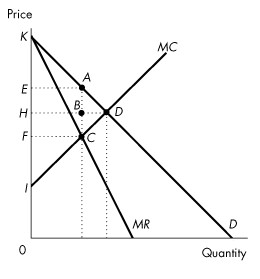
- AACD
- BEADH
- CEABH
- DABD
- EKEA
9Which of the following markets will have the largest deadweight loss?
- Aa perfectly competitive market
- Ba single-price monopoly
- Ca perfectly price discriminating monopoly
- Dboth B and C
- Eboth A and C
10A monopoly can practice price discrimination when it
- Aproduces a good with close substitutes.
- Bhas different marginal costs of production for different output levels.
- Chas decreasing average variables cost.
- Dis a price taker.
- Ecan segment the market according to the different prices the consumers are willing to pay.
11Refer to Figure 13.4.2. Assume this monopolist practises perfect price discrimination. How many tickets are sold?
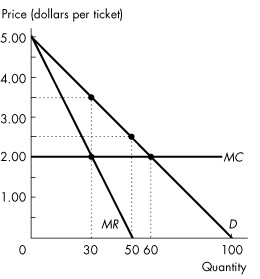
- A40 tickets
- B80 tickets
- C60 tickets
- D20 tickets
- E100 tickets
12Prime Pharmaceuticals has developed a new asthma medicine, for which it has a patent. An inhaler can be produced at a constant marginal cost of $2 per inhaler. The demand curve, marginal revenue curve, and marginal cost curve for this new asthma inhaler are shown in Figure 13.4.6. The patent gives Prime Pharmaceuticals a monopoly for its new inhaler. If Prime Pharmaceuticals can perfectly price discriminate, then it
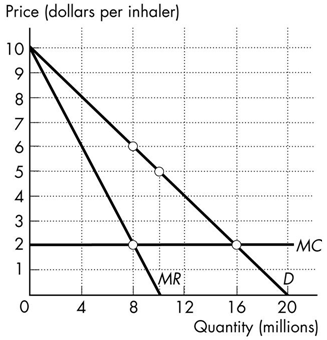
- Asells 16 million inhalers.
- Bcharges a price of $2 for each inhaler it sells.
- Cmakes zero economic profit
- Dsells inhalers for $6 each.
13Consider the natural monopoly depicted in Figure 13.5.2. If a regulator uses a marginal cost pricing rule to set price, what is the quantity produced?
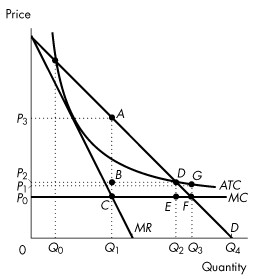
- A0
- BQ2
- CQ1
- DQ3
- EQ0
14Consider the natural monopoly depicted in Figure 13.5.2. What area in the graph represents the deadweight loss arising from an average cost pricing rule?
- ADEF
- BACF
- CDGF
15Consider the natural monopoly depicted in Figure 13.5.2. If a regulatory agency sets a price just sufficient for the firm to make zero economic profit, what output will it produce?
- AQ0
- BQ1
- CQ2
- DQ3
Informationen
- Beschreibung
- Quiz am Econ Chapter 13 tutorial, erstellt von rjferkj rkfnrlnl am 14/12/2018.
- Autor
- rjferkj rkfnrlnl
- Sprache
- English
- Aufrufe
- 8
- Bewertung
- Noch keine Bewertungen Bewerte dieses Quiz