
Quiz
Trigonometry Final
Erstelle ein kostenloses Konto, um dieses Quiz zu beenden
Speichere deinen Fortschritt und sieh dir dein Endergebnis an.
oder mit deiner E-Mail registrieren
Schon ein Konto? Anmelden
Fragen in diesem Quiz (68)
1Convert 10 radians into degrees.
- A10 rad = 10 degrees
- B10 rad = 573 degrees
- C10 rad = 314 degrees
- D10 rad = 1000 degrees
- E10 rad = 628 degrees
2Convert 100 degrees into radians.
- A100 degrees = 6.28 rad
- B100 degrees = 100 rad
- C100 degrees = 3.14 rad
- D100 degrees = 1 rad
- E100 degrees =1.75 rad
3Which of the following is a true statement about the relationship between 1 degree and 1 radian?
- A1 degree > 1 rad
- B1 rad > 1 degree
- C1 degree = 1 rad
4The angles 230 and -130 are coterminal
- ARichtig
- BFalsch
5The angles 2pi radians and 3pi radians are coterminal
- ARichtig
- BFalsch
6What is the length of an arc spanned by an angle that measures 5 radians on the circumfernece of a circle whose radius is 12 feet long?
- A60pi feet
- B120pi feet
- C60 feet
- D120 feet
- E1.2 feet
7If a periodic function achieves a maximumm value of 7 and a minimum value of -3, what is the amplitude of the function?
- A20 units
- B4 units
- C1 unit
- D5 units
- E10 units
8If a periodic function achieves a maximum value of 7 and a minimum value of -3, what is the midline of the function?
- Ay=0
- By=2
- Cy=4
- Dy=5
- Ey=10
9If cos(θ) is positive, what quadrant must θ be in?
- AQuadrant I or II
- BQuadrant I or III
- CQuadrant I or IV
- DQuadrant II or III
- EQuadrant III or IV
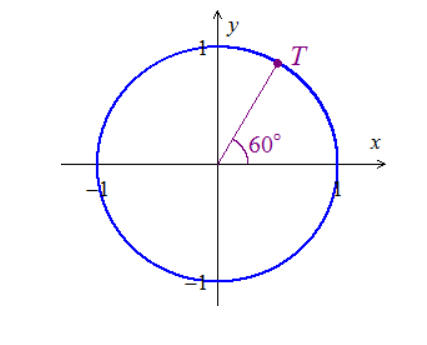
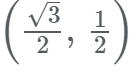
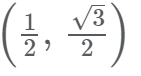
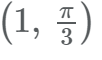
10The point T is on the circumference of a unit circle and specified by 60∘. What are the coordinates of point T ?
- A
- B
- C
- D
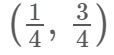
- E
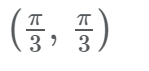
- A
11The point P is on the circumference of a circle of radius 10 units and specified by the angle θ. What are the coordinates of point P?
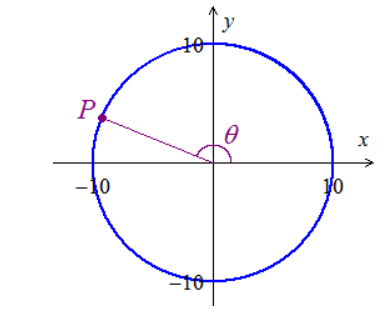
- A(cos(θ), sin(θ))
- B(10cos(θ), 10sin(θ))
- C(sin(θ), cos(θ))
- D(10sin(θ), 10cos(θ))
- E(-10cos(θ), 10sin(θ)
12The equation sin(−t) =−sin(t) is an identity.
- ARichtig
- BFalsch
13Which of the following expressions is equal to 1−cos^2(θ) ?
- Acsc^2(θ)
- Bsec^2(θ)
- C1
- Dcos^2(θ)
- Esin^2(θ)
14Which of the following expressions is equal to tan^2(θ) +1?
- Acsc^2(θ)
- Bsec^2(θ)
- C1
- Dcos^2(θ)
- Esin^2(θ)
15Which of the following expressions is equal to csc(θ) ?
- A1/sin(θ)
- B1/cos(θ)
- Csin(θ)/cos(θ)
- Dcos(θ)/sin(θ)
- Esin^2(θ) + cos^2(θ)
16Which of the following expressions is equal to tan(θ)?
- A1/sin(θ)
- B1/cos(θ)
- Csin(θ)/cos(θ)
- Dcos(θ)/sin(θ)
- Esin^2(θ) + cos^2(θ)
17What is the period of the function q(t) = 5cos((π/3)(t+4))+2
- A4 units
- Bπ/3 units
- C5 units
- D2 units
- E6 units
18What is the amplitude of the function q(t) = 5cos((π/3)(t+4))+2
- A10 units
- B5 units
- Cπ/3 units
- D4 units
- E2 units
19What is the midline of the function q(t) = 5cos((π/3)(t+4))+2
- Ay=2
- By=4
- Cy=0
- Dy=5
- Ey=π/3
20What is the period of the function p(t) = 3cos(2(t-π))+7
- A3 units
- B2 units
- Cπ units
- D7 units
- E2π units
21What is the midline of the function p(t) = 3cos(2(t-π))+7
- Ay=3
- By=2
- Cy=π
- Dy=7
- Ey=2π
22Which of the following algebraic rules represents the sinusoidal function y=F(t) graphed?
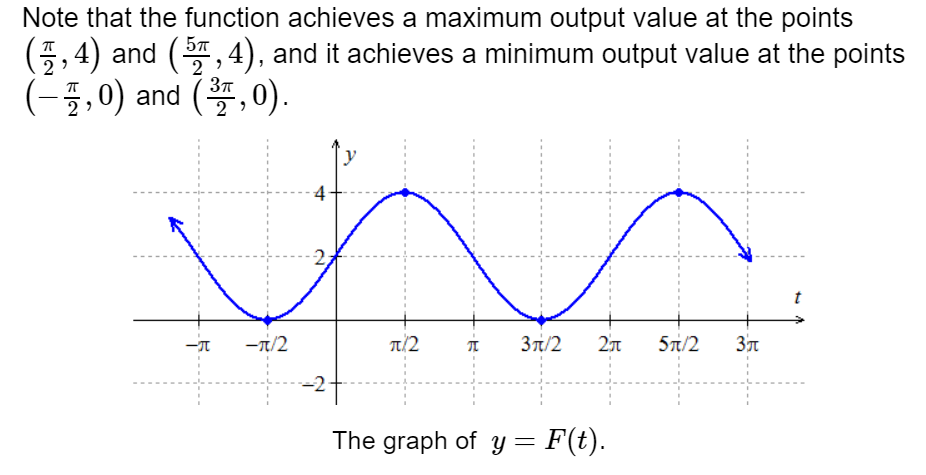
- AF(t)=4sin(t)+2
- BF(t)=2sin(t)+2
- CF(t)=4cos(t)+2
- DF(t)=2cos(t)+2
- EF(t)=sin(t)+4
23Which of the following algebraic rules represents the sinusoidal function y=G(t) graphed?
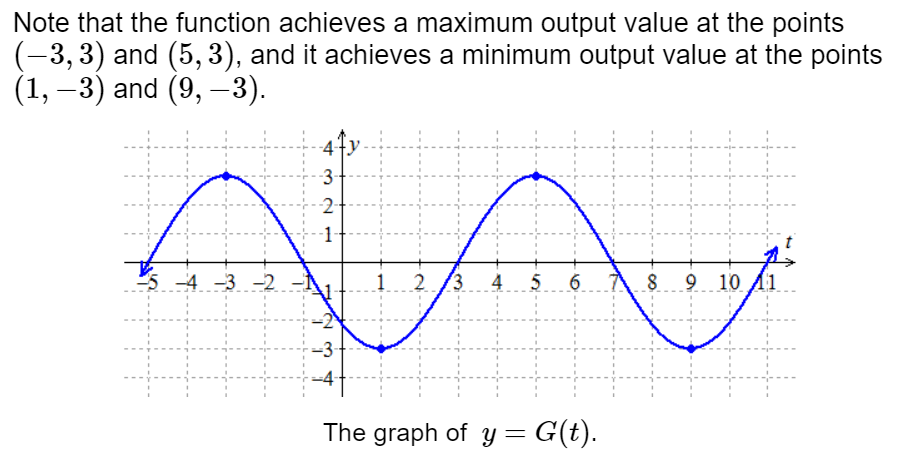
- AG(t)=6cos(π/4(t+1))
- BG(t)=3cos(π/4(t+1))
- CG(t)=-3cos(π/4(t-1))
- DG(t)=3cos(π/4(t-3))
- EG(t)=-3cos(π/4(t+3))
24Which of the following functions has an identical graph as the function m(t)=10cos(π/8(t − 4))+5
- Af(t)=10sin(π/8(t+8))+5
- Bf(t)=10cos(π/8(t − 8))+5
- Cf(t)=−10sin(π/8(t+4))+5
- Df(t)=−10cos(π/8⋅t)+5
- E(t)=10sin(π/8⋅t)+5
25What does cos^-1(1/2) equal?
- Acos^-1(1/2)=π/3
- Bcos^-1(1/2)=π/6
- Ccos^-1(1/2)=√3/2
- Dcos^-1(1/2)=√2/2
- Ecos^-1(1/2)=1/2
26what does sin^-1(-√2/2) equal
- Asin^-1(-√2/2)=-1
- Bsin^-1(-√2/2)=-π/4
- Csin^-1(-√2/2)=3π/4
- Dsin^-1(-√2/2)=7π/4+2kπ for all k ∈Z
- Esin^-1(-√2/2)=-√2/2
27What does sin^−1(cos(5π/6)) equal?
- Asin^−1(cos(5π/6)) =2π3
- Bsin^−1(cos(5π/6)) =5π/6
- Csin^−1(cos(5π/6)) =−π/3
- Dsin^−1(cos(5π/6)) =−√3/2
- Esin^−1(cos(5π/6))=−1/2
28Find all of the solutions to the equation cos(t)=√2/2.
- At=π/4+kπ or t=7π/4+kπ, k∈Z
- Bt=π/4+2kπ or t=7π/4+2kπ, k∈Z
- Ct=π/4+kπ or t=3π/4+kπ, k∈Z
- Dt=π/4+2kπ or t=3π/4+2kπ, k∈Z
- Et=3π/4+2kπ or t=5π/4+2kπ, k∈Z
29Find all of the solutions to the equation sin(4t)=1.
- At=π/2+kπ/2, k∈Z
- Bt=π/2+2kπ, k∈Z
- Ct=π+kπ, k∈Z
- Dt=π/8+kπ/2, k∈Z
- Et=π/4+kπ/2, k∈Z
30How many solutions does the equation sin(4t)=−√3/2 have on the interval [0, 2π]?
- A0 solutions
- B1 solution
- C2 solutions
- D4 solutions
- E8 solutions
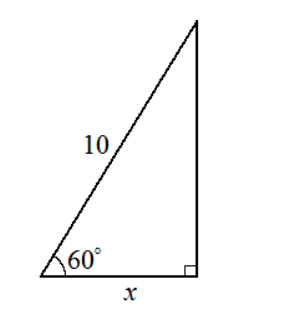
31The right triangle below has a hypotenuse of length 10 units and a side of length x units that is adjacent to a 60∘ angle. What is the value of x?
- Ax=10√3
- Bx=5√3
- Cx=5√3/2
- Dx=5
- Ex=2.5
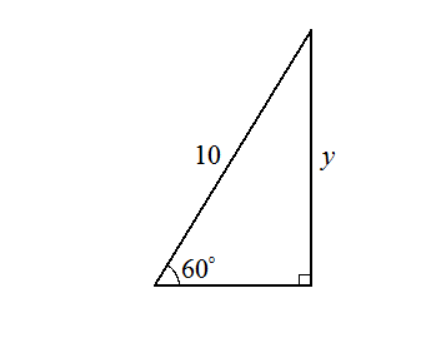
32The right triangle has a hypotenuse of length 10 units and a side of length y units that is opposite from a 60∘ angle. What is the value of y?
- Ay=10√3
- By=5√3
- Cy=5√3/2
- Dy=5
- Ey=2.5
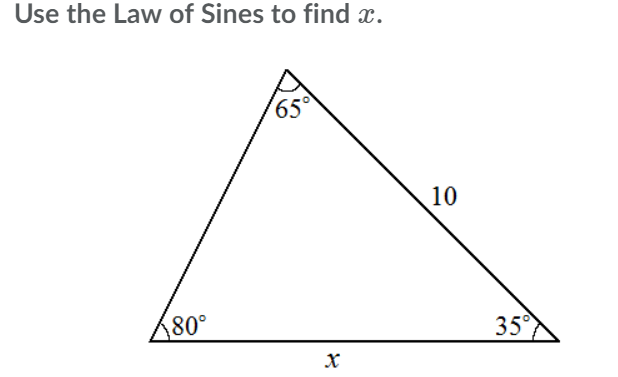
33The oblique triangle (i.e., the non-right triangle) below has an 80∘ angle, a 65∘ angle, and a 35∘ angle. The side opposite the 80∘ angle is 10 units long and the side opposite the 65∘ angle is x units long. [The triangle isn't drawn to scale.]
- Ax=sin(65∘)/10sin(80∘)
- Bx=10sin(65∘)/sin(80∘)
- Cx=10sin(35∘)
- Dx=10sin(80∘)/sin(65∘)
- Ex=10sin(80∘)
34The oblique triangle (i.e., the non-right triangle) below has a side of length 6 units, a side of length 4 units, and a side of length x units which is across from a 60∘ angle.

- Ax=2√13
- Bx=2/3
- Cx=2√7
- Dx=2
- Ex=2√5
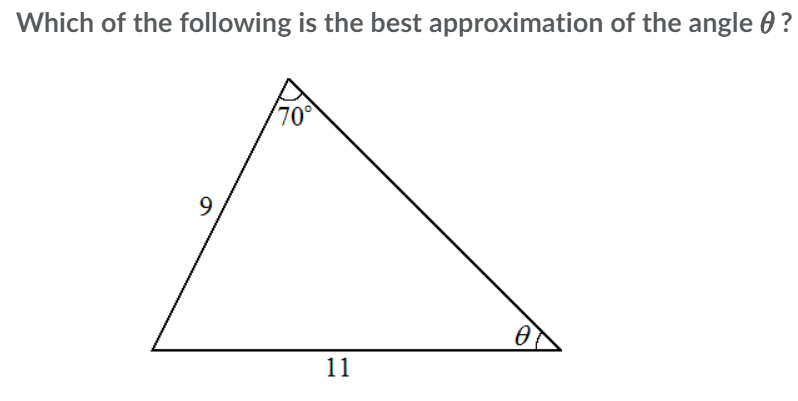
35The oblique triangle (i.e., the non-right triangle) below has a side of length 11 units across from an 70∘ angle and a side of length 9 units across from the angle θ.
- Aθ≈35.1∘
- Bθ≈75.5∘
- Cθ≈44.6∘
- Dθ≈54.9∘
- Eθ≈50.2∘
36The equation sin(t)=sin(π−t) is an identity.
- ARichtig
- BFalsch
37The equation sin(t)tan(t)=sec(t)−cos(t) is an identity.
- ARichtig
- BFalsch
38The equation cos(−t) =cos(t) is an identity.
- ARichtig
- BFalsch
39Which of the following expressions is equal to
cot(t) ⋅ (tan(t) − sin(t)cos(t))?- Asin^2(t)
- Bcsc^2(t)
- C1−sec(t)
- D0
- E1
40Which of the following expressions is equal to sin(t)/1−cos(t)?
- Asec^2(t)
- Bsin(t)−tan(t)
- C1+cos(t)/sin(t)
- D1
- Ecsc(t)-cot(t)
41If sin(A)=3/5 and cos(B)=−5/13, and if the angles A and B are in the second quadrant, then (as you should be able to determine yourself!), we can determine that cos(A)=−4/5 and sin(B)=12/13. Use the appropriate identity to find sin(A+B)
- Asin(A+B)=−33/65
- Bsin(A+B)= 16/65
- Csin(A+B)= 56/65
- Dsin(A+B)= 14/65
- Esin(A+B)=−63/65
42If sin(A)=3/5 and cos(B)=−5/13, and if the angles A and B are in the second quadrant, then (as you should be able to determine yourself!), we can determine that cos(A)=−4/5 and sin(B)=12/13. Use the appropriate identity to find sin(A+B). Use the appropriate identity to find cos(A−B).
- Acos(A−B)=−33/65
- Bcos(A−B)= 16/65
- Ccos(A−B)= 56/65
- Dcos(A−B)=−14/65
- Ecos(A−B)=−63/65
43The equation sin(2t)=2sin(t) is an identity.
- ARichtig
- BFalsch
44The equation 2cos^2(t)−1=1−2sin^2(t) is an identity.
- ARichtig
- BFalsch
45If sin(A)=12/13, cos(A)=−5/13, and π/2<A<π (i.e., A is in the second quadrant), find cos(2A).
- Acos(2A)=−10/13
- Bcos(2A)= 10/13
- Ccos(2A)=−60/169
- Dcos(2A)=−119/169
- Ecos(2A)=−120/169
46If sin(A)=1213, cos(A)=−513, and π2<A<π (i.e., A is in the second quadrant), find sin(2A).
- Asin(2A)= 24/13
- Bsin(2A)=−24/13
- Csin(2A)=−60/169
- Dsin(2A)=−119/169
- Esin(2A)=−120/169
47If sin(A)=12/13, cos(A)=−5/13, and π/2<A<π (i.e., A is in the second quadrant), find cos(A/2).
- Acos(A/2)= √(4/13)
- Bcos(A/2)=−√(4/13)
- Ccos(A/2)=5/26
- Dcos(A/2)=√(9/13)
- Ecos(A/2)=-√(9/13)
48If sin(A)=12/13, cos(A)=−5/13, and π/2<A<π (i.e., A is in the second quadrant), find sin(A/2).
- Asin(A/2)=√(4/13)
- Bsin(A/2)=−√(4/13)
- Csin(A/2)= 6/13
- Dsin(A/2)= √(9/13)
- Esin(A/2)= -√(9/13)
49Find the rectangular coordinates for the point that has polar coordinates (4, 4π/3).
- A(2√3, -2)
- B(-2, 2√3)
- C(-2, -2√3)
- D(2, 2√3)
- E(-1/2, -√3/2)
50Find the rectangular coordinates for the point that has polar coordinates (−12,−5π/6).
- A(6√3, 6)
- B(-6√3, -6)
- C(-12, -1/2)
- D(6, 6√3)
- E(-6, -6√3)
51Find the polar coordinates for the point that has rectangular coordinates (√3,−1)
- A(2,−π/6)
- B(2, 5π/6)
- C(4, 2π/3)
- D(4, π/3)
- E(√5, 3π/4)
52Find the polar coordinates for the point that has rectangular coordinates (−7, 7).
- A(49, 3π/4)
- B(49, −π/4)
- C(7√2, 3π/4)
- D(7√2,−π/4)
- E(7, π/4)
53Express the complex number 3e^(i⋅π//4) in rectangular form, a+bi.
- A3/2 +3/2i
- B3π/4+3π/4i
- C√2/6+√2/6i
- D3√2/2+3√2/2i
- E2.7 + 45i
54Express the complex number −2√3−2i in polar form, re^(i⋅θ).
- A4e^(i⋅4π/3)
- B4e^(i⋅7π/6)
- C16e^(i⋅7π/6)
- D2e^(i⋅5π/6)
- E2e^(i⋅5π/3)
55Which of the following equations in polar coordinates is equivalent to the equation y=2x^2 in rectangular coordinates?
- Ar=2cos^2((θ)
- Br=2sin^2(θ)+2cos^2(θ)
- Cr=2sin(θ)cos^2(θ)
- Dr=tan(θ)sec(θ)/2
- Er=sin(θ)cos^2(θ)/2
56Which of the following equations in rectangular coordinates is equivalent to the equation θ=π/6 in polar coordinates?
- Ay=π/6x
- By=√3/3x
- Cy=1/2x^2
- Dy=√2/2x
- Ey=√3/2
57Find the magnitude of the vector v⃗ =−2i⃗ + 4j⃗ .
(boxes are arrows above the variables that they come after and in the answers pretend there are arrows above the vs)- A∥v∥=2√3
- B∥v∥=1
- C∥v∥=2√5
- D∥v∥=20
- E∥v∥=10
58If w⃗ =⟨3,−5⟩, find ∥ 2w⃗ ∥. (boxes are arrows that are supposed to be above the ws)
- A∥ 2w⃗ ∥=⟨−10, 6⟩
- B∥ 2w⃗ ∥=⟨6,−10⟩
- C∥ 2w⃗ ∥=2√ 34
- D∥ 2w⃗ ∥=−60
- E∥ 2w⃗ ∥=136
59Find the approximate angle that the vector v⃗ =−2i⃗ + 4j⃗ makes with the positive x-axis. (boxes are arrows above the variables they come after)
- A116.6∘
- B153.4∘
- C135.5∘
- D−26.6∘
- E−63.4∘
60If v⃗ =⟨2,−3⟩ and w⃗ =⟨3,−5⟩, find 2v⃗ +w⃗ . (boxes are arrows above the variable they come after)
- A2v⃗ +w⃗ =⟨−20,0⟩
- B2v⃗ +w⃗ =⟨12,−16⟩
- C2v⃗ +w⃗ =⟨8,−7⟩
- D2v⃗ +w⃗ =⟨7,−11⟩
- E2v⃗ +w⃗ =⟨−1,−3⟩
61If v⃗ =⟨2,−3⟩ and w⃗ =⟨3,−5⟩, find v⃗ * w⃗ (boxes are arrows that go above the variable they come after)
- Av⃗ * w⃗ =−19
- Bv⃗ * w⃗ = 9
- Cv⃗ * w⃗ = -21
- Dv⃗ * w⃗ = 21
- Ev⃗ * w⃗ = √47
62Find the approximate angle between the vectors v⃗ =⟨2,−3⟩ and w⃗ =⟨3,−5⟩. (boxes are arrows that go above the variables they go after)
- A0.05∘
- B177.3∘
- C92.7∘
- D14.2∘
- E2.7∘
63If ∥ v⃗ ∥=6 and v⃗ makes an angle of 120∘ with the positive x-axis, express v⃗ in component form. (boxes are arrows that go above the variables they come after)
- Av⃗ =⟨3√3,−3⟩
- Bv⃗ =⟨−3, 3√3⟩
- Cv⃗ =⟨−3, 6⟩
- Dv⃗ =⟨−6√3, 6⟩
- Ev⃗ =⟨6,−6√3⟩
64cos^-1(cos(7π/6))=7π/6
- ARichtig
- BFalsch
65cos(-t)=cos(t) for all t
- ARichtig
- BFalsch
66sin(t+π/2)=cos(t) for all t
- ARichtig
- BFalsch
67An angle of measure 2 radians is larger than a measure 2 degrees
- ARichtig
- BFalsch
68An angle of measure 45 degrees in a circle of radius 1 unit is smaller than an angle of measure 45 degrees in a circle of radius 2 units
- ARichtig
- BFalsch
Informationen
- Beschreibung
- 12th grade Math (Trigonometry) Quiz am Trigonometry Final, erstellt von unuaji k am 03/06/2019.
- Autor
- unuaji k
- Sprache
- English
- Aufrufe
- 3
- Schlagwörter
- Bewertung
- Noch keine Bewertungen Bewerte dieses Quiz